
The future of the Maldives depends on a partnership between entrepreneurs, researchers and tourists
Collaboration between three resorts in the Planhotel group, Bicocca University and the MarHE Centre for marine conservation

Key points
Turning the atolls into centres for mitigating the effects of climate change and for environmental education, by fostering a partnership between resort operators, university researchers and tourists. This is happening in the Maldives, where coral reefs are both an ecosystem that generates economic wealth and supports marine life, and a natural defence for the coastline against rising sea levels caused by climate change. Here, coral restoration is not a secondary activity but a matter of survival, given that the entire archipelago is at risk of being submerged in the coming decades.
At the Diamonds Thudufushi, Diamonds Athuruga and Sandies Bathala resorts, the Planhotel Hospitality Group strives to combine hospitality, scientific research and conservation. “Caring for the environment in the destinations where we operate has always been a key focus for us, which is why we have formed a partnership with the University of Milan-Bicocca, a leader in marine biology,” explains Sara Rosso, president of Planhotel.
The collaboration with the University of Milan and the MaRHE Centre – its research station on the island of Magoodhoo – is, in fact, the scientific cornerstone of the project. And the resorts’ marine laboratories form part of a network that hosts students, researchers, long-term monitoring programmes and fieldwork, having evolved over the years into a space where research coexists with environmental education and where advanced tools are also utilised: from DNA analysis to 3D printing.
Inga Dehnert, marine research manager, coordinates the scientific work. Resident biologists work on the islands, supported by interns – often marine science students from Bicocca University – who stay for three to six months and collect data for research projects. “We bring together a diverse network of stakeholders around a common goal: to promote marine conservation and sustainable tourism through science-based actions,” explains Dehnert. Activities are defined through shared objectives and monitoring protocols. They measure coral cover, coral growth and survival, fish communities and biodiversity, and compare the results of the various interventions.
The presentations
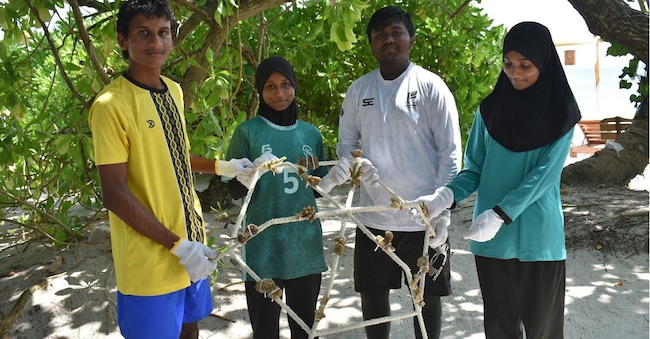
The three islands do not follow the same pattern. Seabeds, depths, exposure to currents, the extent of degradation and coral communities vary from one location to another. “There is no one-size-fits-all solution when it comes to coral restoration,” notes Dehnert. At Thudufushi, the coral structure adoption programme has been running since 2015 and is one of the longest-running in the Maldives. Here, the coral platform has enabled a large-scale intervention using ‘MARRS reef stars’: hexagonal steel structures to which coral fragments are attached, serving to recreate a stable substrate in degraded areas of the reef. The large-scale installation on the island now comprises over 1,500 reef stars on the seabed. Monitoring shows coral growth, good survival rates and a more complex habitat, offering more space and shelter for marine life.

