
The Veneto of the future: presidential candidates talk to businesses
Regional and territorial Confindustria met with Giovanni Manildo and Alberto Stefani. Themes included bureaucracy and human capital

Key points
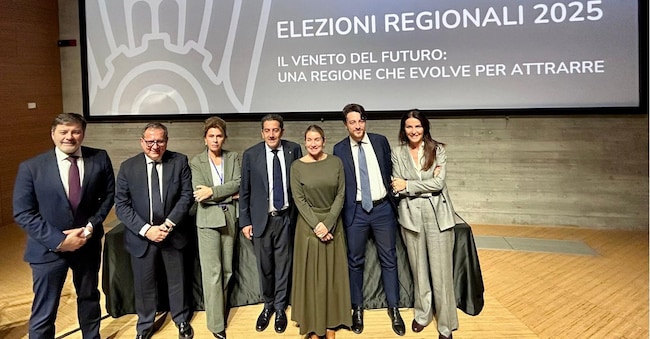
Confindustria Veneto met today, 6 November, with the candidates for the presidency of the Veneto Region, Giovanni Manildo and Alberto Stefani. It was, for the Veneto entrepreneurial system, the first opportunity for confrontation and direct dialogue with the candidates of the two main coalitions (centre-left and centre-right), to whom the points of a new regional industrial agenda were submitted, capable of accompanying the transition of our production fabric and making Veneto a platform of choice for new investments, talents, and enterprises.
The perspective
In the press point following the closed-door meeting, Confindustria Veneto president Raffaele Boscaini, together with the presidents of the Veneto territorial associations (Barbara Beltrame Giacomello of Confindustria Vicenza, Lorraine Berton of Confindustria Belluno Dolomiti, Paola Carron of Confindustria Veneto Est and Giuseppe Riello of Confindustria Verona) gave an initial summary of what had emerged:
"The meeting was useful and constructive. Both of them showed preparation, attention, and a vision for the future of our region, from a perspective that is not merely local but European. It is important for the Veneto region to have a clear perspective in front of it, at least in the medium term, which will allow it to 'put on the ground' concrete projects for the benefit of businesses and local communities. We are in a delicate moment: the national Budget Law is proving to be 'miserly' for the production system, lacking a vision of structural growth that puts industrial investments at the centre of the economic strategy. Wealth is created by generating work and competitiveness, not by interventions on IRPEF and pensions'.
The megatrends
In this scenario, "the role of the Veneto Region becomes crucial," he continued, "Four megatrends on which concrete actions are needed: climate change, digital transition with artificial intelligence, demographic crisis and migration flows, and attraction of investment and talent. Although Veneto has a resilient entrepreneurial fabric, it risks marginalisation without tackling structural criticalities: infrastructural deficiencies, difficulties in attracting qualified human capital, misalignment between training and business needs, fragmented governance'.
The indispensable condition 'is to redefine the relationship between politics and the territory through a new pact between institutions and stakeholders. Intermediate bodies must be recognised as partners in the construction of solutions. Regulatory simplification must become a real high-impact reform to restore competitiveness. Confindustria Veneto is ready to play its part and asks the candidates for an equally courageous and concrete vision for the future of our region,' he concluded.

