Milan women's fashion/3

Prada's identity games, new lightness for Emporio Armani

Only 15 layered looks for the new collection by Miuccia Prada and Raf Simons, convincing debut by Leo Dell'Orco and Silvana Armani for the group's most experimental brand

by Angelo Flaccavento

Prada AI 26-27

3' min read

Translated by AI
Versione italiana

3' min read

Translated by AI
Versione italiana

he theme of identity - brand, personal, collective - is central in this age of permanent fiction. The realisation, always, is that who one is is nothing stable, but a relational act, in which a solid core is shaped in the relationship with the outside world, with others, with history.

Prada, la collezione per l’AI 26-27

Photogallery21 foto

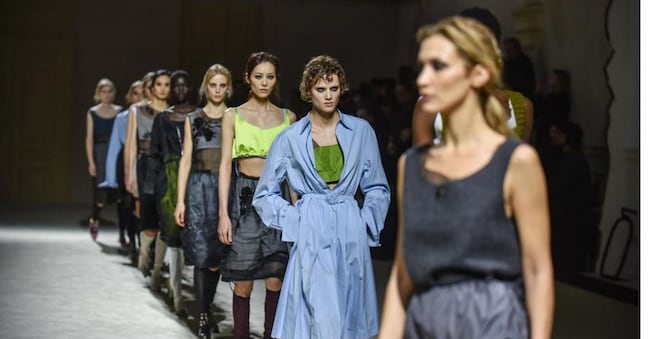
Miuccia Prada and Raf Simons, from Prada, reflect on this theme through an act of undressing - between Gira La Moda and archaeological excavation - while re-imagining in fashion show with an admittedly easy, yet captivating gimmick. The collection is composed of just fifteen layered looks - chiselled with Byzantine quibbles despite the stains, blemishes and pervasive delabré - that pass four successive times down the catwalk, each with one layer down: from coat and scarf to culottes, to summarise.

Loading...

The change of clothing skins powerfully modifies the perception of individual personalities, in an escalation towards the fragile and the direct, culminating in lingerie with an antique flavour. Structured in this way, the test recapitulates salient moments in the brand's history, not for the sake of replication, but, indeed, of identity affirmation. It is a reflection on dressing and undressing, served with unnecessary but abundant intellectual lapses that are equally defining of Pradian identity.

Emporio Armani, la collezione per l’AI 26-27

Photogallery21 foto

The Armani identity is forever linked to the dialogue between masculine and feminine, as shaped by the unforgettable Giorgio. It is impossible not to relate to his legacy, so radical and timeless. And yet the stylistic heirs Silvana Armani and Leo Dell'Orco, who at Emporio Armani work as a couple and in co-ed mode, manage to refresh and lighten the recipe while playing with the counterpoint between rule and its breaking.

Admittedly, Emporio Armani is a container brand in which much is possible, but the free gesture is all the more clearly felt the less it is breaking. Just lighten everything up, attitude first and foremost, and you're done, in a way that convinces.

Marni, la collezione per l’AI 26-27

Photogallery27 foto

Meryll Rogge's arrival at Marni is a return to her origins, namely to the aesthetic code defined by Consuelo Castiglioni, of whom Rogge openly declares herself a fan. The collection even starts with clothes that, illo tempore, had not been on the catwalk, in a sombre palette, and then unravels between archive references and metropolitan abrasiveness. This is a debut, and should be judged as such, but there is a leaden, heavy-hearted feeling that should be lightened.

Max Mara, la collezione per l’AI 26-27

Photogallery15 foto

At a time when everything is falling apart, the interest that fashion takes in remote history is singular. The prospect is certainly singular at Max Mara, where it even looks back to the Middle Ages, focusing on the figure of Matilda of Canossa. It is a Max Mara-style Middle Ages, of course: brought back to the dimension of real, everyday dress, with insistent echoes of Romeo Gigli, who at the fall of the Eighties iconised a neo-medieval/Pre-Raphaelite look made up of maxi coats and flat shoes. The collection is a long variation on the theme, in an earthy, muddy and very respectable palette. Items to wear abound, but the monotony is distracting.

From Genny, Sara Cavazza Facchini thinks of frivolous stories, imagining a vague eighteenth-century of ruffles and small baskets for hedonistic but not unashamed women. At Giada, the usual rigour warms up as hemlines shorten and necklines plunge, proving that subtractive work does not necessarily rhyme with monkish allure.

Etro, la collezione per l’AI 26-27

Photogallery24 foto

The woman at Boss in Marco Falcioni's vision dresses like a man, complete with tie, while at Etro Marco De Vincenzo moves in the balance. On the one hand there is the desire to test new paths - men's tailoring, in this sense, is an excellent start - on the other the acceptance of the maison's codes, always the same despite the infinite variety and vitality of boho decorativism. The result is a moment of stasis, calling for a change of which De Vincenzo is capable, provided that the management also sees the brand with a fresh eye.

At N°21, Alessandro Dell'Acqua thinks of the femininity - and shapes - of the 1940s, but passes over it with a salvific steamroller, deflating, twisting, dirtying with a grunge attitude that is never violent. The pradisms are obvious, but Dell'Acqua's love and skill in making clothes are unique, deeply personal, and this makes all the difference.

MM6 Maison Margiela, finally, has made abnormal normality an enduring topos, if not actually an identity trait, which this season is reiterated with renewed lightness instead of conceptual gloom, so that the result is fresh and convincing.

Copyright reserved ©
Loading...

Brand connect

Loading...

Newsletter

Notizie e approfondimenti sugli avvenimenti politici, economici e finanziari.

Iscriviti