
The geography of artificial intelligence: the role of the Global South

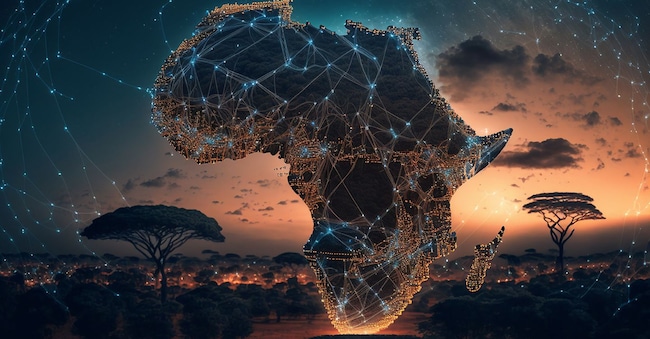
Since the advent of generative artificial intelligence, the global debate has often focused on an alleged backwardness of Africa and the global South more generally. For years, there has been talk of digital exclusion, lack of infrastructure and limited access to emerging technologies. However, this narrative is now partial and, in part, misleading. In recent years, there has in fact been a significant evolution: Africa and the global South are no longer 'absent' from the artificial intelligence (AI) ecosystem, but are actively participating in it. The problem is that this participation does not automatically translate into proportionate benefits. This has led to what scholars call a "paradox of contribution without credit": a substantial contribution to the development of AI that is not recognised, let alone adequately remunerated. The risk is that AI, instead of bridging the digital divide, ends up reproducing - and even amplifying - existing economic and geopolitical asymmetries. The contribution of the Global South to AI today is located along a deeply unbalanced value chain. Looking at the geography of innovation, the centres of decision-making, patents and capital remain concentrated in the United States, Europe and, increasingly, East Asia. However, a crucial part of the work needed to develop AI is done elsewhere.The paradox emerges forcefully precisely by comparing different models of participation. In East Asia, countries such as China, Japan and South Korea are investing heavily in the integration of artificial intelligence and advanced manufacturing, with the aim of building what is referred to as Physical AI, i.e. intelligent systems embedded in robotics and industrial processes that are destined to transform entire production sectors. This model implies high value-added specialisation: design, hardware development, control of industrial supply chains and creation of technological standards. In other words, these countries do not just 'nurture' AI, they govern it and capture its economic benefits. By contrast, the Global South, and Africa in particular, is in a very different position, participating mainly in the lower value-added stages of the chain: data collection, annotation, content moderation. Essential activities, but often invisible and poorly remunerated. This imbalance is not accidental, but reflects historical dynamics of economic dependence, now transposed to the digital domain. Africa now participates in the development of artificial intelligence mainly through two channels. The first concerns the human labour required to train algorithms: an emblematic example is that of the annotators, employed by large technology companies to classify images, transcribe texts and filter content. More generally, they are a mass of workers, precarious and underpaid, in charge of analysing and classifying huge quantities of visual and audio content to train AI systems. The second channel is the supply of data. According to analyses by the World Economic Forum, Africa is emerging as a major source of data for AI training. These data refer to different types - health, agricultural, climate, financial, biometric - and their value is enormous, because they enable the development of more accurate models that can be adapted to different contexts.. We are faced with dynamics that raise fundamental questions about digital sovereignty and the distribution of value. As in the case of natural resources, the risk is that the countries of the Global South will limit themselves to exporting raw material - in this case raw data - without developing the industrial and technological capacities needed to transform it. Thus a real commodification of data takes place: data become a commodity traded on global markets, the value of which is captured mainly by the actors that control the technological infrastructures and algorithms. The parallels with the extractive economies of the past are obvious: even then, many regions of the world provided key resources without fully benefiting from them. In conclusion, the artificial intelligence revolution, like all major technological transitions, is not neutral, as Pope Leo XIV also reminds us. If the Global South continues to be confined to the role of supplier of data and cheap labour, the risk is that of a new form of digital dependency, a system in which value is extracted, concentrated and redistributed unequally. In this sense, AI may not reduce global inequalities, but even reinforce them. To avoid this scenario, it will be necessary to rethink the AI governance model, promoting greater equity in the distribution of benefits, investment in local capabilities, and real recognition of the contribution of countries in the global South. Because, in the absence of these correctives, the promise of AI risks turning into another missed opportunity: a revolution built partly thanks to the Global South, but not for its benefit.

