
The glowing whirlpool of poetic lava by Maria Attanasio
'Landscapes of the Seventh Decade. Interiors. Black Baroque (1979-2021)" is the dense, multi-faceted work by the Caltagirone-based author

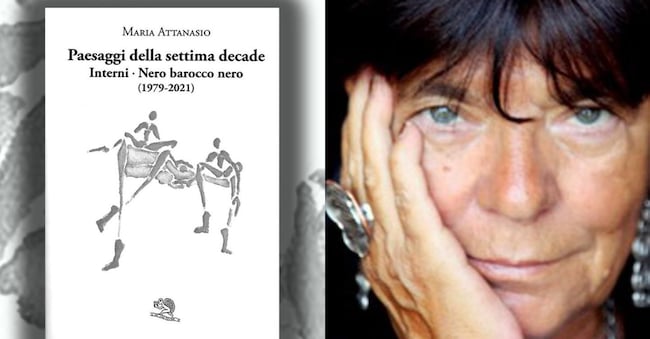
'Landscapes of the Seventh Decade. Interiors. Black Baroque (1979-2021)' is Maria Attanasio's latest poetic work. A dense, multi-layered work, it spans four decades of the life and art of the Caltagirone-based 'biscrittora'. Born a poet, Attanasio finds here the dimension most attuned to her feeling. The verses of the 112 poems divided into three parts ("Interiors (1979)"; "Black Baroque (1984)"; "Landscapes of the Seventh Decade (2020-2020)"), recompose in a rhythmic continuum and in a mosaic collage three crucial collections that, the dates of their first edition or creation being enough, account for the complexity and variety, with the passing of Time and History, of the themes evoked.
Like a masterful pianist, Attanasio plays keys of different pitches and colours: from the 'particular' of private affections and memories to the 'universal' of the collective events of contemporaneity. For the first time in his production, in "Lessico familiare in lingua persa", the penultimate section of his latest collection, texts in the Sicilian language (with an author's translation opposite) appear, touching the deepest chords: his mother's song, his father's presence, life in Caltagirone, she as a child in the night "ccu l'occhi sbarracati" (with eyes wide open). Through the book's five sections, Maria Attanasio's poetic word touches on the highest themes: identity, memory, pain, change, transformation. The poetic word researched, excavated, breathed, never peregrine, is a courageous instrument of resistance and a trace against the 'silence of the ages' (p. 160).
Amelia Roselli
The poetry proceeds in lumps, in clots, going beyond logic and paying homage to those who preceded and nourished it, like that touching, formless 'buzz in the mind' of Amelia Roselli's memory. The poem names and restores identity and depth to things and people: "Only with my father the name lit up / when he called me Mariù, a name that sings". Names that 'in the midst of the darkness still glitter for me' (cf. 'Nommi' p. 178-179). A statement, this one, that applies to what the poet calls 'Lady Poetry' (p. 187): the only art that allows the poet's oblique gaze to make spirals of other meanings emanate from words, including the most banal and common,. An incandescent gorge of poetic lava, the book, which La Vita Felice offers us to make existence less painful, surprisingly ends with verses immediately dear forever to the reader: "Forgive me, Lady Poetry,/ now, in the seventh decade, / I have easy tears - a blade of grass / yielding to the wind, a barge / in disarray (television fiction) - as if this world were / a farewell handkerchief: / shining yellow sorrel / contagion of pain." (p. 187). Words that evoke the evil of living of Montalian memory, through the empathetic and profound revisitation of a Lady of Poetry such as Maria Attanasio.
"Landscapes of the Seventh Decade. Interiors. Nero barocco nero (1979-2021)", by Maria Attanasio, La Vita Felice, Milan, 2025, pp. 187, €14.00.

