
The goldfinch that tells the story in the BIRDS exhibition at the Mauritshuis
The exhibition with Carel Fabritius' famous painting at its centre can be visited in The Hague, Mauritshuis, until 7 June

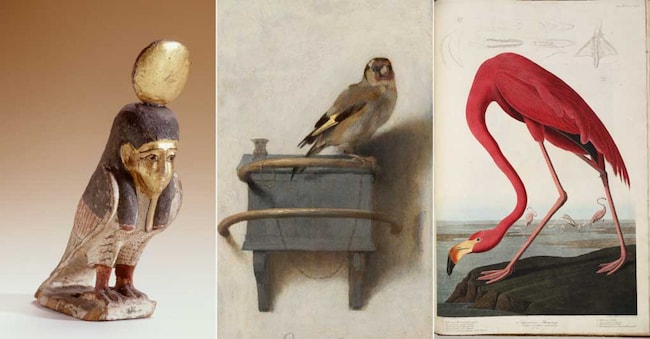
Upon entering the Mauritshuis, the new exhibition 'BIRDS - Curated by The Goldfinch & Simon Schama' seems to whisper secrets of feathers and flight. Until 7 June 2026, the museum in The Hague, the Netherlands, offers a journey through birds and images, where it is not only the painted or sculpted animals that catch the eye, but the stories they tell of freedom, desire and symbolism, across centuries of art and visual culture.
At the centre of the exhibition is Carel Fabritius' 'The Goldfinch', small and delicate, suspended in the space of the canvas with an eye-catching grace. The light, studied and calibrated, brings out every feather and nuance, transforming the painting into a living microcosm. The colour of the plumage, the subtle shadows in the background, the perspective that almost pushes the bird out of the painting: everything invites one to observe slowly, because the story it contains is broader than it seems, a fragment of 17th-century Dutch life that dialogues with centuries of artistic representations and with the visitor's sensitivity.
Simon Schama
Simon Schama, art historian and guest curator, guides the audience on a journey through millennia, from the art of Ancient Egypt to contemporary works by Matisse, Picasso, Tracey Emin and Iris van Herpen. Each bird becomes the protagonist of a story: heavenly messenger, symbol of love, prey, pet or ornament. Light, omnipresent in the exhibition, is not only used to see the works, but to make them breathe: it illuminates feathers, sculpts shapes, creates atmosphere, transforms matter into emotion and makes visible what would otherwise remain hidden.
Between paintings, sculptures, naturalistic objects and installations, the exhibition builds a continuous dialogue between past and present. Some works reveal the care and precision with which man has observed nature, others surprise with modern interpretations that interweave aesthetics and poetry. The delicacy of the stroke, the contrast between light and shadow, the movement suggested by wings and reflections: every detail tells the story of a humanity that has always sought to understand and approach nature.
Walking through the rooms, one realises that every brushstroke, every reflection and every shadow tells not only about the animal, but also how light has shaped the history of visual perception. The museum thus becomes a place where looking at a bird means reading centuries of art, science and symbolism, where every glance illuminates new perspectives and new stories.

