
The Gospel of Jerusalem: a radical reinterpretation of the texts of Christian origins
Silvio Barbaglia proposes a new reading of the historical Jesus and the origins of Christianity, focusing on the first Jerusalem communities and an early redaction of the Gospel texts

The cultural challenge is undoubtedly ambitious, the road is little travelled and interpretative traditions play against it. Yet the desire for research and to find new paths to understand and narrate those very first years, decades, of the development and spread of Christianity, is the spring that has long driven the intellectual commitment of the Novara-born biblical scholar and priest Silvio Barbaglia. An interest that passes through the reconstruction of the image of the very first Christian communities and the drafting of the texts that later became part of the canon of the New Testament, ultimately seeking to trace back in the most thorough and realistic manner possible the extraordinary experience lived by the men and women who were direct disciples of Jesus of Nazareth and handed down his experience and teachings. "This research," says the scholar, "has an 'existential' value for me. I feel a sort of persistent attraction, a continuous invitation to set out on a journey, in an intellectual adventure but above all one of "meaning" in search of the unattainable: that Jesus who really presented himself in the concrete history of some people with all his humanity, with his mortal flesh".
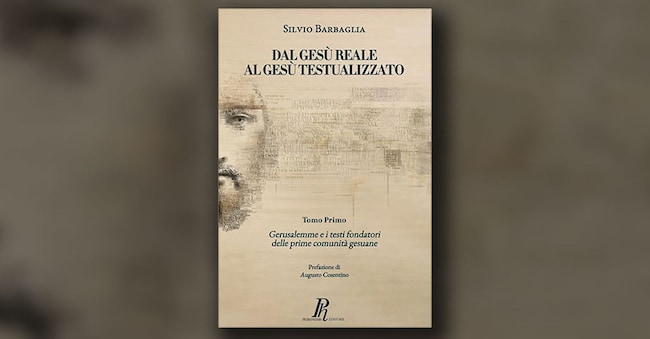
A significant fruit of this more than twenty years of research is the publication of the book From the Real Jesus to the Textualised Jesus, just released by the publisher Phronesis, which is envisaged as the first volume of a multi-volume work, specifically dedicated to studies on the themes of the historical Jesus, the first-century Jewish environment and the first disciple communities.
The method
The method developed in these pages has its strength precisely in the author's ability to reconstruct the historical period and dialogue with the Jewish culture of the time, seeking to translate and make us understand many 'lost' references to the words and teachings of Christ. "It is a path, the one that I have tried to set out on during these years of research, marked by immersion in that Jewish world substantially set aside by the Fathers of Nicaea, capable of revealing many aspects still hidden in the meanders of meaning of the evangelical, canonical and apocryphal sources, perceived to be very close to that context of origin that marked the very formation and culture of the rabbi of Nazareth". In fact, Barbaglia, in approaching and reconstructing evangelical facts and sayings, does not refrain from also making use of the so-called apocryphal texts - that is, those that have not entered the "canon" of sacred texts handed down by the Christian churches - and in general explicitly states that he perceives a strong distance between the written sources handed down to us by the first disciples of Christ and the outcome of the theological controversies of the following centuries, culminating with the definition of the Nicene Creed. Almost as if the relationship between the biblical sources and their subsequent theological elaboration by the Church was not resolved in the best possible way.
The author immediately declares his aim of wanting to 'unify' the historical and theological dimensions of the Jesus story, i.e. not to contrast - as scholars have often done - the 'Jesus of history' and the 'Christ of faith', but to understand how the latter arose from the former through the work of the first believing communities and their founding texts.
Jerusalem
The book focuses on the city of Jerusalem as the cradle and matrix of nascent Christianity, and on the ways in which the first communities of disciples produced the texts that bore witness to their experience of faith and following Christ. Barbaglia depicts the Holy City of the Jews not only as a geographical and symbolic place where the earthly story of the man Jesus of Nazareth comes to an end, but also as a space in which the first communities of disciples developed, who began to put into writing the words, gestures and teachings of their master. The author therefore proposes an interpretation of Jerusalem as a founding workshop of the new faith, and not only as the theatre of Easter events. The Holy City par excellence, the central place of Judaism and the seat of the Temple, would have been the bed from which the new religious 'way' would have made its way, thanks also to the conversion of numerous priests, as witnessed by the Acts of the Apostles.


