
The Grand Tour, today, tomorrow and forever
The exhibition at the Poldi Pezzoli opens with Panini's 'Ancient Rome', a one-off loan from the Met, and continues with a video by director Ferzan Özpetek

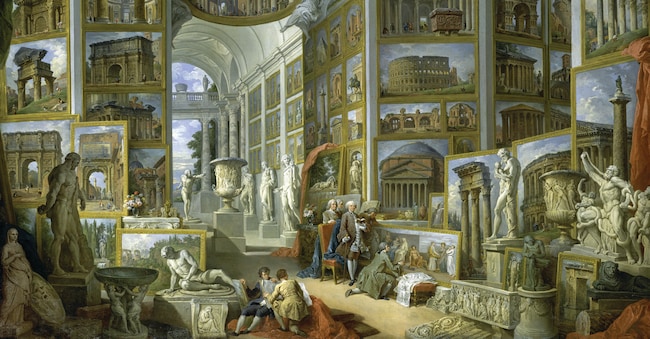
The past becomes a wonder, and it is immediately evening. To reflect and find oneself children of the Pantheon, the Colosseum, the curves of the Laocoon and those who, from Goethe to all the grand tourists, stayed in 18th century Rome to be fascinated by it and remind us of those splendours. The same as the Wonders of the Grand Tour exhibition currently on display at the Poldi Pezzoli Museum in Milan. The initial idea stemmed from the desire to highlight Giovanna Zanuso's donation of the Interior of the Pantheon in Rome by Giovanni Paolo Panini (Piacenza, 1691-Rome, 1765), the only work by the author in Milan's public collections.
It starts with a request to the Met in New York for the loan of Ancient Rome (1757), Panini's masterpiece, made with its twin Modern Rome. A difficult operation but museum diplomacy bears fruit and the work - a unique (and unrepeatable) loan - opens the exhibition. It is a grandiose symphony - almost a souvenir of souvenirs - of Romanity with 61 buildings and statues, from the Arch of Constantine to the Basilica of Maxentius, from the Marcus Aurelius to the Apollo of the Belvedere. They are laid out in an immense imaginary gallery full of dynamism, in a scenography of beauty at the foot of a curtain that rises like a theatre. The work's postcards are, in turn, individual paintings created by Panini, who thus takes credit for himself, in a grandiose experiment in meta-painting, with, at the centre, the client, Count Étienne-François de Choiseul-Stainville, the French ambassador to Rome, holding a guide in his hands, and Panini himself. He was able to actualise each space with human figures wandering among the ruins, thus bringing out the grandeur of the ancient remains and the culture that had wanted them. The one that young people from all over Europe came to discover to train, to make their own forms and styles considered eternal. And, on their return home, perhaps they would pass by Panini's workshop to buy views or whimsy, fantasy panoramas inspired by antiquity, and have a memento in their homes.
With Panini's Ancient Rome begins a journey inside the Poldi Pezzoli to discover the masterpieces in the collection that speak of that felicitous phase of classical culture that permeates Europe and our thinking. It is the Grand Tour, theorised by Richard Lassels, and unfolded in canvases, sculptures, objects of all kinds. Panini's Interior of the Pantheon in Rome (1743), which the author replicates several times, is a hymn of classicism that becomes contemporary: the painter makes the light descend from the oculus and creates grandeur, restoring a vision impossible to the human eye because he superimposes the dome, the walls with the columns and the ground floor crowded with tourists, with their eyes upwards, and faithful in prayer. Next to Panini are two views by Gaspar van Wittel (Amersfoort, 1652/3-Rome, 1736), on ten-year loan from Giovanni and Enrico Peloso. The Dutch artist, father of architect Luigi Vanvitelli, is the first true author of vedute, the vedutista par excellence, and the Panoramic View of Rome from Villa Medici (1687), in pendant with the Panoramic View of Rome from Trinità dei Monti (1687), is a film with a clear light. As is Canaletto's Architectural Capriccio with Ruins (c. 1756), with a loggia with pointed arches, a triumphal arch, and a fountain.
But not all grand tourists could afford to return from their educational journey with priceless paintings or sculptures. They wanted, however, a souvenir to keep at home or even just to display as a pass for cultural ascendancy. Thus a new market was born that was satisfied by a highly specialised manufacture producing various and easily transportable objects: from fans to small bronzes, from micro-mosaics to stones engraved with views of Rome, Naples, Herculaneum and Pompeii. And the exhibition offers a selection of fans painted in gouache or watercolour, a testamentary legacy of Carlo Borgomaneri, dating from the late 18th century to the early 19th century. They are very refined souvenirs, sometimes signed, mounted on ivory slats, often inlaid. Precious gifts to take home, such as the micromosaics used to decorate snuff boxes, favours, coffee tables, cabinets, men's and women's jewellery, some examples of which can be admired in the exhibition: refined earrings, necklaces, bracelets with views of Rome or Naples.
Eternal beauty always in the pocket, to build a new look and be part of it. As director Ferzan Özpetek, the protagonist of the exhibition, succeeds in doing with his video reinterpretation of the Grand Tour, entitled Tutti gli dèi. Starting from the Pantheon, he creates a dreamed dream in which he enters and exits classicism: "This journey of mine is an invitation to let oneself be touched. To wake up, like the woman in the Pantheon, in the knowledge that the true wonder of art - and of existence - is the possibility of feeling alive in front of the light'. Which is everywhere, you just need to know how to see it, even in the darkest recesses.


