
The green heart of upholstered furniture: sofas and cushions to the test of sustainability
The eco-sensitivity of design: between disassemblable reissues, certifications and recyclable interiors, the primary goal is to minimise the presence of polyurethane in the home.
4' min read
4' min read
No object like the sofa at home restores a sense of warmth, domesticity and relationship. At the same time, it is one of the products of excellence in Italian and European design: the sector's leading companies are, each with their own tools, embracing the challenge to make it more sustainable. It is a difficult road, because the upholstery supply chain has several environmental criticalities, starting at the end of its life cycle, both because there is no dedicated disposal chain (it ends up in bulky waste) and because of the structural complexity of the product.
And it is precisely from this complexity that the road to making the heart of Italian upholstered furniture and homes more sustainable starts. An eco-sofa has two main characteristics: it lasts a long time and, when it stops being used, it must be able to be disassembled to recycle its individual parts. This avoids landfill or incineration and allows it to be included in the flow of the circular economy. Cassina, an almost 100-year-old company founded in Meda (Monza Brianza), has developed an indicator to assess the recyclability of products, called Circular Tool: for each piece it assesses how much it can be reused, repaired, recycled. Moreover, for five years (together with Zanotta, acquired in 2023) it has activated a laboratory at the Milan Polytechnic to implement this philosophy throughout production. The flagship product is the Mon-Cloud by Patricia Urquiola, 99.85 per cent disassemblable at the end of its life, with upholstery that reduces the presence of polyurethane to a minimum, using instead of synthetic materials vegetable materials derived from agriculture, such as algae, agave, organic oils and microorganisms.
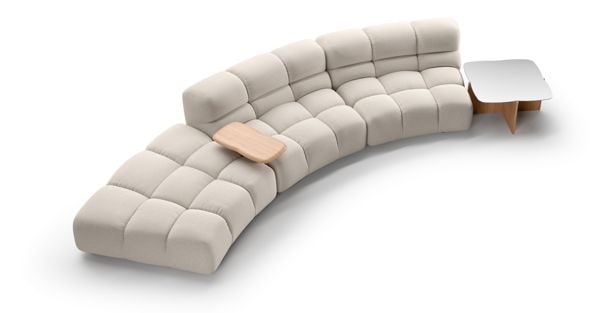
B&B Italia, on the other hand, was founded in Novedrate (Como), in 1966, with innovation in its DNA: it was the first company in Italy to use injection moulding technology. Managing Director Demetrio Apolloni recounts: 'This year I was in a hotel in Liguria, where I found a sofa from the Coronado line, one of the first to be produced by the company. I knew where to look for the year of production: that sofa was from 1968, and it was still perfect. For me, sustainability starts here above all". In the present, B&B Italia has reissued a 20-year-old sofa, the Tufty-Time, design Patricia Urquiola. The remake two decades later is a perfect measure to assess the steps being taken on upholstered furniture to reduce their impact. The new version is entirely disassembled, the cover is made of recycled polyester and fixed without the use of glues, just as the plastic components are recycled. According to Apolloni, we are still in a transitional phase for this transition, 'the drive to change comes from the sensitivity of the company and the designers, but on the market it is not yet an absolute value: consumers look at price, comfort, aesthetics and durability, but not enough at materials or the circular economy. Right now it is up to the companies, which also bear the cost of this transition, but the change will become faster when the sensitivity of the buyers also evolves.
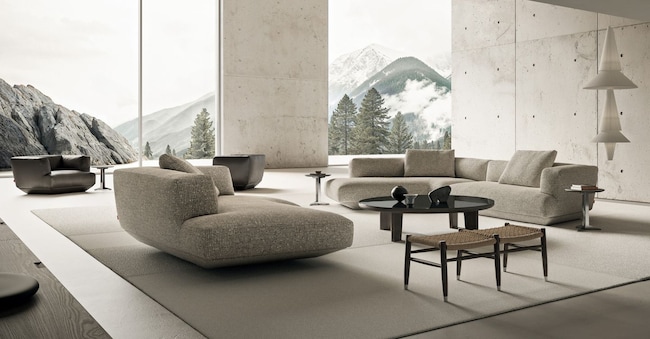
Flexform, which started as a workshop in 1959 and became an industry in the following decade, has collaborated with some of the greatest designers, from Joe Colombo to Asnago and Vender, Cini Boeri and Rodolfo Bonetto. It has embraced the challenge of sustainability on the materials side: fabrics, leathers, woods and metals are selected not only according to quality criteria, but also geographical proximity to the company. Furthermore, it has chosen to use only goose down certified Gold by Assopiuma, a guarantee of respect for the environment, the processes and the animals themselves. Gold goose down is also biodegradable: after the end of its life cycle, it becomes nitrogenous fertiliser for soil cultivation. The synthesis of this Flexform philosophy is the Loungescape, the seating system designed by Antonio Citterio, who imagined it "like a landscape" rather than a piece of furniture, with the idea that even the most domestic object there is can have a connection with nature, both in terms of aesthetics and materials.
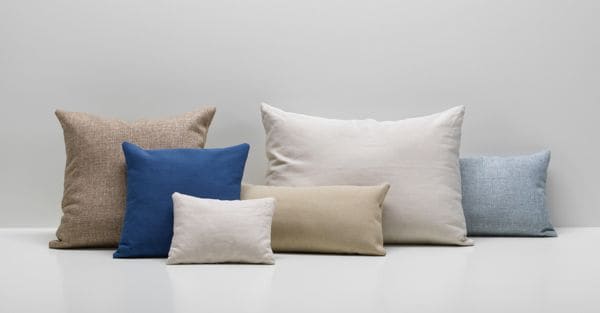
For Vitra, a design company based in Basel, Switzerland, sustainability is a kind of operating system upgrade that involves everything: the way they develop and manufacture products, the sourcing of raw materials, the organisation of the supply chain. Every year, new materials are replaced to make upholstery more sustainable. And not only upholstery: the Tip Ton family of chairs, designed by Barber & Osgerby in 2008, is now available in the post-consumer recycled material RE. The production of the Uten.Silo organiser, by Dorothee Becker from 1969, has been modified to use only industrially derived recycled plastic. The latest innovation is the material used for the upholstery of the Vitra Cushions, converted to Pet fibres or polyester, both of which are 100 per cent recycled: they do not contain the slightest trace of animal elements.

