
The spirit of Gucci: between identity and turnover; Moschino’s new energy

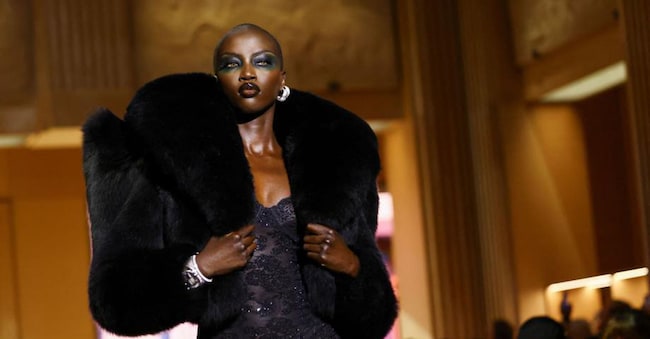
The fashion industry is going through a slowdown. Brands are not growing as they should, or are shrinking dramatically. Sales are essential. With his characteristic cynical and biting humour, Demna decided to stage his second Milan show for Gucci in a shop, complete with merchandise on the racks, an inaccessible private area reserved for very important clients (in this case, Anna Wintour, Jannik Sinner and the like), and a host of shop assistants recruited for the occasion from the Montenapoleone boutique. The choice is in itself a commentary on the present, a reaffirmation of pressing priorities. Demna’s narrative is perhaps more subtle and philosophical, but this does not detract from the self-evident bluntness of the intention.
For him, the shop is a place where people and stories intersect, “because,” he says, “Gucci is a space of possibility where anyone can become whatever they choose to be”. The collection navigates between aspiration and mass appeal, between the elite and the mainstream. It bears Demna’s hallmark in the distortion of details – sharp shoulders, square-toed moccasins – grafted onto accessible, even banal, garments and archetypes. Gucci, in short, as a wardrobe for everyone, from the high-society lady to the shoplifter. And so, potentially, for no one.
Moschino: this is the philosophy guiding Simone Rizzo and Loris Messina in their reinvention of the brand. PRONTOMOSCHINO? they proclaim in the press kit-manifesto. Literally: the fashion show is a convergence of two currents – the descending one featuring the models, and the ascending one comprising four hundred extras caught in the act of going about their business, like passers-by on the street. It is a high-impact stunt, typical of these two young creatives, who are infallible communicators. But it is a risky move: many of the real people, dressed in their own clothes, are more interesting than the models.
Rizzo and Messina’s Moschino actually gets off to a good start, without irony or clichéd slogans, with plenty of colour and a great sense of freshness; but for a collection aimed at the masses, it still feels a bit too contrived, and leans a little too heavily on tropes that have now become avant-garde clichés, such as the hyper-draped crinolines seen in Anderson’s Loewe collection. It’s a stumbling block: the theory is there, the energy too; now it needs a touch of that lysergic realism that suits the pair so well.
There is a reassuring candour in Matteo Tamburini’s approach to Tod’s: a fluid, spontaneous yet deeply considered way of working, born of an awareness of his position as creative director, of his creative possibilities, and of his target audience. A limitation, perhaps, but one that does not restrict. Using a highly personal blend of rebellion and restraint, Tamburini disrupts the classic – Italia only by narrative convention, cosmopolitan at its core – with gestures that leave a personal mark, and hits the mark. He brings together codes belonging to different worlds, without attempting to resolve their differences; he blurs and blends categories, because this is a fluid age.

