Museums

The Guggenheim between two worlds: Abu Dhabi opens, Bilbao celebrates Jasper Johns

The new branch in the UAE expands the Foundation’s network, whilst the Basque museum reaffirms its economic and cultural strength with the retrospective

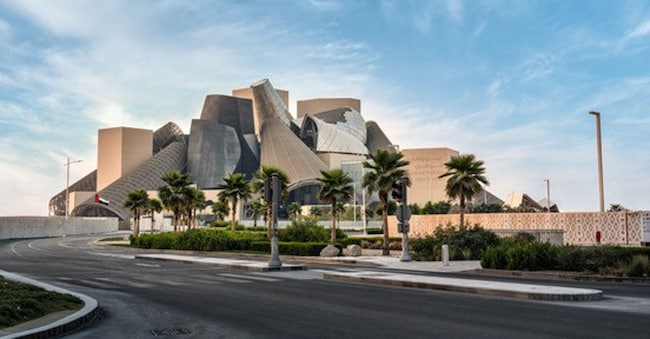
Guggenheim Abu Dhabi

5' min read

Translated by AI
Versione italiana

5' min read

Translated by AI
Versione italiana

Thirty years after transforming the fate of Bilbao, the Guggenheim brand is set to write a new chapter in its history. On 11 December, the Guggenheim Abu Dhabi, the new venue designed by Frank Gehry, marking the expansion of the Foundation into the Gulf after nearly twenty years in the making. Covering some 80,000 square metres, with 30 galleries and a collection dedicated to art from 1960 to the present day, it will be the largest museum in the Guggenheim network. Whilst Bilbao was established as a driving force behind the regeneration of an industrial city, Abu Dhabi, on the other hand, presents itself as a global cultural platform: a museum designed to tell a history of art that is no longer centred on the West, but built through dialogue between the Middle East, Asia, Africa and the rest of the world.

Whilst Abu Dhabi represents the Foundation’s future, Bilbao continues to embody its most emblematic success. The Basque museum is hosting ‘Jasper Johns: Night Driver’ until 12 October, curated by Enrique Juncosa, a major retrospective dedicated to Jasper Johns (1930), one of the artists who redefined the language of American art in the second half of the 20th century. This choice is anything but random: whilst the Guggenheim network expands into new geographical horizons, Bilbao reaffirms its role as a museum capable of reinterpreting the great figures of modernity through exhibitions of international scope.
Loading...

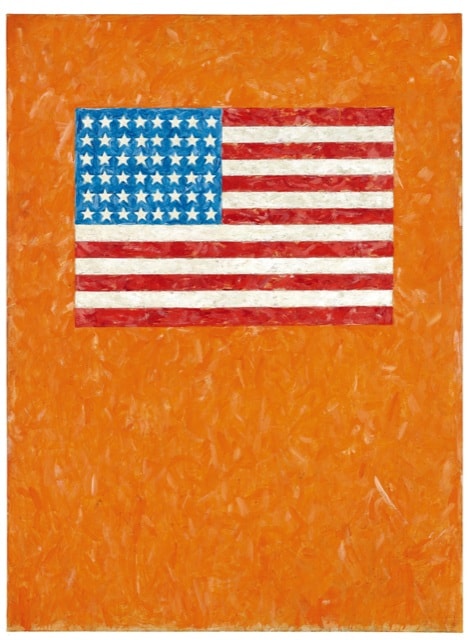
JAasper Johns. Bandiera su sfondo arancione («Flag on Orange Field»), 1957. Encaustico su tela. 167,6 x 123,8 cm. Museum Ludwig, Colonia. Donazione della Ludwig Collection, 1976. © Jasper Johns, VEGAP, Bilbao, 2026

An economic and cultural driving force for the Basque Country

2025 ended on a positive note in terms of visitor numbers, with 1,305,003 visitors, surpassing – albeit only slightly – the previous year’s record (+3,660 admissions). May, June and July were the best months in the museum’s history, and the summer of 2025 ranked as the second busiest ever, after that of 2023.

The Guggenheim Bilbao has once again demonstrated the soundness of its economic model in 2025. The museum covers 78.4 per cent of its operating budget independently, generating around 25 million euros directly. The main source of income remains ticket sales, which generated 15 million euros over the course of the year. Added to this are €5 million from sponsorship and membership schemes, supported by over a hundred partner companies and the network of Friends of the Museum, whilst the bookshop, merchandise and catering concessions contribute a further €4 million. The remaining 21.6 per cent of the budget, amounting to approximately €7 million, is provided in equal parts by the three founding institutions – the Basque Government, the Provincial Council of Bizkaia and Bilbao City Council – with a contribution of around €2.33 million each. This financial balance confirms the museum’s ability to sustain itself through its own activities and to maintain a high level of international appeal, whilst also marking a particularly positive start for the new Director-General Miren Arzalluz, who took up her post in 2025.
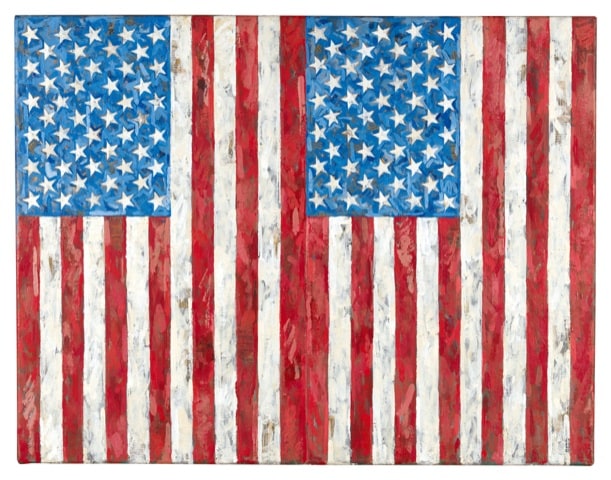
Jasper Johns. «Bandiere (Flags)», 1987. Encaustico e collage su tela. 65,5 x 83,8 cm. Collezione dell’artista. © Jasper Johns, VEGAP, Bilbao, 2026

In addition to its cultural value, the Guggenheim Bilbao continues to be one of the main economic drivers of the Basque Country. In 2025, the museum’s activities generated a total economic impact of 782.3 million euros on the regional economy, contributing 676.7 million euros to the Basque GDP. The knock-on effect also generated €106.1 million in tax revenue for public authorities and supported 14,319 jobs.
The retrospective dedicated to Jasper Johns

The retrospective ‘Jasper Johns: Night Driver’ – as the museum explains – is supported by a mixed funding model, combining the museum’s own resources and private sponsorship, whilst maintaining complete curatorial independence. The Guggenheim does not disclose either the budget or the visitor targets, emphasising instead the growing organisational complexity of major international exhibitions, where transport, insurance and loans now represent one of the main cost items. Organised in collaboration with the artist’s studio and the lending institutions, the exhibition is sponsored by the BBVA Foundation. It brings together around 140 works, including paintings, sculptures, drawings, prints, an artist’s book and a scenographic project, offering a comprehensive overview of more than sixty years of artistic exploration.

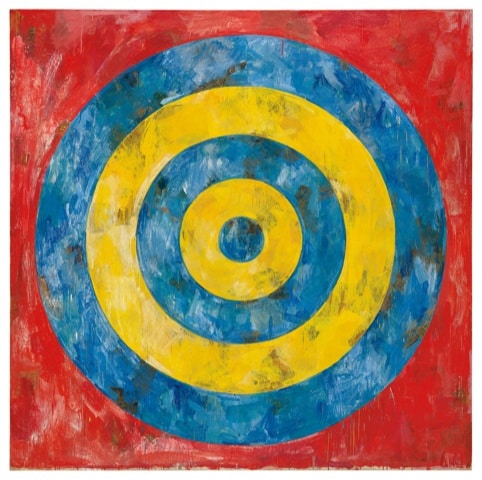
Jasper Johns. Diana (Target), 1961. Encaustico e collage su tela. 167,6 x 167,6 cm. The Art Institute of Chicago. Donazione della Edlis Neeson Collection. © Jasper Johns, VEGAP, Bilbao, 2026

The journey begins with a decisive turning point: between 1954 and 1955, Johns destroyed most of his earlier works and painted his first famous ‘American Flag’, ushering in a series of works based on universal images – flags, targets, numbers and maps – which would foreshadow Pop Art. Moving away from the emphasis of Abstract Expressionism, Johns developed a minimalist and restrained visual language, capable of combining formal rigour with emotional intensity, and exerting a decisive influence on the subsequent movements of Minimalism and Conceptual Art. The title, ‘Night Driver’, draws on a drawing the artist produced in 1960 and serves as the key to understanding a creative journey that highlights the continuity and extraordinary coherence of his artistic practice.

The market: a classic post-war blue-chip

More than seventy years after the debut of his famous ‘Flags’, Jasper Johns remains one of the pillars of the post-war international art market. His output is relatively modest; many key works are held in the collections of major American museums, and the availability of early paintings on the market is increasingly limited: a combination that sustains high values and constant demand from major collectors.

The artist’s record dates back to 2010, when ‘Flag’, 1958, was sold privately for around 110 million dollars to the billionaire Steven A. Cohen. The painting came from the collection of the artist’s long-standing gallerist, Leo Castelli. 

At auction, however, the record is held by ‘Small False Start’, 1960, which sold at Christie’s in 2022 for $55.3 million from the collection of Paul G. Allen. The sale of the collection belonging to S.I. Newhouse in May 2026 was particularly significant: ‘Gray Target’ fetched $28.8 million, whilst ‘Figure 2’ was sold for $8.9 million – results which demonstrate how historic works continue to attract international competition, albeit with a greater focus on quality and provenance.

Loading...

Alongside his paintings, the market for his prints also remains highly vibrant. Johns is regarded as one of the great innovators of contemporary printmaking, and his prints – particularly the series featuring flags, targets and numbers – represent one of the most liquid segments of his market. The rarest prints can fetch over a million dollars, as demonstrated by ‘Flags I’ (1973), which sold for $1.68 million at Christie’s, whilst the more affordable range of lithographs and screen prints continues to fuel international collecting.

In a market that, over the past two years, has primarily favoured ‘blue-chip’ artists, Jasper Johns is a prime example: an artist now firmly established in art history, bolstered by the scarcity of his works in museums, global demand and a critical reputation that continues to translate into financial stability.

Copyright reserved ©
Loading...

Brand connect

Loading...

Newsletter

Notizie e approfondimenti sugli avvenimenti politici, economici e finanziari.

Iscriviti