
Jonathan Anderson's happy debut at Dior
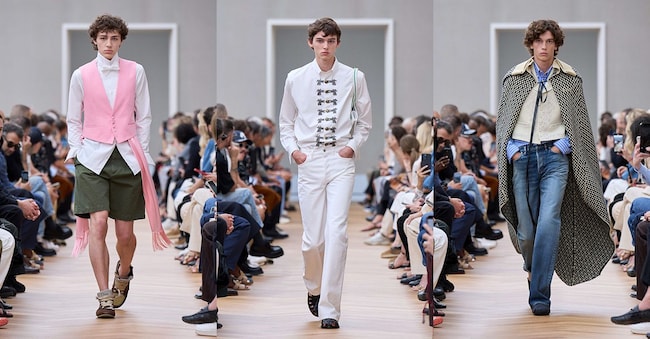
It was the most eagerly awaited fashion show in Paris and it did not disappoint expectations: a collection respectful of the maison's codes and at the same time surprising
3' min read
3' min read
Halfway through Paris Fashion Week, finally, it was D day. D for Dior, of course: the most anticipated moment of the entire season. Is it the longed-for agnition of the new? The fulfilled hope of the fateful and increasingly rare fashion moment, the raison d'être and unique principle of dynamics for the whole system? It is, but up to a certain point. Jonathan Anderson makes his debut at the creative direction of France's most august maison, the first figure in seventy years to work on men's, women's and couture collections, laying the foundations of what could be his path but avoiding taking big risks. The rehearsal is perfect, energetic and flawless, but no, it is not a moment of total reset, an epochal watershed - perhaps not even the right historical congeries for such an event. Aware of the limitations and needs, primarily commercial, of such a brand in such a group, Anderson acts with sensitivity and astuteness, focusing his attention and message, for the first time in his career, on style instead of design, on manner instead of things, on narrative instead of architecture. The collection narrates, with great freshness, of a group of young gentlemen, handsome and healthy and probably from the rive gauche - the French is obligatory -, who dress by spontaneously mixing chinos and tailcoats, English countryside and couture, ties, tweeds and capes and then many normal things, perhaps wrapping their necks in an obvious and decadent satin cravat. Anderson's abstract aesthetics and Dior's pomp and circumstance cannot at first be reconciled, but it is in this distance that the strength of the arranged marriage lies. At the moment the marriage tastes like sorbet: colourful but with little flavour. But there is so much to put in the shop, and it is all desirable. Better still, it evinces an attitude of healthy confrontation with the past and the archive, and therein lies the formula. 'After all,' says Anderson, 'Monsieur Dior created the New Look by looking a century or two back'.
Even Junya Watanabe looks back to imagine the present, and reconfigures brocades, tapestries and tapestries into a wardrobe of archetypal jackets, with a solid but not stale masculinity, with a whiff of rebellion in the smooth surface treatment and beatnik allure.
The always cryptic and always imaginative Rei Kawakubo, understandably concerned about the fate of the world, imagines a tribe of shamans who can lead humans back to love and brotherhood. An admittedly utopian hope, which translates into a string of dresses and tunics with maternal and curvilinear twists, and colours that are now primary and now lysergic. Here there is no need for narratives or superstructures: the power of vision is in the construction of things, and it reverberates with the clarity of thunder.
In comparison, the Latin pathos of Willy Chavarria, suspended between racial pride and social denunciation, appears awkwardly sonorous - a protest certainly cannot be silent - which is then the lesser evil. It is the sartorial rendering of the forms, and then the barbaric attempt to create sciantosa dresses, that is unconvincing.
It has a fresh and chaotic, messy and cartoonish, in the best of ways, Kenzo, where Nigo finally reconnects with the origins of the story, namely the spirit of Jungle Jap, Kenzo Takada's first shop-emporium in Paris. No pretence at reinventing the wheel, but plenty of energy and just as much spontaneity.

