
The heat and the long working summer of riders, drivers, farm workers, bricklayers between one anticyclone and another
According to the latest report by Workclimate (Inail and CNR), 19 regions have issued ordinances to regulate work during the hottest hours in agriculture and construction. According to Wmo and Oms above 20° Celsius for every additional degree, labour productivity drops by between 2 and 3 per cent. Worldwide 2.4 billion people exposed to extreme weather conditions

5' min read
5' min read
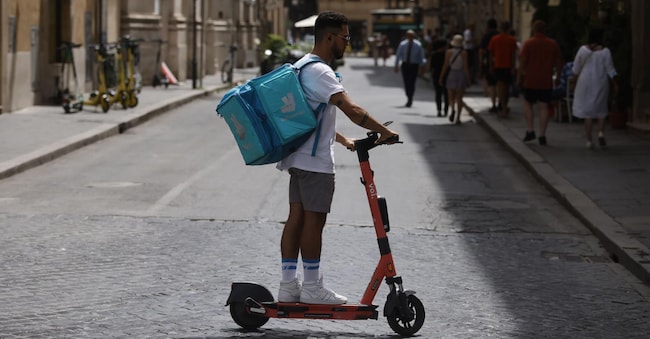
How hot! Numbers are not enough to count how many times in this long and beautiful summer the exclamation has been uttered, even from holidays. However, the working summer is longer and more difficult for some categories of workers than for others, from riders to drivers, to labourers, agricultural and construction workers, but also postmen and security guards, to name but a few. Temperatures in many areas of the country repeatedly touched 40° and stayed above 30° for a long time, without giving much respite even at night. The increase in heat has led to increased caution and protection for those at work, but also to increased worker protests and organisational measures in companies, where climate change has now become a structural issue as summer approaches. As the temperature rises above 20°, for every extra point marked by the thermometer, the productivity of those at work decreases by between 2 and 3 per cent. This estimate by the World Meteorological Organisation (Wmo) and the World Health Organisation (WHO) will affect more and more companies and workers as temperatures rise. Already today, 2.4 billion people in the world work in extreme climatic conditions. The issue certainly concerns certain areas of the globe, including Africa, the Arabian Peninsula, India, and the countries of South America, where temperatures now reach 40° and more, more frequently than in the past. The summer of 2025 in the United Arab Emirates is distinguished by an extreme heat wave, after an already very hot spring, with temperatures that even exceeded 50°. In Italy, the situation is less extreme, but this August, for example, the anticyclone Charon has scorched the peninsula, where temperatures have been recorded touching 40 degrees. If the heat is advancing, work is calling for different organisation, especially since the days of long summer factory shutdowns are long gone: globalisation and the internationalisation of companies have reduced even those in August and made it necessary to rethink shifts during the summer period. In several sectors, also taking into account regional ordinances.
Regional Ordinances
.The protections for those who work are much more than in the past, as recounted on the one hand by the ordinary redundancy fund and the wage supplement allowance that can be requested by companies in the event of excessive heat (over 35°), or extreme weather conditions, which make activity risky, but as recounted on the other hand by the regional ordinances dedicated to this issue. With the exception of Trentino Alto Adige and Valle d'Aosta, all the regions have issued ordinances in which they give indications on sectors and time slots to allow people to work safely, as shown by the latest Workclimate report, the result of collaboration between Inail and CNR. They mainly concern certain sectors, such as floriculture, agriculture and construction where people are often exposed to heat. But they also concern the time slots in which to work. As the Workclimate report explains, in many regions the ordinances arrived only after the first heat wave began, highlighting the need for a more preventive approach and better national coordination, as now requested by several trade unions. The measures are homogeneous by time slot (12:30-16:00), provide exceptions for essential services, and all apply to construction and agriculture/floriculture or related sectors. Only a few regions extend them to sectors such as logistics and riders, which is the case in Piedmont and Lazio. The trade unions called for the focus to be extended to other categories of workers, such as postmen and security guards.
The difficulty of implementation and irregularities
.The Workclimate report shows, however, that enforcement problems persist: on the one hand, it is crucial to ensure that companies comply with the ordinances, on the other hand, it must be considered that the rules are not always easy to enforce safely. Not all workplaces, in fact, have adequate areas where workers can rest during the hottest hours, especially for those workers who, for logistical reasons, cannot return home during the break. In July, there were many injuries related to prolonged exposure to the heat, and there were growing concerns about declining productivity and reduced wages. However, the presence of the ordinances did not prevent the occurrence of many irregularities related precisely to working hours, as revealed in the Carabinieri's operation that focused on agriculture and between 31 July and 11 August carried out sweeping checks on 888 companies. Among the irregularities that emerged, especially in the South, was that of working during the time slots prohibited by regional ordinances. Rising temperatures have also led to an increase in protests this summer, as the report shows: from Globo to Carrefour, to Stellantis and Electrolux, there have been protests and strikes by workers on hot days, but there have also been specific measures taken to improve weather conditions in the factories and to revise work shifts. What caused the most uproar was the case of the home food delivery platform Glovo, which had initially foreseen for its riders a bonus for deliveries during the hottest hours, equal to 2% for temperatures between 32 and 36 degrees, 4% between 36 and 40, and up to 8% for temperatures above 40 degrees, triggering protests from the unions, which instead demanded that deliveries be suspended during the hottest hours. The home food delivery platform first suspended the bonus - and certainly not the deliveries - due to the numerous criticisms, only to be forced by the Court of Milan to pay riders 30 cents more per delivery when outside temperatures exceed 25 degrees. The court also ruled that riders must be equipped with certain safety devices to protect themselves from the heat, such as hats with visors, sunglasses, sunscreen, thermal water bottle and mineral salts.
The International Framework
.Returning to Wmo and WHO data, 2024 was the hottest year on record, with temperatures in many areas of the world exceeding 40 degrees and even 50 with increasing frequency. This worsened 'the impact of heat stress on workers around the world', who were exposed to heat stroke, dehydration, kidney dysfunction and neurological disorders. "All factors that compromise long-term health and economic security," the experts explain, in a context where "about half of the world's population is adversely affected by high temperatures". "Heat stress at work has become a global social challenge," said Wmo Deputy Secretary General Ko Barrett, "Protecting workers is not only a health imperative, but also an economic necessity. By the way, in numerical terms, the issue is a hot one, as according to the International Labour Organisation, more than 2.4 billion workers are exposed to excessive temperatures worldwide, with more than 22.85 million work-related injuries each year linked to heat stress. The two UN organisations, Wmo and WHO, are therefore calling for the implementation of specific workplace action plans, tailored to specific sectors and regions and developed in collaboration with companies, workers, trade unions and public health experts..

