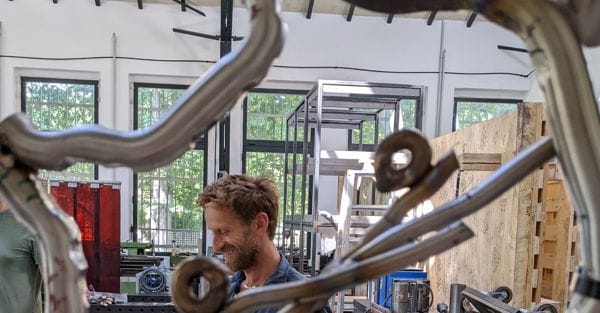
The house without walls by Petrit Halilaj
In Dogliani, the Kosovar artist creates a work that does not monumentalise memory, but puts it in tension

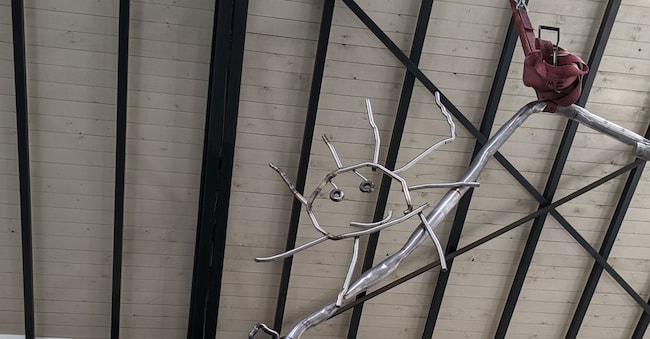
There is a point, in the Langhe, where the landscape seems to abandon its bucolic vocation to take on the density of a page by Aby Warburg: a space where time passes quickly - it is true - but only to return again and stratify. It is in this interstice - more conceptual than geographic - that Abetare (a day at school), Petrit Halilaj's new intervention for the second edition of Radis, the Fondazione per l'Arte Moderna e Contemporanea CRT and Fondazione CRT's public space art project, is set.
Dogliani
We are in Dogliani, in the province of Cuneo, where, in the Borgata Valdibà, the Kosovan artist builds a house without walls, made of childish signs, located in the area of the old school abandoned since the Seventies. A work that does not monumentalise memory, but puts it in tension. The spark arises in him from a specific memory. Halilaj recalls his first visit to the village: 'I felt a connection immediately. The benches, the chairs, the stoves left there took me back to Kosovo, to the moment when I found out in 2010 that they were going to demolish my primary school'. There too, outside the building, the desks were stacked, destined for disposal, covered with anonymous carvings. From that visual impact came the Abetare series, an archive of signs recovered in extremis. In Dogliani, that archive becomes larger and the children's drawings of Runik are short-circuited with those of the Piedmontese benches, in an overlap that resets geographical distances to zero. "It is as if children from different places and times drew together," explains the artist. "I didn't want to impose an external narrative. I wanted to listen to what the space already held".
The childish gesture
The su
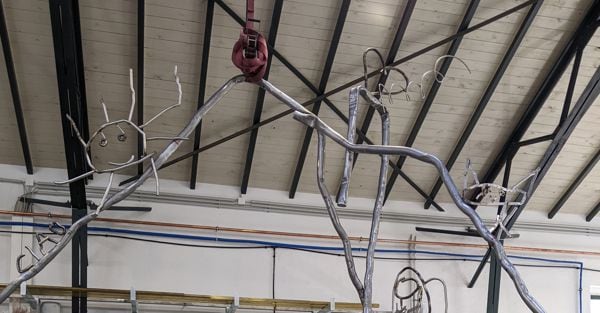
he attention to the child's gesture is not sentimental, but so analytical as to recognise in those minimal forms - hearts, houses, animals and names - a universal repertoire that precedes languages and perhaps even biographies. A place of convergence between different worlds that does not need to be explained, only observed. "There is a shared language that surpasses words," he says. "Children's drawings, everywhere, reflect the same obsessions." In this dialogue between Dogliani and the Balkans, there is a double movement: the anthropological precision of the signs and, at the same time, a poetic discarding of them. The hills of Piedmont remind the artist of an unexpected echo of Kosovo: "In the softness of these hills there is something that brings me back home and at the same time to the future. Not nostalgia, mind you, but resonance with the theme of home has been running through his work for years. Halilaj lost two homes during the war and since then that concept has shifted. "I started to imagine that not having a stable base could be an advantage.
The House
La