
The human body as a masterpiece of every age
Curious itinerary between England and Veneto in the medical collections: at the Hunterian Museum in London, set in the Royal College, four plates look like Arte Povera, with fantastic figures, and are the oldest anatomical preparations in Europe.

4' min read
4' min read
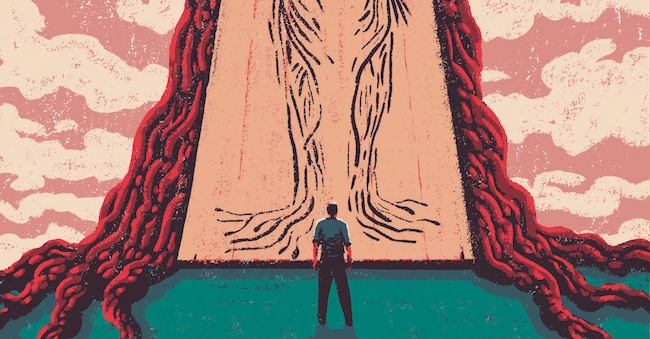
I found them in front of me unexpectedly, about ten years ago. A polyptych composed of four wooden boards measuring approximately two metres by seventy centimetres, arranged vertically, unprotected - as in a church - and a short distance apart. An informal, material work, a stroke of genius by someone from Arte Povera who has pasted bizarre, naturalia-like figures on several layers of paint? Perhaps tree branches, perhaps corals, or seaweed developing filigree inflorescences? As I desperately search for a caption, a dashing, caned gentleman of Indian descent comes to my rescue, telling me about the legendary seventeenth-century plates called 'Evelyn'. On each one is skilfully pasted, crushed, overpainted a part of the human body: the spine and the nerves, in the first; the distribution of the veins, in the second; the aorta and the arteries, to follow: the first three plates, anthropomorphic, form fantastic figures, like funny little men standing around. In the fourth appear, isolated like bushes, the vagus nerve with the sympathetic nerves and, further down, the lungs and liver.
The mysterious guide introduces himself: he is a retired doctor and works as a volunteer at the Hunterian Museum in London, housed within the Royal College of Surgeons. You can imagine the astonishment: the plates of that wonderful and highly expressive polyptych are the oldest anatomical preparations in Europe! If they used to be placed somewhat casually at the entrance to the old collection of Sir John Hunter (1728-1783), the renowned Scottish surgeon, they now appear under glass in the renovated museum of medicine and art embedded in the Royal College (which I had the opportunity to report on the front page of this newspaper when it reopened on 28 May 2023).
The author of the pinewood plates is Giovanni Leoni d'Este, assistant to Professor John Vesling who worked in Padua in the first half of the 17th century. Purchased by John Evelyn in 1646, they were donated to the fledgling Royal Society, only to be acquired by the then rapidly expanding British Museum in 1781; since 1809 they have been part of the College's extraordinary collection, a place where some of London's surgeon-humanists go on weekends to take anatomical drawing lessons, copying Leonardo da Vinci or William Hunter (John's brother). Art and medicine have intertwined their paths for centuries, with absolute peaks in the Renaissance and Baroque - the Wunderkammern are an example - at a time when we Italians were true pioneers. Today, the medicine of war, with its implications and ethical issues, deserves attention. It is addressed extensively at the English Royal College but also in several museum contexts in Europe, broadening thoughts about our present.
From Lincoln's Inn Fields, the 18th-century square that houses the Hunterian and Soane Museums, we move on to the Serpentine Gallery, where Giuseppe Penone's beautiful exhibition 'Thoughts in the roots' is on until 7 September. Twelve vertically arranged wooden boards dominate the central room of the gallery, twelve young trees "hollowed out" by the artist so that the nerve structures, the internal circulatory apparatuses, emerge there: Alberi libro (2017). Analogies, references and correspondences emerge with the animal and mineral kingdoms, as well as with our Evelyn plates. So let us move on to their place of origin, Padua, home to none other than the world's oldest anatomical theatre. Inside Palazzo Bo, the seat of the University, one discovers a masterpiece of architecture, a panoptic system that surpasses all Michel Foucault-like ideals and has remained untouched and perfectly preserved since 1594. Elliptical in plan, in the shape of an inverted cone, it has boxes distributed over six floors of carved walnut. In the centre, at the bottom, the anatomical table: Where death is happy to succour life, reads an inscription in Latin. This model was imitated in several European faculties (and, if we think about it, 'operating theatre' in English still translates as 'theatre'!). And while we're in Padua, we can't miss the G. Morgagni Museum of Anatomy, founded in 1860 and beautifully refurbished in 2018. The anatomy theatre in Padua stopped operating in 1872 due to increasingly rare executions, as the corpses dissected were exclusively those of people sentenced to death. The person responsible for the creation of this masterpiece, Girolamo Fabrici d'Acquapendente (1533-1619), was also the promoter of anatomical illustrations in colour. And here the relationships between medicine, art and wonder extend to bibliophilia.
We then move on to the waters from which Evelyn's boards sailed in the 17th century, to England. And we land at the Scuola Grande di San Marco, the Civil Hospital of Venice, undoubtedly the most beautiful health resort in the world. After admiring its façade, we cross the main entrance and ascend to the second floor: the capitular hall, where the altar by Sansovino is located, houses the Museum of the History of Medicine. It houses a unique selection of astonishing volumes, a discovery for all ages, including the first 'pop-up' books in history, complete with 'liftable' paper/leather flaps through which we can admire illustrations of our bodies. To the right of the hospital entrance, on the other hand, one discovers the small and precious 'Andrea Vesalio' Museum of Pathological Anatomy, with its Historical Pharmacy, which houses anatomical preparations (oddities included) and represents a kind of work in progress curated by the Venetian medical community. Looking at our body as a 'work' of nature and medical art, exploring it by connecting the parts with a whole, combining ethics and aesthetics, allows for increased acceptance, knowledge and respect, for oneself and for others. Our itinerary between England and Veneto could then be extended to the not too distant Bologna, to the university museum of Palazzo Poggi which houses Ulisse Aldrovandi's Wunderkammer and the cabinet of the 'anatomist lady' Anna Morandi. But for this I would suggest another trip... perhaps between Italy and Germany?

