
The ‘Hydrogen Island’: projects, research and transport
In Sicily, efforts are under way to turn H₂ into the energy of the future, with a mix of PNRR projects and large-scale private initiatives

Producing hydrogen to power the future, from factories to transport. This is the aim of a number of projects currently under development across Sicily, with a total installed capacity of 9.16 MW: Res Integra’s H2-Sr, Agrobiofert’s H2 Farm, Magicmotorsport’s Idrogeno Rinnovabile and Duferco Energia’s Hvgm. This is a technology which, following the PNRR era, will continue to be developed on the island thanks to a further €31.2 million in funding from the ERDF, alongside additional prospects such as its use in the rail sector.
Investment in this sector has long been one of the objectives of the ‘Regional Innovation Strategy for Smart Specialisation – S3’ of the Sicilian Regional Government’s Department for Productive Activities, which provides for support for activities relating to ‘experimentation, research and development, both within the hydrogen value chain, as an alternative energy source, and with regard to technologies capable of eliminating or mitigating CO₂ emissions into the atmosphere’.
Not all projects, however, are the same. The Sicilian case provides a comprehensive overview of the various possible uses of hydrogen. H2-Sr, a company within the Irem Group, has designed and built a plant for the production of renewable hydrogen via electrolysis in Priolo (Syracuse), powered by a photovoltaic system that generates the necessary renewable electricity and supplies the electrolyser.
Also in Priolo Gargallo – which, not coincidentally, is one of Italy’s main petrochemical hubs – work has been completed on H2-Farm, a project by the Catania-based agricultural company Agrobiofert, which has installed two 1 MW electrolysers at a disused site. The plants will be powered by solar energy generated on-site and will be capable of producing around 37 kg of hydrogen per hour – totalling over 324 tonnes per year – which will be stored and managed using compression and storage systems.
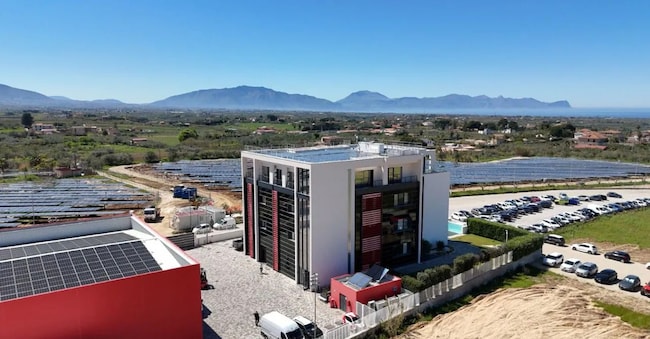
In Partinico (Palermo), on the other hand, Magic Engineering (part of Magicmotorsport) has designed and built an industrial laboratory for research and experimentation into hydrogen. In short, in the Palermo area, the focus is not so much on hydrogen as on expertise. An electrolyser and a 2.4 MW solar farm have therefore been built, complete with storage systems for both electricity and hydrogen. And that’s not all: with the ‘H2 P-Jump’ project, submitted as part of an ERDF call for proposals, the company aims to focus on researching safe and more cost-effective systems for storing the hydrogen produced by the plant.

