
Fondazione con il Sud celebrates its 20th anniversary and launches the “Sud Vivo” project
Event attended by President Mattarella: ‘Those born in the South should be able to stay there’. The Prime Minister: Support for demographic regeneration

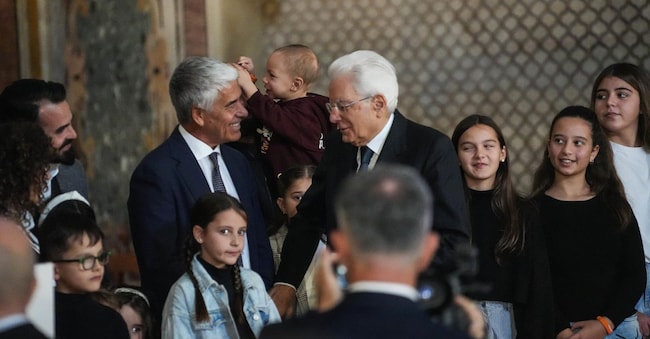
Over 2,000 initiatives, carried out in collaboration with 6,700 third-sector organisations; 4,500 people placed in employment; the management of 110 confiscated properties and 57 monuments: the twenty-year record of the Fondazione Con Il Sud is marked by significant figures, which were presented yesterday in Naples at a ‘Sud Vivo’ event dedicated to the issue of depopulation in Southern Italy and the prospects for demographic regeneration. The event took place within the Donnaregina Monumental Complex, in the presence of the President of the Republic, Sergio Mattarella.
“As the Foundation’s four guiding principles so clearly state,” said President Mattarella, “those born in the South should be free to choose to remain there, should be able to return if they have gained experience elsewhere, and those coming from outside should be able to settle in the South. And this provides a key to the development of the entire country: those who work towards this aim are carrying out a vital role in the life of our national community.” The Head of State also took the opportunity to have his photograph taken with the children of the La Paranza Social Cooperative.
Concerns about depopulation. Italians are increasingly concerned about the depopulation of the country, particularly in the South. 73 per cent of citizens – more than 7 in 10 – say they are concerned about the issue and believe it should be tackled as a priority. This figure represents a rise of 13 percentage points compared with the previous survey in March 2025. These are the findings from the preliminary results of the survey ‘Italians and Depopulation… Not Just in the South’, conducted by the Demopolis Institute, directed by Pietro Vento, on behalf of the Fondazione con il Sud and presented in Naples. The decline in birth rates, meanwhile, worries 8 out of 10 Italians, with figures remaining largely consistent across the whole country. According to Istat data cited in the report, between 2001 and 2023, the South lost around 730,000 residents. Projections for 2080, even in the least pessimistic scenarios, indicate an estimated loss of around 8 million inhabitants, with a sharp decline in the younger age groups. For 69 per cent of those surveyed, the most effective measure to combat depopulation is the creation of job opportunities in the affected areas. This is followed by tax incentives and support schemes for businesses and young people (61 per cent), improvements to public transport and mobility (56 per cent), support for the purchase or renovation of a first home in small villages (54 per cent) and the strengthening of educational, healthcare and personal care services (51 per cent). Sixty-two per cent of Italians believe that local regeneration projects should be promoted jointly by public institutions, businesses and the voluntary sector, whilst only a third would entrust this task exclusively to public institutions.
But a turnaround is still possible. “It is not just Naples, but countless areas in the South – including inland regions – that demonstrate there is a desire to tackle depopulation,” says Stefano Consiglio, president of Fondazione con il Sud. “We are trying, with the resources at our disposal, to stand by these communities. It is important that this support extends to regional authorities – and many regions are already taking steps in this direction – and to all national bodies, because if the South becomes depopulated, this is not just a problem for the South; it is a problem for the whole of Italia.’ Consiglio continues: “Today we are presenting the ‘Sud Vivo’ report, which, as well as containing data, aims to tell the many stories of the South that is fighting back, that is improving, that is creating opportunities to provide jobs for young men and women from the South and, at times, even attracting people from the North who come to work in the South. We are trying to show the other side of the South – the side that is working to improve things – the many people, men and women, young and old, who are offering hope. To overcome this despondency, this sense of inevitability, it is important that there is hope. Many young men and women are proving that it is possible to improve things.”
The report, edited by Francesco Izzo and Fabrizio Minnella, brings together short stories of communities that are taking action and showcasing a vibrant South. ‘Where there’s eating, there are crumbs,’ says Francesco Izzo, drawing on a Sicilian saying to illustrate the cross-fertilisation brought about by the many projects in the third sector. Eighteen stories tell of a South that creates value, welcomes others, innovates and organises itself; a South that does not give up or complain, and which has something to say to the whole country.


