Sustainability

The infinite potential of solar energy produced in space

Plans by companies and public agencies to put solar panels in orbit are advancing: the crux is efficient energy transmission

by Leopoldo Benacchio

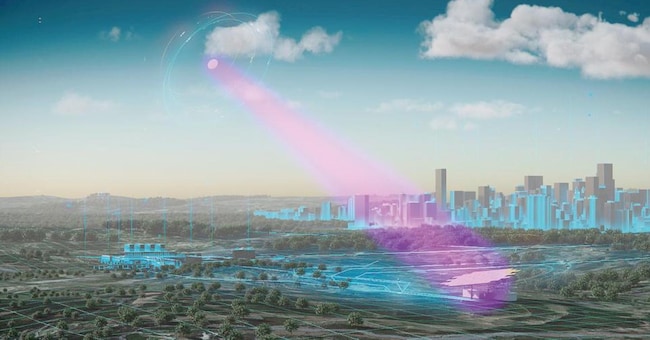
Dal Sole alla Terra. Una volta prodotta l’energia, questa deve essere concentrata, convertita in microonde e poi trasmessa a un ricevitore di grande area sulla Terra

4' min read

Translated by AI
Versione italiana

4' min read

Translated by AI
Versione italiana

Having nearly infinite, clean, cheap and sustainably produced energy has always been a dream of modernity. Let alone now, with the increase in world population, the use of energy-intensive technologies that make our lives easier, from air conditioners to artificial intelligence.

It was 1941 when, in one of his beautiful science fiction stories, Isaac Asimov first hinted at the idea of harnessing solar energy in space and somehow bringing it back to Earth. From dream to science fiction is a short step, but from science fiction to reality is also sometimes a short step, Verne teaches us.

Loading...

Huge panels in orbit

Asimov's intuition now seems to be close to realisation, with a few important question marks remaining. It was discussed, very recently, at the 'Energy for Security' conference, held in Côte d'Azur, France, at the end of November, and there, amidst a thousand distinctions and cautions, several companies presented projects to turn the dream into reality.

This is based on the possibility of using large areas, in orbit, 'covered' with solar panels that produce energy by converting sunlight.

This is certainly advantageous in space, where there is no atmosphere, which takes away at least 30 per cent of the light, absorbing it, and where it is possible to convert sunlight into energy practically 24 hours a day, if solar panels are optimally positioned.

Once the energy has been produced, it must be concentrated, converted into microwaves and then transmitted to Earth, where a receiver, also of large area, would receive it.

The critical points are obvious: firstly, to be competitive and useful, this energy must use areas of in-orbit solar panels of the order of a square kilometre and multiples thereof, with problems of launch costs and fleet control once in orbit.

However, launch costs have plummeted in the last five years, thanks to SpaceX, and are likely to fall again.

How is energy transmitted to the ground?

Transmission to the ground is then done by converting electricity into microwaves, and some interesting experiments have also been done on this recently, for example by the University of California at Berkley, Caltech, with its Sspp, Space-based Solar Power Project.

The benefits would be equally obvious: having clean energy constantly and drastically reducing the earth's need for batteries for storage.

Perhaps the most crucial point is the transmission, which must necessarily be very efficient, so as not to lose the advantage over more traditional terrestrial, and today convenient, modes such as the various forms of renewable energy. Those who have carried out the first experiments on Earth assure us that the impact on the ecosystem, starting with the atmosphere, on any animals that may be intercepted, means such as aircraft or other satellites do not seem to create problems.

It's a bit like the glass-half-full argument, but the percentage of technicians, politicians and companies who see it as half full has been steadily increasing in recent years.

Benvenuti (Iau): 'Concerned about the impact on the sky'

"The impression I came back with from the three-day conference is that we have made remarkable progress,' says Piero Benvenuti, Director of the International Astronomical Union's Centre for the Protection of the Sky. 'Obviously as the world astrophysical community, which I represented in my speech and also at the subsequent conference in Vienna convened by the UN, we are concerned about the possible impact on the sky that these projects might entail and on which we are continually doing research. In addition to having a very high cultural value, in fact, or even a religious value for many communities on our planet, the sky, or rather the universe, represents a laboratory for the physics of very high energies, impossible to study in terrestrial laboratories.

However, it is not only Caltech that is at the forefront: the Japanese space agency (Jaxa) has plans to launch orbital panels and test energy transmission on a commercial scale in the near future, the European Space Agency, Esa, has launched the Solaris programme in 2021 to study the technical and economic feasibility of the concept, and a decision on a full programme is expected by 2025. There are also several in the US and UK, such as Overview Energy and Aetherflux, which have detailed plans and adequate funding.

The most interesting case is perhaps in China, where they are working on a set of satellites, Omega 2.0 being the prototype, which with a bowl-like structure collects sunlight. The Chinese also want to have an area of at least one square kilometre in orbit and have managed to transmit, in ground tests, just over 2,081 watts on 55 metres of baseline.

Energy for satellites

One day, the system could transmit energy to other places besides Earth. Star Catcher, the company that conducted the test at the Nfl stadium in Florida, is investigating the possibility of redirecting sunlight to other satellites, providing energy in space and, with the looming need for space farms in orbit for computing and AI, it is not surprising.

Finally, it is worth mentioning that it is not only 'civilians' who are interested: the US military, and perhaps others, are very interested in technology that allows power to be transmitted anywhere in the world on demand, overcoming one of the main problems of modern battlefields. It could also be useful in the aftermath of natural disasters or to serve mountainous or difficult-to-access communities.

Copyright reserved ©
Loading...

Brand connect

Loading...

Newsletter

Notizie e approfondimenti sugli avvenimenti politici, economici e finanziari.

Iscriviti