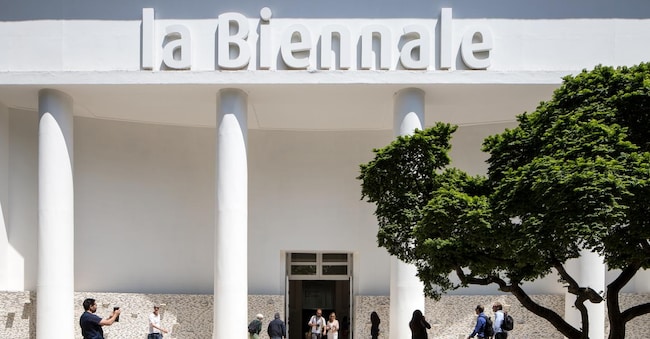
The event

Intelligences' at the heart of the Architecture Biennale 2025

Explained by Carlo Ratti and the president, Pietrangelo Buttafuoco, the concept of the 19th edition, which opens on 10 May (until 23 November)

4' min read

4' min read

Natural and artificial intelligence. Informal settlements and collective intelligence. Temporary spaces that may become permanent or inspire other projects around the world. But above all, architecture at the centre of the story, in dialogue with art, engineering, environmental and climate sciences, in an original research "to be carried out together, to bring new ideas into the built environment".

Carlo Ratti

This, in brief, is the proposal of Carlo Ratti, curator of the 19th International Architecture Exhibition (which will open in Venice from 10 May 2025 and close on 23 November) who, together with the president of the Foundation, Pietrangelo Buttafuoco, illustrated his project for the next Biennale. Now begins a year's work for Ratti, an architect and engineer by training, director of the Senseable City Lab at the Massachusetts Institute of Technology (MIT) and founding partner of Carlo Ratti Associati, appointed in December 2023 at the suggestion of the then president Roberto Cicutto with the current president Buttafuoco.

Loading...

Intelligence, intelligences. This term, in the plural, is the focus of Ratti's reflections, starting with the natural and then moving on to the artificial and the collective. "Everyone talks about intelligence, and it is important to explore the theme through those researches in which intelligence is embodied in something, in the physical component. That is why architecture comes into the picture.

Hence the title of the Architecture Biennale 2025: Intelligens. Natural. Artificial. Collective. The hashtag? #IntelliGens
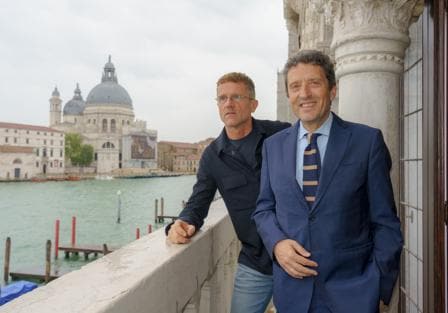
Pietrangelo Buttafuoco e Carlo Ratti

Ratti and President Buttafuoco repeatedly referred to Umberto Eco's concept of the 'Open Work'. "Space is not a where, but a how," the President of the Biennale recalled in his introduction, adding, "and it is like a function, a gait, an intensification of what is much more than a sign, a meaning. And again 'let us imagine what space has become today, in the flux of digital transition'. Buttafuoco anticipates Ratti's research by recalling his commitment to dealing with "future time, with a vision that transcends contemporaneity". And again, 'contemporaneity as a reservoir of memory, cultural matter that faces and confronts science'.

The Biennale 2025 will see Venice as the protagonist, both because the Italian Pavilion at the Giardini will be restored and Ratti has proposed to make Venice a living "laboratory" of experiences, in addition to the exhibition that will be set up at the Arsenale, and because "Venice is the natural intelligence of the lagoon that remains within its limits, of those works such as the Mose that keep it dry, it is synonymous with the collective intelligence of the peoples who have inhabited it". We start from Venice to enter into the broader exploration of the rest of the planet.

The second chapter will be dedicated to natural intelligence, to how our environment has been shaped over millions of years.
The third will focus on artificial intelligence 'which is bringing something new,' says the editor, 'but its evolution must be considered in harmony with natural intelligence. No less important will be the focus on what would happen if things got out of our control. On the basis of the data collected, we will study the different options, also looking from outside our Planet, to find solutions for the most urgent challenges'.

Care for sustainability

.

Ratti's focus on sustainability is reflected in his commitment to "making a 100% circular Biennial: everything that will be used will be recycled. We will really do a project where content and container are the same thing'. And Ratti from Venice announces an alliance with the Triennale in 2025, "both will be in the same year, there will be a synchrony, a dialogue".

In his account, Ratti mentioned two Biennales that were significant for him, the one led by Rem Koolhaas ten years ago, and the one by Alejandro Aravena in the following two years, which was particularly focused on the theme of the 'collective'. "The one on Fundamentals in 2014 was an important test with a strong synergy with national participations, free to express themselves, but in coordination with the theme of international curatorship. I hope that in 2025 too," says Ratti, "we can count on a thousand synchronised voices, to tackle the same issues together. The Biennale as a place for sharing ideas and solutions proposed by different countries'. The imagery is that of a sort of 'global tool box' with specific answers for the different cities, particularly in relation to the climate emergency and beyond.

Open to all ideas

.

Ratti promises a Biennale "open to everyone's ideas", a place where bottom up suggestions, proposals, spaces can come together. A Biennale that knows how to make the new generations fall in love with architecture: "many young people in Europe and America are pessimistic about the future, but enrolments in architecture faculties are decreasing. Architecture is part of the problem but it is also a solution, and the best way to deal with anxiety about the future is also to think about the design of architecture". An invitation from the Biennale to look at the project as an opportunity to transform the present, to make a contribution that can have "important impacts, beyond the event, a lasting legacy in cities, in universities and for the entire discipline".

Four methodological pillars: 'Transdisciplinarity', where architectural projects will promote collaborations between different professionals, with the aim, wherever possible, of advancing scientific knowledge. "Living Laboratory": as anticipated in 2025, the Central Pavilion at the Giardini will be undergoing renovation. It will therefore be replaced by a series of special projects capable of transforming portions of Venice and the external areas of the Biennale venues into Living Labs - living laboratories, where multiple forms of intelligence converge. "Gathering Ideas": adopting a collaborative approach to design is fundamental, all the more so in a time of crisis. On 7 May 2024, the Biennale's website opens a space for the collection of ideas to broaden the heterogeneity of voices, visions and suggestions. Finally, the 'Circularity Protocol': as anticipated, the Exhibition aims to achieve particularly ambitious circularity goals. Through the elaboration of a Circularity Manifesto, precise guidelines will be defined, outlining a new standard for future cultural events.

Copyright reserved ©
Loading...

Brand connect

Loading...

Newsletter RealEstate+

La newsletter premium dedicata al mondo del mercato immobiliare con inchieste esclusive, notizie, analisi ed approfondimenti

Abbonati