
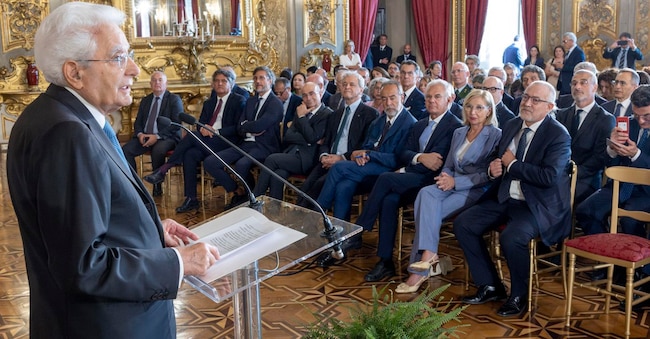
The speech of the President of the Republic at the Fan Ceremony
12' min read
12' min read
Palazzo del Quirinale, 30/07/2025 (II term).
Thank you President. You have proposed many important points, which should not be ignored.
And in renewing my greetings to all, I will try to collect them. Always on the basis that the questions are, dutifully and fully, free, as are the answers.
And above all, bearing in mind the duty not to exceed the limits of my powers and to respect the spheres of competence of the Government and Parliament, trying to develop - as is always desirable - an aptitude for reflection and exhortation.
Obviously - as you know - it is not my place to express - opinions on issues that are being debated in Parliament or on individual judicial investigations, but this limitation, which I meet out of institutional duty, does not detract from the importance of the issues you have highlighted.
You, just now, mentioned that the courteous custom of the Fan, of your gift, dates back to 1893.
A distant era, but I can't help but notice that, in international life, we are coming dangerously close to the standards of behaviour of that time.
Sometimes, at this time, I think of an element that, in the past decades - after the Second World War - helped to sustain peace on the world level and to facilitate development in the world: the aspiration of many states - large, medium and small - to be, rather than feared, as was the case in the past, admired for their system and way of life; and to be, consequently, listened to and followed.
Today, many protagonists of international life aspire to be feared rather than respected and admired.
This choice may, perhaps, produce some advantage in the immediate term, but it affects, largely undermines and perhaps wipes out, for the future, trust, prestige, authority; and, therefore, stable and effective influence in the international community.
The experiences that history clearly presents are ignored: authentic lessons, not to be forgotten; because the life of the world does not begin today and so much has already been seen in the past.
The many elements of novelty that mark this age of ours should lead to quite different choices.
Just think of how many challenges arise, new and global, that we all know from life experience.
Alarming and common enemies of humanity - from any country and any political regime - have arisen in recent years and must be countered and prevented with common, inevitably global instruments.
After the covid pandemic, the dangers of new pandemics, in a world that is ever more collected in life and ever more united in communications: an irreversible aspect, which requires common tools such as that, precious, of the WHO - the World Health Organisation - a fundamental point of reference for the safety of all and particularly indispensable for Africa.
Environmental catastrophes are becoming more and more frequent, with the dramatic consequences we have also suffered in Italy.
Economic activities of great social impact that are exercised outside any rule of law or market, because they have developed - and are increasingly expanding - outside any state, supranational, global order.
The increasing polarisation of wealth, with a very small number of people having immense assets, in the face not only of large pockets of poverty, but also of a tendency for the prospects of most societies and young people, in particular, of every nation to be progressively reduced, with serious, very serious, increases in social insecurity.
A widespread tendency to irreducible opposition, intolerance of opinions differing from one's own, refuge in superficial slogans, prejudices, among which anti-Semitism resurfaces, most seriously, which is also fuelled by stupidity.
Artificial Intelligence, a fascinating tool with an immensely positive scope in the field of health, which - like all new opportunities that science delivers to mankind - places the responsibility of positive and not perverse use in front of us, particularly since, for the first time, the intellectual sphere is involved.
The tendency, cultivated by many, to set aside the inalienable centrality of multilateralism. Also through the attempt to discredit and demolish the role of the UNO, its Bodies, its Agencies, hinging on the shortcomings and ineffectiveness of its action, conditions that, to a large extent, derive from limitations and privileges produced by the power selfishness of individual states, starting with the anti-historical right of veto.
Eighty years ago, in 1945, the United Nations Charter was adopted in San Francisco. Let us ask ourselves: would the world have been better off without the UN?
Faced with these phenomena - as we are always reminded by many - there are those in the international community who appear distracted, unaware. There are those who engage in wars of territorial conquest, in tests of strength, in the pursuit of domination over their neighbours.
As it was - precisely - 132 years ago.
There seems to be a widespread belief that history has begun to flow again after years of stagnation. I do not have this impression but, in any case, the right direction cannot be to go backwards, with the choice of a world always in perpetual conflict.
On the Middle East, it is even a foregone conclusion, unfortunately, to say that the situation in Gaza is becoming, day by day, dramatically more serious and intolerable; and we hope that the announced pauses will be matched by spaces of effective ceasefire.
Two months ago, on one of the most solemn occasions at the Quirinale - the meeting, for our National Day, with the ambassadors representing countries from all over the world in Italy - after recalling the horror of the barbaric attack by Hamas on 7 October two years ago, with so many victims among defenceless Israeli citizens and with the despicable kidnapping of hostages, still odiously detained, I stressed how unacceptable is the Israeli government's refusal to respect the norms of humanitarian law in Gaza, recalled a few days ago - precisely - by Leo XIV.
I added, at that meeting, that it is inhuman to starve an entire population, from children to the elderly, and that the abusive, violent occupation of territories attributed to the Palestinian National Authority in the West Bank is serious. I expressed alarm at the sowing of suffering and resentment that is taking place, which, besides being unfair, runs counter to any real need for security.
What happened in the weeks that followed is even more shocking. It seems as if the path of continuous war everywhere has been chosen, forgetting that war gives rise to new ranks of adversaries, new recruits of enemies, induced also by resentment, frustration, despair.
The incredible bombing of the Holy Family Parish in Gaza has been called a mistake.
For many centuries, from Seneca to St Augustine, we have been reminded that 'errare humanum est, perseverare diabolicum'.
Mistakes were also made in shooting at ambulances and killing doctors and nurses on their way to help the wounded at the most tragic places of the clash, in targeting and killing thirsty children in line for water, in killing so many hungry people in line for food, in destroying hospitals by killing even children hospitalised for malnutrition.
It is difficult, in such a chain, to see an involuntary repetition of mistakes and not to recognise the obstinacy to kill indiscriminately.
A condition depicted, in an emblematic manner, by the wounded child, taken in with his mother in an Italian hospital after losing his father and nine siblings - all children - in the bombing of his home.
Russia's aggressive posture in Ukraine continues, distressingly, a boulder on the prospects of the European continent and its youth.
I would like, also on this, to share some thoughts with you, recalling an episode that took place in this palace and that seems intensely significant to me.
In September 2021, these halls hosted the annual meeting between the EU presidents of republics without government tasks.
In the course of the discussions, the then President of Finland - Sauli Niinisto - informed those present that, as 2025 - this year - would be the 50th since the 1975 Helsinki Conference on Security and Cooperation in Europe, Finland would initiate a new conference to examine the state of cooperation on the Continent and define criteria for its development.
Underlying this announcement was the proud claim that Finland could once again play this role because it was neutral.
After five months, Finland determinedly applied to join NATO, of which it is now a member.
Because Russia's aggression against Ukraine changed the history of Europe.
That great country, which remains so despite the grave responsibilities its current leadership has taken on in the face of history, and on whose cooperation we had placed so much trust in the European Union, has increasingly taken on a disconcerting configuration of military power.
It is well known that the EU and NATO countries that, together with Russia, border the Baltic Sea harbour the serious concern, if not - as is being stated - the conviction that Russia, after its aggression against Ukraine, is cultivating the intention of other, new initiatives of aggression, to the detriment of their security or even the independence of some of them.
These changes - so profound and unexpected - have caused, among other consequences, an understandable disorientation in public opinion. Disorientation aggravated by a skilful and perverse work of spreading false news and false portrayals.
On the level of the reality of international relations, Russia's choice and posture have, rather than upset, obliterated the balance; a balance that guarantees peace and deters warlike adventures.
It is history - the teacher of life - that teaches that as long as we have not succeeded in eliminating temptations of domination over other peoples from international life (which, more or less, is tantamount to wanting to eliminate evil from humanity), it is balance that prevents the temptations of domination from being followed.
Assuming the Berlin Blockade of 1948 and the fall of the Berlin Wall in 1989 as starting and ending points - interestingly, we go from one event to the other in the same city - for a few decades we lived - even in the Cuban crisis of 1962 - in a state of peace or, if you like, absence of war on a global scale, due to the nuclear balance between the two opposing great blocs.
Subsequently, for a good number of years, we have lived in the balance determined by the reassuring prospect of extensive nuclear disarmament: from the arsenal reduction agreements, which were actually implemented, to the non-proliferation agreements, to the decision to set up, in Europe - with the participation of Russia among others - a body for shared continental security, the OSCE.
A balance, this, finally positive, achieved at least between what had been the opposing world poles after World War II.
As of 2022, this balance - already weakened by some backtracking on commitments - is no longer there.
There is an urgent need to restore it. Not to cultivate prospects and dangers of war but, on the contrary, to preserve peace.
Hence the need for adequate defence capabilities of the countries gathered in the European Union, so that it can truly play the role to which it is called: to be an actress of security and promoter of peace.
Corresponding to this is the urgent need for the construction of a common foreign and defence policy. Common foreign and defence policy also for the purpose of making the sovereignty of its member states effective and not illusory, sharing aspects of a supranational dimension.
In full connection and harmony with the Atlantic Alliance, an alliance of free peoples, a guarantee of stability and peace for decades, whose steadfastness - to answer your question - is superior to any moment of divergence or confrontation of opinions within it.
The European Union, however, is not limiting itself to this necessary work of strengthening security.
One valuable ongoing action is sometimes overlooked: the number and extent of trade and free trade agreements with many, large parts of the various continents.
From Canada with the Ceta to Latin America with Mercosur, from Japan to the negotiations begun with India and other major areas, a network of economic and commercial collaborations is being set up that produces common interests, shared perspectives and, in this way, presides over peace: a model - which includes the fundamental rapprochement with the United Kingdom - alternative to that of economic confrontation that risks, on the contrary, producing other, rougher and more dangerous forms of confrontation.
A model that draws inspiration and strength from what happened on our continent, having made market collaboration the basis for achieving peace and prosperity.
With regard to the relationship between politics and justice, I can only refer to the image - used ten years ago - of institutions that do not perceive themselves as opposing fortresses, with the aim of conquering space in the territory of others, but as parts of a system - designed by the Constitution - in which one respects one's own limits, because one has a duty to do so and because in this respect lies the true guarantee of protection of one's own spheres of attribution.
From Montesquieu's 'L'Esprit de lois' there is an awareness, translated into democratic constitutions, of how freedom and equality are guaranteed in the distribution of the various functions of power between institutions and the decisive importance of checks and balances.
You, President, have drawn attention to the most pressing issues concerning information and the condition of journalists, information professionals.
Last year, on this same occasion, we had the opportunity to dwell extensively on some particularly relevant issues. I will not repeat those considerations - of which I would point out the increased urgency - but will limit myself to emphasising once again the delicate role that free and independent information plays in the health of our democracy and in the construction of an international order not bent to power interests.
The progressive attainment of freedom of opinion, won by the French and American revolutions, was expressed through the 19th century gazettes that spread visions and ideas among literate citizens that were confronted in debate and also in political struggle. There was no requirement that the proclamations conveyed correspond to recognised truths, being, precisely, opinions.
Over time, a new need arose, a further freedom came into being. In addition to the right to express oneself, the right to information, the right to be informed and the value of a free and independent press that offered citizens the representation of facts and not their narration subordinated to specific interests was affirmed.
This is the vital function of journalism as a 'watchdog' against the temptations of the excesses of power, recognised by the European Court of Justice itself.
Thus was born the ethics of journalism, enshrined in the law establishing the Professional Order, which demands that information workers respect the truth of facts. Freedom of opinion and authenticity of facts are not the same thing. In other words, freedom of opinion does not alter factual truth, that is, it cannot be a motive for lies, nor can it create something that can only imaginatively be called alternative truth.
Freedom to lie is not among those that can be claimed. Facts are not bendable to opinion, they possess an unconquerable force.
Pluralism of opinion - a fundamental value - is not a substitute for free and independent information.
Hence the special responsibility borne by editors and journalists, actors in the delicate process of conscious citizen participation, of guaranteeing the common space of democracy.
It is no coincidence that, in nations where the freedom of citizens does not prevail, forms of control and manipulation of public opinion are notoriously present.
The measures that, in Italy as in the European Union, are being taken to ensure that journalism can fulfil its function as a witness to reality and its guardian, correspond to the aim of affirming the principle of equal rights among all people, while also avoiding the risk of a new form of class discrimination between citizens who have access to self-styled free forms of information and citizens who can access paid media.
I said journalism as witnessing facts.
In this respect, you wanted to mention the situation in Gaza where there is an attempt to obscure the reality at hand. Preventing journalists from doing their job is unforgivable. The journalists killed in this and other wars are martyrs to the cause of freedom of information.
The importance of the rules that, in a democracy, in the rule of law, protect the freedom of each individual, also creating institutions for this purpose in the field of information, is therefore self-evident.
The European regulation on media freedom will enter into force on 8 August - in a few days - and, from then on, its rules will be applicable: they will cover - among other things - the issues of editorial independence, the content of large digital platforms, and the independent operation of public service media.
The latter is an even more sensitive issue, and points to the absolute necessity that the guarantees provided by the legislation be implemented and not circumvented.
The picture offered in the Parliamentary Commission for General Addressing and Supervision of Radio and Television Services on the subject of the appointment of the RAI President is discouraging. Freedom lives from the functioning of institutions, not from their paralysis.
The function of digital platforms, which are not mere containers but complex environments that influence and shape social, economic, and cultural interactions, has also been included in a landscape that is not easy in itself.
The imposition of Algorithmics - and an unscrupulous use of artificial intelligence - creates hegemonies that deny pluralism, organising network content in such a way as to force users into obligatory channels, acting as a hidden mediator, of unknown characteristics and purposes, with distorting characteristics, far removed from those of freedom and pluralism of information.
Thus, the Internet, from its mission of freedom of expression and dissemination by anyone, is converted into a place of organisation and raids for the propagators of the most incredible fake news.
The world of information is undergoing a whirlwind transformation. A transition must be planned that safeguards the function of independent information - and thus of journalists who, in turn, avoid the temptation of self-censorship - while recognising and making its function in democratic life operative.
President, dear guests - all of whom are welcome - at the conclusion of this dialogue on the basis of the solicitations of the President of the Association, I would like to thank you for this beautiful fan, expressing appreciation to the Academy of Fine Arts of Naples and great compliments to Emilia Fimiani for 'Oltremare-Oltrecielo'. In its charm, this fan collects and expresses the best aspirations of our era.
Thank you all, with best wishes for a happy holiday!
Brand connect

