
The Italic art of circumventing the truth
The exhibition "Tragicomica: Perspectives on Italian Art from the Second Twentieth Century" is at the Maxxi until 20 September
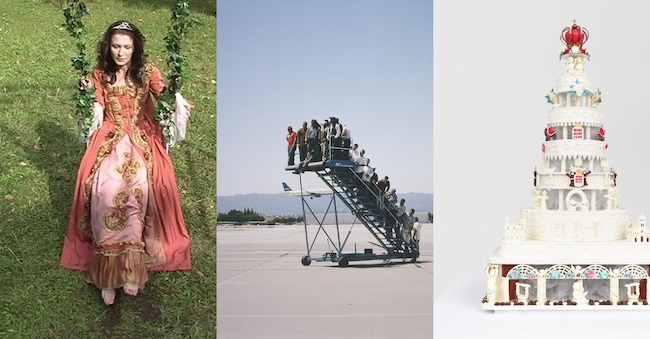
In the Italian tradition, the tragicomic is not a simple stylistic register but a true posture of the gaze, a way of crossing experience that prefers deviation to emphasis and cracks to completeness. From the Divine Comedy - which already in its title rejects the irreparable fall of tragedy in order to move towards a more prosperous outcome - up to the twentieth-century declinations, one recognises a constant reluctance to absolute solemnity, replaced by a form of intelligence capable of accepting the drama without handing it over entirely. As Giorgio Agamben has observed, it is 'an anti-tragic intention that runs through national culture as a continuous low, rather than as a declared category' (Categorie italiane, 1996).
Museo MAXXI in Rome
It is against this background that Tragicomica, the exhibition set up at the MAXXI Museum in Rome and curated by Andrea Bellini and Francesco Stocchi, is set. The ambition is not to establish a canon, but rather to articulate a constellation, a set of works and positions that, juxtaposed by resonance rather than by chronological succession, restore the discontinuous texture of Italian art from the post-World War II period to the present. What emerges is a lateral narrative, refractory to linear arrangements, in which the comic does not attenuate the tragic but dislocates it, exposing it to a less frontal light.
The incipit, entrusted to Lucio Fontana, is in this respect exemplary. The double utterance - "I am a saint" and "I am a carrion" - introduces a dissonance that seems to propagate throughout. There is no synthesis, but cohabitation of contraries, according to a logic that suspends any claim to univocal coherence.
There is an ideal proximity to Friedrich Nietzsche's insight: 'We have the art not to perish because of the truth'. Here, however, truth is neither denied nor sublimated, but circumvented, touched upon indirectly, as if only a gap could make it habitable.
It is not surprising then that figures such as Piero Manzoni or Maurizio Cattelan emerge as central nodes. In the former, Merda d'artista continues to function as a semantic slippage device, capable of destabilising any hierarchy of value. In the second, works such as La Nona ora or Novecento insist on a suspended theatricality where irreverence is accompanied by a melancholic vein, almost as if to signal the impossibility of a definitive break.

