Japan 'bridge' to Asia

The Italian Pavilion, an international showcase for 'Made in Italy' food

Italian agri-food exports to Japan, +9.9% between 2023 and 2024, with a value exceeding one billion euro

by Vincenzo Miglietta and Nicola Filippone

7' min read

Key points

  • Centrality of the entire agritech sector in rethinking the societies of the future
  • Primo Market trends and opportunities for Italian wine in Asia

7' min read

Italian exports to Japan, just to limit ourselves to so-called food & beverage, exceeded one billion euros in 2024 (Istat data). 773 million in food products, 218 in beverages, 34 million from agriculture, fishing and forestry. Ambassadors of Made in Italy in Japan are wine, extra virgin olive oil, preserved tomatoes, fresh cheeses. Hence the importance of the Italian Pavilion at Expo Osaka 2025; a showcase of excellence to strengthen the image of our country and make Japan a 'bridge' for launching the entire Asian basin, especially in the face of an international situation that sees the unknown of the US market due to tariffs. "Japan is a friendly country that appreciates our products, our lifestyle and our cuisine," said the Minister of Agriculture, Food Sovereignty and Forestry, Francesco Lollobrigida, in Osaka for the thematic week dedicated to food and agriculture at the Italian Pavilion during his visit to the Expo. "We are proud to be able to showcase the excellence that makes the Italian agri-food system great and the cutting-edge tools developed by our Agritech sector," says Lollobrigida. "With this exhibition more and more people will have the opportunity to learn how Italy works and this means giving our economy the opportunity to consolidate old markets and open up new ones.

But what can we do to increase our export share? 'We,' explains Lollobrigida, 'have a deep connection between what we do and the history of the place where we do it. Italy is the nation of differences, despite being small, it has a very special production that on the one hand is an element of strength, because we have so much to offer in any sector. On the other it can be an element of weakness, given the parcelling out of companies and the difficulty of making an impact on large markets. This is where the work of the agencies and the government comes in, in trying to organise the association system, the business system, and to arrive all together. The Italian Pavilion here at the Expo is just the demonstration, you manage to show from the works of Leonardo to Caravaggio to exceptional sculptures, to wonderful paintings, to our current technologies that the world envies us all together and you manage, through this, to achieve an exponential promotion that then gives returns, because those who really see and breathe what Made in Italy is, then cannot do without it and this means creating wealth and market'. The Minister then highlighted the figures for Italian agri-food exports to Japan, which are expected to grow by +9.9% between 2023 and 2024, with a value exceeding one billion euros.

Loading...

The centrality of the entire agritech sector, in rethinking the societies of the future, a key theme of the Osaka Expo, saw the inauguration, with the presence of the Minister, of a series of organic vegetable gardens: a temporary installation capable of drawing attention to the issues of food and sustainability, in a fun and immediate way.

Another key moment was the work of the first Market trends and opportunities for Italian wine in Asia, a round table dedicated to exports in the wine sector, organised by the Ministry in collaboration with ICE, which saw the speeches, after introductory greetings by the Commissioner General for Italy at Expo 2025 Osaka, Mario Vattani, and Minister Francesco Lollobrigida, of Matteo Zoppas, President of ICE, Federico Bricolo, President of Veronafiere; Massimiliano Giansanti, President of Confagricoltura; Luigi Scordamaglia, CEO of Filiera Italia and Director of Markets and International Policies Coldiretti; Lamberto Frescobaldi, President of Unione Italiana Vini (UIV) and Marzia Varvaglione, President of Comité Européen des Enterprises Vin (CEEV).
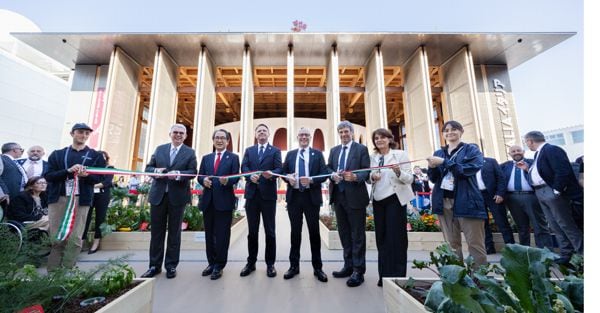
al centro il Ministro dell'Agricoltura Francesco Lollobrigida

Protagonist of the works is the Asian market, which with its 9.4 billion dollars of consumer value is a great opportunity for Italian wine exporters: according to a recent analysis by the Uiv-Vinitaly Observatory, exports will return to growth with a +16% forecast up to 2028 after the drop in recent years due to the contraction of consumption in China. "With the institutional visit of Minister Francesco Lollobrigida we inaugurate an important week, not only for Expo, but for the future of our societies," stressed the Commissioner General for Italy at Expo 2025 Osaka, Amb. Mario Vattani. "The presence and synergic work of important partners such as ICE, Veronafiere, Confagricoltura, Filiera Italia, Federvini, Unione Italiana Vini and CEEV increases the systemic value of a mission that sees the Italian Pavilion as an instrument of growth diplomacy at the service of the internationalisation of our Italian companies."

Il Commissario Generale per l’Italia ad Expo 2025 Osaka, Amb. Mario Vattani

"We want to confirm the important value of Italian agribusiness," said the President of ICE, Matteo Zoppas, "we must help entrepreneurs, large, small and medium enterprises, in their process of internationalisation. Tradition, history, art, but also values, principles and traditions are the cornerstones of Made in Italy that we are also expressing within this Italian Pavilion. Minister Francesco Lollobrigida has indicated a clear trajectory: to bring Italian agrifood exports to 100 billion euros. This is an achievable goal, because the Italian agri-food industry is recording solid and constant growth performances. This is demonstrated by the figures for our wine: in 2024 the sector reached 8.1 billion euros (+5.5% on 2023) and in the first two months of 2025 wine exports reached 1.2 billion euros, up 3.6% on the same period in 2024. East Asia represents a strategic market: Italian wine exports in 2024 touched EUR 434 million. Moreover, in 2024 we exported 5.6 billion euros of agri-food products to Asia, an increase of 7.5% compared to 2023 and 41.6% compared to 2019. Numbers that tell of a market with high potential, but we need to continue to invest in promotion and the removal of technical obstacles, such as non-tariff barriers and certifications. ICE is committed to this front, working in synergy with the network of embassies and the Sistema Paese (also made up of SACE, Simest, and Cdp) that operate under the aegis of the growth diplomacy promoted by the Ministry of Foreign Affairs, in liaison with the Ministry of Agriculture. Italian wine, like all agri-food products, is no longer confined to the ethnic channel. It is increasingly entering local cuisines, even in Asia. It is appreciated for its quality, for its cultural value, for the identity it represents. And this makes us even stronger in global competition. Today we have worked on the development of the wine sector by creating a meeting between Asian and Japanese companies and importers in the Expo setting, where supply and demand met and courted each other'.

"After taking part in the 2015 Universal Exhibition in Milan with the Wine Pavilion, Veronafiere with Vinitaly is once again in the front row at the Expo in Japan to strengthen the presence of our wine-growing system on international markets. Vinitaly is a real brand-flag for Italian wine promotion. With a masterclass and forum organised in Osaka together with Ice-Agency, it confirms its commitment with institutions and companies to enhance the wine product as an ambassador of our culture, territory and unique lifestyle in the world," said Federico Bricolo, President of VeronaFiere.

"Asia represents a mosaic of markets that are extremely diverse in terms of culture, economy, and regulations: a complex challenge but also an enormous opportunity for Italian wine," says Massimiliano Giansanti, President of Confagricoltura. "Our producers can count on globally recognised strengths: excellent quality, wide variety, and a strong territorial identity. In order to successfully tackle these commercial outlets, it is essential to 'work as a system': we need increasingly close collaboration between companies, institutions and consortia, with the aim of promoting a coordinated image and structuring an integrated organisation capable of cutting costs and facilitating widespread penetration. Japan, China and South Korea, more mature markets, alone absorb almost 300 million euros of Italian wine, or about two thirds of the entire export to Asia. There is room to grow within this triangle and to broaden horizons towards India, Vietnam, Hong Kong and Singapore' .

"This is a prepared market, ready to understand and appreciate wine as an expression of Made in Italy, but not only wine, also territory, culture, lifestyle and tradition. Japanese consumers are very attentive and particularly demanding, as they look for labels that are sustainable, have a low environmental impact and are authentically rich in history. This applies to wine as well as to all Italian food products. With particular attention to the quality of ingredients and respect for the product (just think of the art of cutting), Japan is one of the countries in the world most capable of understanding the added value of our agri-food sector and appreciating it for what it is really worth. Expo Osaka is a unique opportunity to present our excellence between tradition and innovation to the rest of the world in an extraordinary Italian pavilion that is one of the most visited of all," says Luigi Scordamaglia, AD Filiera Italia and director of markets and international policies Coldiretti..

"Having said that the American market is not replaceable, the fluidity and uncertainty of the current context, as well as the possibility of the introduction of tariffs on Italian wine, have set off an alarm bell that we can no longer ignore. The sector must become aware of the need to broaden its range of action, diversifying its exports towards new destinations. The Asian market, in this regard, may become the most strategic outlet for the commercial future of our companies. In order to effectively penetrate these countries, a twofold effort will therefore be needed: at the entrepreneurial level, to find the right cultural, communication and distribution channels, and at the political-institutional level to ensure the removal of barriers to trade also through free trade agreements," said Lamberto Frescobaldi, President Italian Wine Union (UIV).

'In celebrating the opening of the Osaka Expo, it is important to remember even today the fundamental role that wine continues to play, uniting people from different cultures and continents. Wine is much more than just a beverage, it is a symbol of our heritage and culture, a tool that has given value to so many territories and, moreover, a natural companion to gastronomy, both traditional and contemporary,' commented Marzia Varvaglione, President of the Comité Européen des Enterprises Vins (CEEV). 'For centuries it has represented an indissoluble and privileged link with the territory it belongs to, as well as an ambassador and expression of the territory itself.

Copyright reserved ©
Loading...

Brand connect

Loading...

Newsletter

Notizie e approfondimenti sugli avvenimenti politici, economici e finanziari.

Iscriviti