
The Journeys of Hercules: Threads that Bind the Mediterranean
Giovanni Brizzi proposes a voyage from Tyre, across the ocean, to Crotone, following in the footsteps of Heracles/Melqart, to whom Alexander the Great and Hannibal looked up

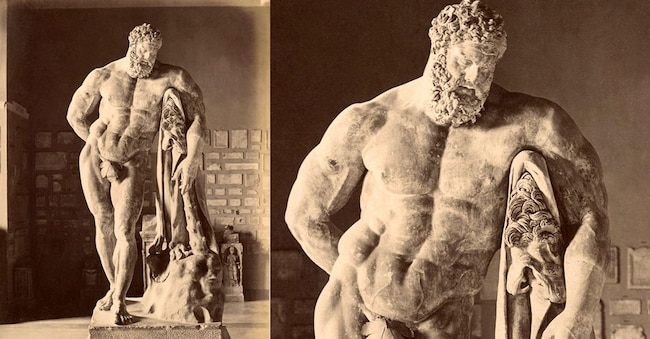
The Mediterranean is a tapestry of gods, myths and ships, weaving together cultural threads and fascinating connections. Within that web of intertwining languages, trade and religions lies the story of Heracles/Melqart, which Giovanni Brizzi, professor emeritus at the Alma Mater Studiorum in Bologna, reconstructs with care and curiosity in *i* *Le vie di Ercole* , a rich and thought-provoking book, itself a synthesis of decades of research and questions: ‘The paths of Heracles/Melqart are routes, or rather ideal journeys; and, all of them, are on the one hand vectors of a symbolic civilisation, and on the other, channels of mutual recognition between different cultures. In my view, they have a great heart; indeed, they are not only the heart, but the very veins of a world.”
Heracles, son of Alcmene, is a figure born of the literature of Hellas, and thus of the West: he is a formidable warrior, arrogant and violent, to the point of defying the gods. He is also a tireless traveller, journeying from Spain to India, and, according to Pisander of Rhodes, he is the ‘most righteous of slayers’, capable of vanquishing monsters, purifying the land and becoming the leader of the Greek colonial movement: he is the ‘héros culturel’, a dual soul born of the synergy between menos, the fury of the lion, and metis, the cunning of the fox. Perhaps – writes Brizzi – ‘before him, Melqart, his Phoenician twin and predecessor, had already made his mark; Herodotus discovered him in Egypt and then in Tyre, and he would become increasingly identified with the Greek hero, perhaps having already embarked as the most illustrious of the passengers on the ships of Hiram of Tyre, a contemporary of Solomon, which set sail in search of metals and precious goods towards Ophir and the Horn of Africa, and towards Tarshish/Tartessos, the indigenous kingdom in southern Spain’. Thus, the journey on which the scholar takes us is a gripping voyage around the Mediterranean, in which he weaves together literary sources, archaeological findings and compelling working hypotheses. Memphis, on the Nile Delta, where Heracles’ presence is confirmed, marks the start of the journey, before reaching Tyre where Herodotus encounters the Phoenician Melqart: both are god and man, experiencing life and death, and founding cities. The route then takes us to Cyprus and Carthage, and on to the edge of the Sahara, to Lixus by the ocean, and to the Pillars of Hercules, the ‘gates of the evening’.
Heracles/Melqart arrives in Spain, in Cádiz, crosses the Pyrenees and the Alps, and Hannibal, who is waging war against Rome, finds it easy to identify with the god, undertaking, from Cádiz towards Italia, a sort of bloody pilgrimage dedicated to the god. According to Livy, he reaches ‘ad portam Collinam, usque ad Herculis templum’ (Heracles, welcomed to Rome during the lectisternium and having become Hercules, had already become the object of a state cult by 312 BC), but Rome is not conquered. And the commander took refuge in Croton, at the temple of Hera at the Lacinium, where he encountered Pythagoreanism, of which Heracles is a symbol. Just as he had been, earlier, for Alexander the Great: the infinite paths of Hercules almost trace out a heart, that of our civilisation, the one from which we all come. The Sea is truly nostrum.
Giovanni Brizzi, The Life of Hercules, il Mulino, 200 pages, €15


