
The land of the Kurds is their identity
Danilo De Marco has depicted life in two villages: these nomadic herders and farmers have no homeland, but their language and culture are their homeland

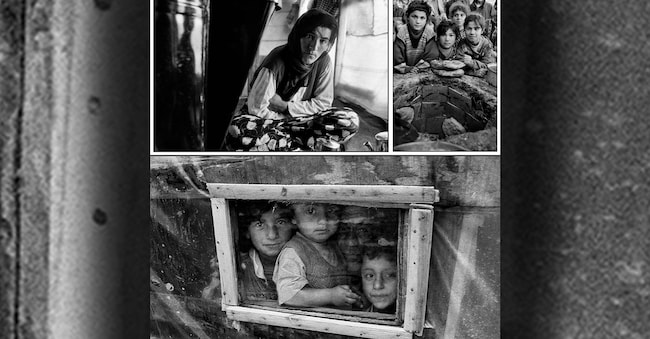
In Turkey, the term ‘Kurdistan’ is not recognised and it is forbidden to use it. The inhabitants of Anatolia are referred to as ‘mountain Turks’ and, on maps, their land is hidden behind the shadow of a single K. This is the very letter that photographer Danilo De Marco chose for the title of his new, remarkable work *i* *Interno K*. A Kurdish Story , a book of photographs and essays of great value that do justice to a people of almost 40 million – the Kurds, in fact – scattered since the 20th century across Turkey, Iran, Iraq, Syria and Armenia, as well as having migrated across the globe, all whilst the West looked on with distracted or averted eyes. And, with the war against Iran unleashed at the end of February by Donald Trump, the Kurds find themselves even more in the eye of the storm. A diaspora that has gone largely unnoticed on Europe’s doorstep, and which seems to have no end in sight.
A people without a homeland, who found it in the strength of their identity, of their language – which is always a mother – and of standing on the front line to save themselves. Always on the run from someone, from threats, from arrests, from injustices, yet bound together by resistance and memory, shaped by bards and poets. And in 1998, Danilo De Marco travelled for a month from Istanbul, reaching almost as far as the Syrian border, beyond Mardin, and then on to Keşan, on the opposite side of Turkey, close to Greece. Thanks to the presence of Fadime Deli, a researcher at the Sorbonne, he passed through dilapidated villages of tent-homes, entered the lives of these men, women and children, and listened quietly from the sidelines, with respect and discretion. He took around thirty 36-exposure rolls, that is, a thousand photographs: ‘Many are repetitions, almost identical; I’d take a shot to the left or spot another situation, and I’d take another shot whilst moving: many of these shots serve as a way of getting closer; they’re test shots to understand, to see better. Out of the total number of shots, perhaps a hundred good ones remain.” A truly engagé work, just like De Marco himself, which was exhibited last spring at the Sorbonne in Paris and has now taken the form of a book: photography is politics, it is a form of denunciation, it is an archive of suffering and hope. Certain transparencies, in the half-light of the tents, become solid, tangible, and these eyes that pierce the lens reach our own and ask us: ‘But do you know how we live?’ On the run from it all. Kamil, aged 52, used to own more than 350 goats, but the Turks burnt everything and killed the goats. So, to survive, all that’s left is to move from place to place and look for new work. Families hire a large lorry and set off. The children, who are often ill and without medicine, cannot go to school; and for them, it is better this way because, in Turkish schools, they are first forced to speak only Turkish and then told that there is only one nationality: the Turkish one. Many men have spent years and years in prison on charges of having joined the PKK, the Kurdistan Workers’ Party. Women are the glue that holds these nomadic lives together, as they are the heirs to the Kurdish female fighters in Syria who played a crucial role against ISIS and are now free from the shackles of patriarchy, even though they fear a return to Islamic Sharia law.
From the dim light behind the curtains – so unhealthy – faces emerge like rocks of pride and dignity, and, as Arturo Carlo Quintavalle writes, ‘Danilo’s photographs are always constructed with rigorous geometry; the disorder of the tents, the randomness of the figures, their peering out or drawing close to one another, even their overlapping within the space, are always organised by correspondences, connections, balances and precise relationships. It is order imposed upon disorder’, lending further strength to the faces, and to the eyes above all. The close-ups invent dialogues between incomprehensible languages; they possess the solidity of facts and of the quest for justice and freedom. Because, as Ebru Günay, a Kurdish lawyer and activist, writes in one of the book’s most moving essays: ‘Photographs do not merely depict poverty; they also reveal the isolation of an entire people and convey even more: when one loses everything, one need not lose oneself entirely. Even when a people are driven from their homes, they can preserve their memory, their language, their mourning rites, the sharing of bread and the strength to remain united. This book speaks of that fragile yet indomitable dignity.’ A dignity rooted in a millennia-old culture, made up of nomadic herders and farmers who lived in harmony with nature and continued to sing of joys and sorrows, just as their ancestors had done since time immemorial. There was oral poetry and lullabies, the elegies of women and the soaring song of Melayê Djezir (1570–1640), the Dante of the Kurds, who introduces himself thus: ‘I am the rose of Eden in the principality of Botan / I am the torch of Kurdistan’s nights’. And that light reaches out to us and reminds us, through De Marco’s photographs, that not forgetting is not a neutral stance; it is the very foundation of justice and democracy.
Interno K. A Kurdish Story, edited by Danilo De Marco, Forum, 148 pp., €18


