
The lady does better in the theatre than on TV. The Ortombina era begins

The new pays off, the new wins at La Scala, confirming the auspices of the eve: Dimitrij Šostakovič's "Lady Macbeth of the District of Mcensk" delivers one of the most tense and involved December 7ths, where the clangorous and shouting pit demanded by Riccardo Chailly, easy to grip and liked by many, is mirrored in a company that, on the contrary, holds the bar of acting steady. The highlight is the leading lady, Sara Jacubiak, a young soprano with Polish roots and American schooling, whose voice has been kissed by the gods for power, modern class and adamantine intonation. Humble roots, great soul. What an acquisition for Milan. She and the director, Vasily Barkhatov, the two debutantes. He, 43, is the youngest at the helm of the latest Ambrosian openings. Not a dull moment, not one of boredom. His ingredients, there they are: lots of theatre, lots of irony, a pinch of circus in the funny tricks of the ghosts and above all those two flaming human torches in the final scene. Frightening. Both for Alberto Malazzi's chorus, marvellous in their stone whispers, so Russian, and for the whole room, which literally feels the terrifying blaze of the flame on it for a few moments. And then the stench of the hastily fired fire gases. A political gesture to close this work, so far grotesque, so far fiction. A memory against every dictatorship.
But if the new wins in the theatre, and pays off with the record reached in ticket sales for the "première", which reached the astronomical figure of 2,679 thousand euro, it loses on TV: the live broadcast of "Lady Macbeth" on Rai1 has the lowest audience ratings recorded in the last ten years, 1.11 million. Tosca" had involved 2.8 million, almost three times as many. There it was played easy, everything was designed for television, starting with the direction, with her ascending to the sky, which only in the filming could be seen as an upside-down dive. We, the audience, had only seen a stand-in for Anna Netrebko hanging by a thread and lifted into the air, without understanding anything. And so the open question on the media 7 December that the whole world watches - it's true! - remains this: whether to create an object, the umpteenth, for the flat screen, or whether to dig in, to gamble, to go ahead believing in the present strength of theatre. And if it is right and proper to divulge that rare object that is opera (not even so much, given the avalanche from the East) by bringing it on TV and hoping for proselytes, the final objective must remain the conquest of the public for the pleasure of the theatre. Where theatre is born new, every night.
And where, therefore, it is already compulsory to look ahead: as of this 7 December, the season of Fortunato Ortombina, superintendent appointed after Dominique Meyer at the helm of La Scala, has officially begun. Both were present at this 'Lady'. Indeed, not only them but also Meyer's predecessor, Alexander Pereira. Three popes in the hall. The two former ones in the stalls, in the middle of the audience, while the new one towered well up from the proscenium stage, first order, to the left. Since before the revolutions of the transalpine superintendents, with Stéphane Lissner at the head, in 2004, the seats assigned to the theatre's top management had stood in that turret. Clearly visible, because on the one hand perpetually exposed to the gaze of the public, but on the other hand in constant control of the pit and stage. Ancients. Among them, there were those who still preferred them (perhaps even taking a few naps in full view) and those who declined them, opting for the central row of VIPs, in the stalls.
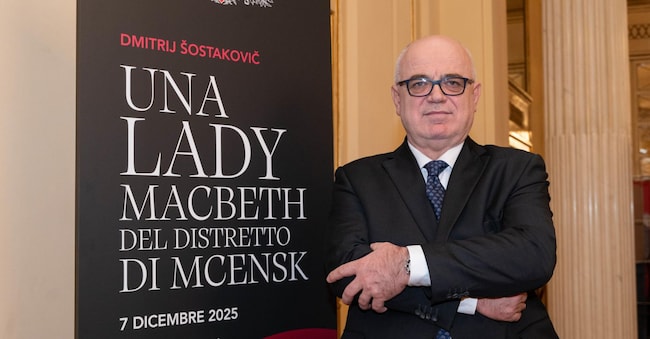
Throughout the performance of Šostakovič's opera, Ortombina never took his eyes and attention away from the orchestra for a moment. Arms folded, leaning forward, listening. At La Fenice, he could always be seen, unfailingly at every performance and rehearsal, standing at the back of the auditorium. The whole theatre knew it, sensed his presence. At La Scala, this new and targeted attention to the professors sitting at their music stands appears to be a gesture aimed at the sensitive heart of the theatre. It is in need of directors who will take care of it, making the team grow, restoring its polish and competitiveness in the world. We already know the titles of the next two 7 December: 'Otello' for next year, directed by Damiano Michieletto, and then 'Un ballo in maschera', where the tenor hunt is on. Both will be directed by Chung. His, by the way, was the memorable La Scala premiere of 'Lady Macbeth' in 1992. Verdi remains a guarantee: the numbers on TV will go up. The door to the new remains open.

