
The Lucerne that Wagner fell in love with
Between light, peace and musical notes, a trip to the house museum of the creator of the total work

3' min read
3' min read
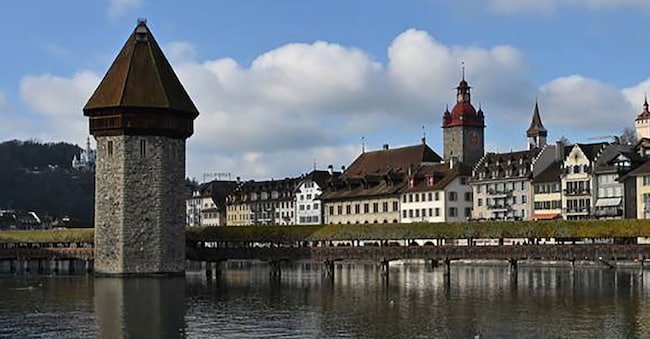
There is something mysterious and seductive about Lucerne, now more than ever a destination for international tourists, especially from the East. Its peace, its powerful and unspectacular beauty had already attracted illustrious artists such as Richard Wagner who, after staying there, wrote 'Silence and peace around me, wherever I go I am surrounded by a veritable wonderland: I know of no more beautiful place'.
Impetuous and perpetually on the run, the German composer loved the land of lakes and mountains; he had discovered it in 1849 when he moved to Zurich with his friend Franz Liszt, who was on the run for taking part in the liberal uprisings; he left the city quickly after falling in love with Mathilde Wesendonck, the wife of his major patron. A scandal that forced him to wander for a few years before settling in Munich, where the conductor Hans von Bülow resided with his young wife Cosima Liszt, Franz's daughter. It is 1863, Wagner is already in his fifties and, despite his friendship with von Bulow, he cannot resist Cosima's charms. It was to be an intense and profound love affair from which Isolde was born in 1865, Eva in 1867 and Siegfried in 1869; to protect his affections, his music Wagner with Cosima and his children hid in Lucerne.
Wagner's Refuge
In the Villa of Tribschen, the artist stayed with Cosima Liszt-von Bulow from 1866 to 1872; it is a white, two-storey residence with a red-tiled roof and is situated on the top of a hill overlooking Mount Pilatus not far from the lakeshore. Since 1933, Villa di Tribschen has become the Richard Wagner Museum, a must for visitors, not only for music lovers. In the park, a plaque commemorates the great concert that Arturo Toscanini conducted in 1938 to honour the composer. In the building, Wagner finished his opera 'Die Meistersinger von Nürnberg', continued to compose 'Ring der Nibelungen'; he completed 'Siegfried' and went on to compose 'Götterdämmerung'; he also wrote the 'Wahlspruch für die Feuerwehr' for the fire brigade and, on the occasion of the founding of the German Empire in 187, the 'Kaisermarsch', the imperial march. The museum tour reconstructs the life of the German composer, poet, theatre director, conductor and essayist.
Travelling through its history
.In the 'Meistersinger Stube', the singers' room, Wagner set up his library/study where he worked on several operas; several scores are on display, along with writings from the Tribschen years; among them also his autobiography entitled 'Mein Leben' my life, which he dictated to Cosima. The visit to the museum house is accompanied by a documented and rigorous audio guide that recounts Wagner's existence, his political, musical and theatrical choices, and his relationship with Ludwig II, the young ruler who had just ascended the throne of Bavaria at the age of 18. The musician's existence is clearly analysed through the analysis of Wagner's anti-Semitism. Through the audio guide, one can listen to various Wagnerian pieces that place the composition at that precise moment in life and history. In the centre of one room is a portrait of Ludwig II, the most illustrious guest who stayed at Tribschen. Wagner could not fail to be grateful to him: the sovereign not only paid the rent for the villa, including servants, but also took charge of the external and internal alterations the composer had requested, including fine furnishings and fabrics. In the centre of the salon is his Erard piano, whose pure sound can be heard through headphones; on the instrument, the composer had the names of Siegfred and Tristan engraved. Wagner was enthusiastic: "The joy of playing this instrument, only the performer can experience." Wagner took the Erard to Venice, Paris, Biebrich, Vienna, in 1864 he was forced to sell it to pay his debts but bought it back ten years later. now it is where the Maestro wanted it.
Richard-Wagner-Weg 27, 6005 Luzern (CH)

