
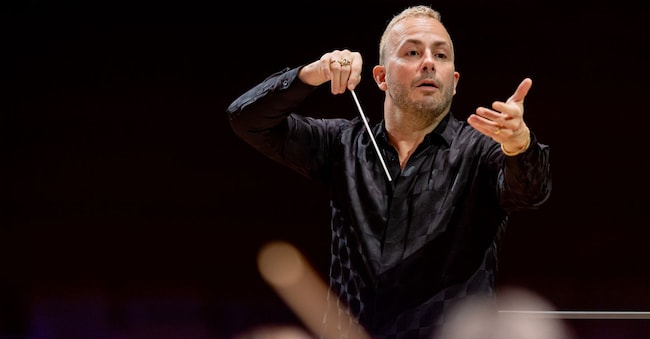
The greatest energy generator on the podium: Yannick Nézet-Séguin
At 50, he is one of the most celebrated conductors. He possesses the X-factor that will revolutionise classical music: making pure joy resonate.

5' min read
5' min read
When asked which aria best describes him, he cites two, Vissi d'arte, vissi d'amore from Puccini's Tosca and Glitter and be gay from Leonard Bernstein's Candide. "They are two aspects of my personality," he says. "The joy of living happily and, at the same time, the awareness of facing dramatic moments, in which art and music are more important than ever." Yannick Nézet-Séguin is one of the most celebrated conductors. He is 50 years old and conducts the Metropolitan Opera in New York, the Philadelphia Orchestra and the Orchestre Métropolitain de Montréal. He tours the world acclaimed by the most important musical institutions; he will conduct, after Riccardo Muti in 2025, the next New Year's Concert at the Vienna Musikverein, leading its Philharmonic Orchestra. The Financial Times called him 'the greatest powerhouse on international stages'. And seeing him at the Palais Garnier, perhaps better known as the Opéra de Paris, at the Concert des Ambassadeurs Rolex, is yet another confirmation. The occasion is a special one: the Opéra is 150 years old - it was 1875 when it was inaugurated - and to celebrate the anniversary Rolex, sponsor of the institution since 2014, has brought together from around the world the best opera talent it supports. "A sort of family reunion", Yannick calls it. It had already happened at La Scala a few years ago, but he was not part of it then. "Now we all know each other, and there is a current among us that I hope can be felt by those who listen to us". Enthusiasm is the hallmark of his conducting, and it can be heard loud and clear in the performances. "I believe in friendship, even on the podium. The best performance is not the one where I am in control of everything, but the one where I can release the joy of shared music. In life and in work, I am for long-term relationships: mine with Pierre (Tourville, violist, married in 2010, ndr) has lasted 30 years, for 25 I have been working with the Montreal orchestra, for 13 with the Philadelphia orchestra, and in the last 7 the Metropolitan Opera has joined me'.
Yannick says he decided to become a conductor at the age of 10, when he saw one on TV and immediately shared his dream with his family. He played the piano then. At 22, he conducted his first concert, a symphony by Rachmaninov. He knows he is far from the stereotype of the classical conductor. "In the common imagination, he is an âgé gentleman, very serious, who rarely smiles and tells his people: 'You are wrong here, you are late, your sound is too sharp'. That is also part of our work, of course, but for me music is pure emotion, and there is a special way of conveying it to the audience. If there are three thousand people in the theatre listening to us, each of them will feel it in a unique way: we will have three thousand different emotions connected in the same place and time. If this is not magic...'.
Leading at these levels is certainly also an exercise in leadership. You need competence and charisma, confrontation with different cultures, but 'above all you need to listen. I often get to conduct an orchestra and I am younger than most musicians, I have less experience. I remember conducting a Richard Strauss piece with the Vienna Philharmonic. They had played it 25 times with five different conductors. How could I think mine would be better? I seek dialogue 'heart to heart'. I do not claim to be the holder of the truth. The only two conditions of my conducting are: arriving at rehearsals after unceasing study and impeccable preparation on the piece. And then a great passion, which is the fundamental tool to transmit what you know'.
Hence his interpretations, which critics describe as 'passionate, sincere, ardent'. Deeply personal. Music is first and foremost authenticity. "I have never felt pressure to be myself, to look the way I do, or to have a manicure with coloured nails. If you can be yourself on the podium, and sometimes it takes a bit of courage to do that, something beautiful always happens. And that is what is changing in the classical world today: the X-factor is the ability to express yourself to the full. I notice this even more in young people: in the next ten, twenty years we will have a different universe than the one we are facing now. And, for example, there will be many more women on the podium'.
Among his goals in directing overseas institutions is to open the door to a new generation of interesting and hitherto underrated composers from Africa and Latin America. This will allow classical music to reach different audiences. "Here's a theme that fascinates me: when I go to Asia, especially Korea, Taiwan and Japan, I meet much younger audiences than in our western theatres. I feel like a rock star, kids come to the dressing rooms to ask for our autographs. I don't really know why it happens there, but I would like that same enthusiasm to spread here. And I have faith that it will happen. In this, the digital world and social media are a great help: revealing what goes on backstage, sharing a few tracks brings us closer together. TV series and cinema also help. Yannick, for example, was Bradley Cooper's mentor for the film Master, in which he plays Leonard Bernstein. "He would sit on the floor and listen to my rehearsals; he would ask me dozens and dozens of questions," he says. "It was important to teach him the technical aspects of conducting, but also to bring him to that kind of abandon typical of Bernstein. We watched hundreds of videos of his conducting together. And in the end Bradley, who chose to interpret the most difficult pieces, for example the last five minutes of Mahler's Second Symphony, turned into a very good Leonard'. It is a story he had already told Classic FM about the release in cinemas and on Netflix. "From that film, which was beautiful, a small scene, one of the last, in which the composer walks next to clarinetist David Oppenheim - played by Matt Bomer - with whom he is having an affair, has remained in my heart. No one speaks, but I always imagined his thoughts, a kind of "What if...", what would it have been like, if we could have lived our love with sincerity? And I feel grateful to live in a place and time where I can openly declare that I am married to the man I love'.

