
The Munich bomber’s final calls, the torture chamber in Kyiv and the first act of the Ukrainian spy story
Anastasiia Berezovska, a suspect in the attempted murder of the oligarch Vadim Ermolaev, has been found dead near Kyiv. A Ukrainian secret agent has confessed to the murder; he is said to have helped the woman carry out the attack without his superiors’ knowledge

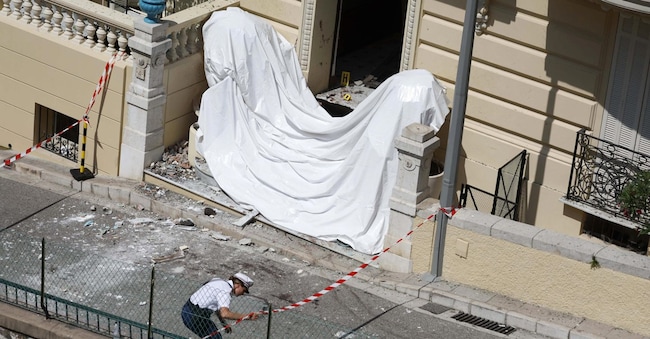
On 29 June, at around 9.00 pm, a bomb exploded at the entrance to a residential block in the Principality of Monaco, near the border with France, injuring three people, two of whom were seriously injured. A week later, near Kyiv, the Ukrainian authorities found the body of a woman who had been shot dead. Among those injured in the Monaco attack is Vadim Ermolaev, a Ukrainian businessman with Cypriot citizenship, who was struck, along with his partner and son, by an explosive device placed outside his home. The woman killed in Kyiv is Anastasiia Berezovska, who had been the subject of a Europe-wide manhunt for several days on suspicion of having planted that bomb. It sounds like the plot of a Hollywood spy story, but it is one of those cases where reality surpasses the imagination of even the best screenwriters.
The attack and the manhunt
It all begins with a clap of thunder that shatters the tranquillity of this little tax haven on the Côte d’Azur. On the evening of 29 June, Vadim Ermolaev is on his way home after dinner with a woman and his thirteen-year-old son. As they were about to enter the building, the three were hit by the shockwave of an explosion that threw them to the ground. They were taken to hospital in Nice; the woman’s condition appeared to be the most critical, whilst Ermolaev and the boy were soon out of danger. The authorities in Monaco revealed that the explosion was caused by a bomb detonated remotely by remote control. It comes as a shock to the Principality’s wealthy community: the Minister of State Christophe Mirmand states that this is an unprecedented case, and Prince Albert II describes it as a ‘criminal’ act that has shocked the whole of Monegasque society.
The possibility of terrorism was ruled out almost immediately, although initially all options remained open and France made its counter-terrorism investigation units available should the need arise. At first, the assumption was that there was a single attacker, but on Friday 3 July, the Monaco police released a composite sketch of the suspect. She is a 39-year-old Ukrainian woman with brown hair, a stocky build and a tattoo on her right arm, possibly a snake. CCTV cameras in the area had captured her on several occasions as she scouted the area around the building in the days leading up to the explosion. Her name is Anastasiia Berezovska, and since then she has been the subject of an international manhunt, with an Red Notice issued by Interpol on charges of attempted murder and placing an explosive device in a public place.
On the trail of the suspect
The authorities searching for Berezovska have revealed another detail: the suspect speaks German. She has, in fact, been living in Frankfurt for some time, where German police are searching her flat. She is not there: according to investigators’ initial accounts, after the attack she crossed the border into France on foot as far as Beausoleil, where she picked up a car registered and hired in Germany before fleeing towards Italia. According to Morgan Raymond, deputy public prosecutor in Munich, the relative sophistication of the bomb and the modus operandi of the attempted murder suggest that the woman did not act alone, and may even have been assisted in her escape. The most unclear aspect remains the motive: with a terrorist link ruled out, the authorities are considering a settling of scores within organised crime, given the possible links to Ermolaev’s business activities. Some are also beginning to speculate about the involvement of the Ukrainian secret services, but many grey areas remain.
Who is Vadim Ermolaev
“As far as we are aware, he is not wanted by the authorities in any foreign country.” These are the words of Monaco’s Attorney General Stéphane Thibault, who adds that Ermolaev has never been the subject of an investigation in the Principality. The Ukrainian businessman’s relationship with his country of origin, however, is more complicated. Vadim Vladimirovich Ermolaev, 58, is a well-known oligarch who rose to prominence in the early 2000s and built his fortune in the property, agri-food and spirits sectors. Through his control of the company Alef, he is one of the most influential property developers in the Dnipro region and a regular feature in the top 100 richest people in Ukraine. He is also co-owner of the Estonian finance company Versobank, which was suspended in 2018 by the European Central Bank for breaching anti-money laundering regulations.


