
The last fishermen on Lake Maggiore: 'Co-op saves from extinction
Giorgio Brovelli is president of one of the two companies on Lake Maggiore: 'Finding Italians who want to do this job is really difficult'.

4' min read
4' min read
The profession of lake fisherman, whose origins date back thousands of years, is in danger of disappearing. In Piedmont too, as on Lake Como and Lake Garda, the category is struggling with difficulties dictated by climatic factors, food changes, competition from industrial fishing and regulatory restrictions. Giorgio Brovelli, president of the Cooperativa pescatori acquacultori del Golfo di Solcio (Lesa, in the province of Novara), founded in 2005, one of only two in the entire Lake Maggiore basin (the other is the Società cooperativa dei pescatori professionisti del lago Maggiore, based in Stresa, in the province of Verbania), knows something about this. The cooperative, which employs 26 members in the summer season and 21 in the rest of the year, deals with fishing, fish processing and sales, and catering. "Unfortunately we have a hard time finding fishermen,' explains Brovelli, who is 68 years old and started working as a fisherman when he was 14. 'Finding Italians is impossible and even with foreigners there are great difficulties: we have applied for four fishermen, two from Bangladesh and two from Sri Lanka, who are relatives of people who already work for us, but due to problems of managing the flow and respecting the rankings it is not possible to get them to come. As long as my strength and health assist me I would like to go on for a few more years to find someone to teach the trade and who can carry on this tradition, but it is really difficult.
In order to be able to fish in the waters from Solcio towards Sesto Calende, the members of the Cooperative have to pay a concession to the Borromeo family, which holds the fishing right: 'There used to be 120 of us on the entire lake, there were not so many spaces and everyone had their own areas. Then, as the years went by, things changed because of fish diseases, the period when there was a ban on fishing due to Ddt contamination, and so the fishermen became fewer and fewer, and today there are only 10-11 of us in all. I fished for 20 years with the historic Stresa cooperative and my fishing teacher was Giuseppe (Pepi) Ruffoni, thanks to whom I learnt to fish all over the lake and not just in the lower lake. This is why Prince Borromeo accepted my request to give me and another fisherman from my cooperative the authorisation to fish in the waters of the entire lake'.
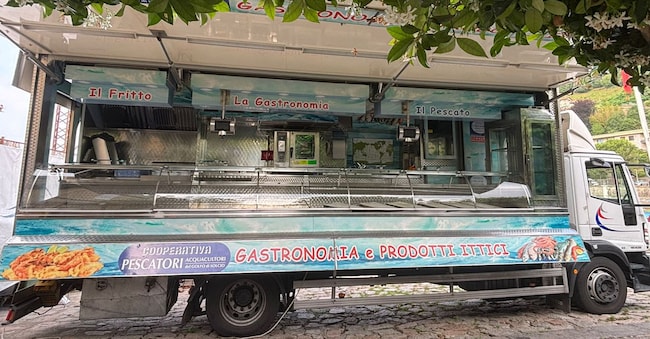
Brovelli emphasises that 'being a fisherman is a job that can only be done if you have a passion for it, otherwise as you get older it becomes burdensome because there is a whole host of things to do. In the afternoons you have to cast the nets, then at night until five in the morning you go fishing, and when you come back you have to process the fish and then deliver it - as well as to restaurants, fishmongers, delicatessens, street vendors - to the Milan fish market, from where it is sorted to many regions. With our mobile stalls we also participate in Campagna amica markets and the municipal markets of Arona, Gattico, Verbania, Novara and Armeno. We finish at noon, have lunch, then go to bed and in the afternoon we start the tour again. You have to find people who can be taught to do all these things so that tomorrow they can carry on the cooperative's activities. Today you don't find any Italians willing to do this anymore, with a few very rare exceptions, while once there was a queue of young people to learn the trade and there was a fight over who could get on the boat. The cooperative is also involved in catering: it runs the Osteria 'La vecchia scuola' in Lesa and the restaurant 'Da Giò', created on a barge moored in the Gulf of Solcio.
For those who only do the fishing, the monthly pay is around 1,400/1,500 euro, but those who also do the processing and/or deliveries earn more. "Once they have learnt the trade well, the fisherman can also decide to go freelance and deliver only part of the catch to the cooperative and the rest on their own. But even so, it remains difficult to find any.
There is no shortage of expenses for the Gulf of Solcio Fishermen's Cooperative. In addition to paying its share of the Borromeo fishing right (30,000 euro per year to be divided among all the fishermen who use it), it has to bear the maintenance costs of the mobile fishing benches and nine boats moored between Solcio, Dormelletto, Arona, Meina, Solcio and Cannero, from where they fish for whitefish, gardon, whitefish, perch, pike, perch, lake trout and lake char. An experienced fisherman like Brovelli, who operates throughout the lake, can catch almost a hundred quintals a year.

