
Lazzarelle, the co-operative that provides work for female prisoners, is holding its ground and expanding
From a coffee roastery to a bistro, then catering, cleaning services and a refreshment bar: the numerous regeneration projects being carried out in Naples

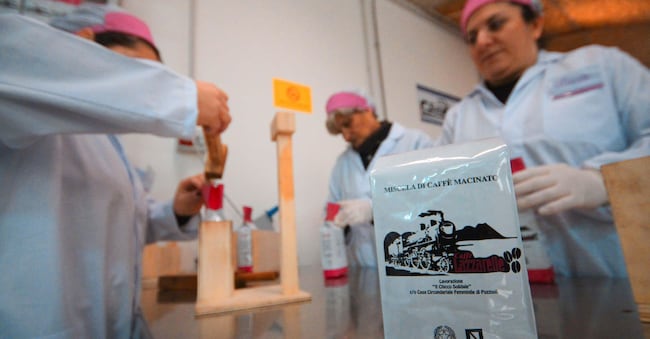
The Lazzarelle cooperative is diversifying and growing: not even the earthquake in the Campi Flegrei managed to weaken it. It is a social enterprise which, in 2011, began producing coffee within the women’s prison in Pozzuoli, Campania – on the initiative of Imma Carpiniello, a political science graduate with a strong entrepreneurial spirit – and has since also opened a bistro in the Galleria Principe in Naples. The co-operative’s aim is to provide work for female prisoners, enable them to earn a little money honestly, deter them from reoffending, and help them learn a trade they can use when they return to normal life.
The project initially met with resistance, but then the women involved became passionate about it and inspired others to join in. It got into full swing and undoubtedly had a positive impact. However, in May 2024, a 4.4-magnitude earthquake in the Campi Flegrei area brought the main activity – coffee production – to a standstill. The prison in Pozzuoli, which houses the coffee roasting facility, was damaged by the earthquake: cracks appeared in the cells and other parts of the historic building, a former 15th-century convent. This necessitated the evacuation of the approximately 140 female prisoners, who were first taken to the courtyard for safety and then transferred to other prisons in the region.
A large proportion of them are being transferred to a wing of Secondigliano prison, also in Naples. There, space is limited. And there is no possibility of relocating the Lazzarelle’s activities there as well. There are therefore fears that the co-operative may have to scale back or even cease its operations. But that is not the case. ‘We’ve turned to an external coffee roasting business run by friends already involved in the third sector,’ says the organiser. ‘It’s a temporary arrangement. We’re looking for other spaces in which to reorganise production.’ She then adds: “In truth, we’ve never stopped. And the shock caused by the bradyseism has spurred us on to do even more.”
Firstly, the bistro is located in the Galleria Principe, opposite the Mann, Naples’ Archaeological Museum – one of the most important and extensive in the world, and always bustling with tourists. Established in 2013 with the support of the Charlemagne Foundation, the Bistrot Lazzarelle aims to be a place where, through food, conviviality and the pleasure of a coffee or a salad, people can actively contribute to the empowerment of women and men who are currently serving sentences or have been released from many of Italy’s prisons, and to promoting a shift in thinking about prisons – from a punitive system to a place of social reintegration. The bistro has also become a cultural hub, hosting exhibitions, conferences, meetings and book launches. These activities are expanding, and the number of women working there is growing.
Next, a new co-operative is being set up to provide catering services for public events, conferences of all kinds, and even private events and parties. The kitchen is situated within the premises adjoining the Church of Pio Monte della Misericordia, another landmark in Naples’ historic centre, best known for housing Caravaggio’s *The Seven Works of Mercy*. The co-operative has taken on a chef and a pastry chef, and has also involved five female prisoners, thus launching yet another venture in rehabilitation and economic empowerment.


