
The journey of life: Homo Faber kicks off with Guadagnino's creative direction
The exhibition dedicated to international high craftsmanship curated by Michelangelo Foundation, with Luca Guadagnino and Nicolò Rosmarini, opens in Venice at the Cini Foundation.

3' min read
3' min read
Ten themes and one common thread: The Journey of life. Now in its third edition, Homo Faber, the exhibition dedicated to international high craftsmanship, opens to the public on 1 September. The exhibition, promoted and curated by the Michelangelo Foundation, has chosen this year to avail itself of the art direction of Luca Guadagnino and Nicolò Rosmarini to imagine a journey, among the over 800 works, that retraces the crucial moments of life. Here then, Birth, Chilhood, Celebration, Inheritance, Love, Journeys, Nature, Dreams, Dialogues and Afterlife: a narrative that unfolds in macro scenes, spaces marked by the time of existence, where the art of making is the protagonist. The journey begins playfully in pastel shades and pink: a ribbon unravels in the first cloister where the Goose Game recounts the mystery of birth, evokes the chance of fate and cultivates the wish for a good star with tapestries that are as many boxes of the spiral, embroidered by hand all over the world. "We want enchantment, elegance and timelessness," explains Luca Guadagnino. "What we do aspires to grace. Childhood opens up to sounds and colours, between experiments and toys, toy soldiers and dolls' houses, fairy tales and puppets. A papier-mâché forest of cypresses and magnolias introduces the Palladian Cenacle where life's special moments are celebrated. In the ancient refectory, under the faithful reproduction of The Marriage at Cana by Paolo Veronese, a gigantic mirrored table gathers cutlery and plates, trays, glasses, carafes and glass masterpieces in an ideal multicultural and transnational banquet. The vivid light of the Lagoon, which has accompanied the visit so far, gives way to half-light in the Heritage room: on the walls, black and white photographs of the Foundation's restoration, on the ceiling a video telling the story of ten families of artisans, from Italy to South Africa to Uzbekistan, where manual skills and production capacity are passed on from father to son. A heterogeneous world of soap makers, gemstone inlayers, ceramists, shoemakers, doll makers.
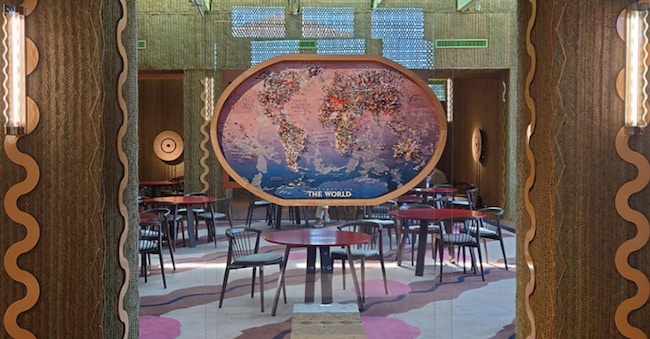
Love occupies a double space, with a distinction between the moment of courtship - a riot of flowers made with every technique, material and skill - and the moment of union, with objects inspired by the symbolism of the heart, the knot, the kiss, life in two. If travelling is one of the great pleasures and life-changing experiences, the truss pavilion houses maps and globes, astronomical clocks and compasses, sextants and all the instruments useful to world explorers. In the same space, a tea room with a menu inspired by the flavours of ancient Venetian trade routes. In the newly renovated space of the former print shop, the natural world explodes: objects made of wheat grass and eggshells, organic shapes reminiscent of pods, pebbles, tree trunks and twisted vines: craftsmanship imitates nature and merges with it. "Instead of a geographical criterion, I liked the idea of adopting a simple and poetic theme for this edition of Homo Faber, but one with universal resonance," explains Hanneli Rupert, vice president of the Michelangelo Foundation.
The eighth display is a dreamlike and evocative space: once again the lights go out and in the former historical swimming pool, captured by the reflection of the water, the creatures of the dream are reflected: tall mannequins, all the same, surrounded by masks and faces one different from the other, frightening and comical, poetic and surprising, contemporary experiments and ancestral symbols, demons and fairies, nightmares and fairy-tale inspirations. The penultimate room is dedicated to dialogue, to the interweaving of skills, ages, specialisations. The theme of the encounter as the fulcrum of an exchange that brings together master and apprentice, great fashion houses and small artisans, designers and craftsmen. Perhaps the least resolved room closes with a challenging theme: the after. That is, how crafmanship interprets or celebrates the end of life and the memory of those who are no longer with us, the passage from the beginning of the journey to its end.
Leaving the island of San Giorgio, the journey begins again in the city, among calle and campi and 70 ateliers selected from the best Venetian craft workshops, paper and papier-mâché, glass and mosaic, lace, porcelain and murrine, artistic printing and gold leaf decoration, theatre costumes and gondolas.

