
The Maestro's 'liquid history' is a lesson in hospitality and Made in Italy
"It's not about mixing ingredients. It's about understanding people and making connections.
by Stefano salis
 Aggiungi Il Sole 24 Ore
ai preferiti su Google
7' min read
7' min read
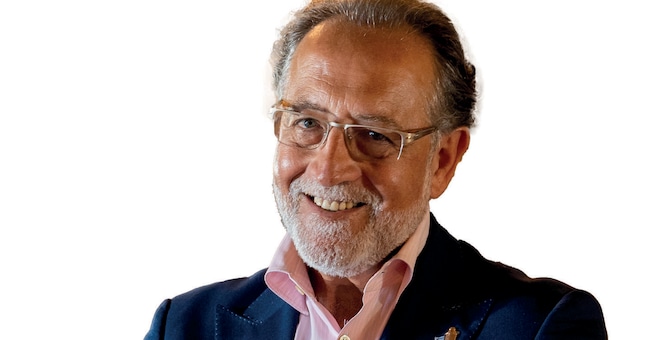
One anecdote, among the hundreds he could tell. "He often came to my place to drink Stevie Wonder. He got on well. Thinking of him, I had created a cocktail, Champagne Wonder, which had sweetness and smoothness, with bubbles. He liked it. One evening I notice that while my pianist plays, he accompanies him with his head. I approach. "Steve, do you by any chance feel like playing?" He smiles and says yes. He felt comfortable at home. He went to the piano, and, for over half an hour, it was a magical moment and silence. I cannot describe it. No one ordered me to do anything; no one dared interrupt that emotion, a private concert for which one would pay considerable sums of money. But the most beautiful thing, for me, is that, at the end of the evening, he gets up to leave. I go to say goodbye and thank him and he gives me a round of applause, I ask him why and he says 'from one artist to another artist'. I still get chills thinking about it'. There are two artists, then: a 20th-century pop music legend and him, Salvatore 'The Maestro' (as he is known to everyone in the environment) Calabrese, from Maiori to the world with a well-balanced cocktail of humility, knowledge, curiosity, respect, professionalism and openness to others that have made him the protagonist of a unique 'liquid history' (an alcoholic and philosophical category he invented). International celebrity, awards to no end, some of his creations permanently becoming part of those contemporary classics that every bartender, everywhere on earth, knows and performs on his recipes. "A way to be made immortal," smiles The Maestro. Walk into a serious bar and ask for a Breakfast Martini, a Negroni Svegliato, a Spicy Fifty: Salvatore's 'legacy'.
We have a coffee on a solemn December morning in Palermo. We are at the Villa Igiea: the hotel, which has been spruced up and is open all winter for the first time, celebrated Salvatore's cocktails the night before (it is spontaneous to call each other "tu", and he encourages the practice) with the presentation of the new drink list. In Rocco Forte's hotels, the imprint of The Maestro's signature bars is decisive. At the Donovan at Brown's in London Calabrese is at home; here in Palermo he comes often and has been inspired by the island's local history for cocktails of remarkable quality and depth, and in January, at the legendary De Russie in Rome, he will sign an important collaboration with his name. Last night it was a sight to see him wandering among the tables. A word for everyone, a hug, an affable smile. He greeted me by asking which cocktail I would like to try from the new list. 'You do it,' I said, but, of course, I 'asked' for a timeless Martini made by him to start: you don't get that every day. The Maestro does it to perfection, so much so that he has received the 'stamp' of the British royal family for it. 'I have served Queen Elizabeth several times, and Charles, and all the members of the Royal Family,' he recalls. Not to mention the meetings with Mandela, Fidel Castro, Mick Jagger, De Niro, or the cocktail made sitting next to Schumacher driving a bolide: so many stories. 'I have been confidant with many people, known and not. But what is said at the bar stays at the bar. I have given birth to love stories and arranged some marriages, and I have also seen a few divorces. But for these I am not responsible,' he smiles. Calabrese's philosophy has a magic word from which he never deviates, and he has explored its meanings far and wide: hospitality. It is a culture that comes to him from his Campania origins. 'With us, as soon as you enter any house, the first question is always "what are you having?". The limoncello, the fragolino, in short the homemade liqueur is never made for oneself, always for the eventual guest'. Of the Amalfi coast he has retained the warmth of humanity, the simplicity of relationships, the spontaneous openness to others, the amiable accent; from his second home, London, he has taken a certain aplomb that makes him appear impeccable at all times. "But if one thinks mixology is just about mixing and inventing certain cocktails, one is way off the mark": Salvatore is a master not only in execution, in the search for and care of the perfect ingredients, he is so because he has the will to understand what is really 'behind' a cocktail. That 'liquid history' that has led him, to say, to be one of the greatest cognac experts (and to create with this distillate a cocktail that made the headlines, the most expensive in the world), and author of books that have sold, sold, millions (millions!) of copies.
The appellation 'Maestro' was given to him by his boys, and it soon spread internationally: respect, which makes sense in this world, and which identifies Calabrese's many skills. "I like designing bars, understanding spaces, foreseeing what the customer will encounter before and afterwards; it's not just about being good at preparation. You have to understand people, be able to communicate, exercise and practise the hospitality that is the very purpose of our work. I always say that the bar is a theatre: welcome to mine!". Yesterday evening, at his side was a pupil such as Federico Pavan, whom Salvatore does not hesitate to praise. 'He is one of the best in the world'. He continues. "I don't want a pupil of mine to become a 'little Salvatore', he has to become himself. And I still learn today, from my boys, every day. And from my customers'. I ask to explain further. "You. Last night you told me to choose what you would drink: you had ordered a pasta with tomato sauce, first you wanted Martini. Here, I have to figure out what goes with your experience, what you request, how I can think of a cocktail that works for you. It's always a meeting, our meeting. At some point in the night, I see The Maestro relaxing. He drinks a 'simple' Negroni, while talking to some customers and young, and brilliant, Sicilian wine producers, new generations of historical brands (the evenings at the Villa Igiea are full of beautiful people, perfectly organised and successful). 'I am not a big drinker,' he says. 'And then the Negroni, in its simplicity and complexity, always fascinates me'. When he was a young boy, it was the Negroni that was his test. "Mr Raffaello, my tutor at the time, had authorised me to make the Americano. But one time I dared a Negroni. He took me in the back and gave me a slap on the wrist. "Don't do what you're not ready to do yet". Even now, when I make a Negroni, I deliver it and hope it goes well': he exaggerates - and knows it - the Maestro. Then he explains, seriously. 'Making a cocktail is looking for a harmony of flavours, a balance between bitter, spicy, sweet and so on. I don't go behind the bar and experiment with bottles. I have to dream the cocktail; when I have a vision of what I want to create I start thinking about the flavours and then it's like a jigsaw puzzle that comes together, the distillate that will give structure, the element that breaks it up, the twist of a certain kind. When you drink you have to perceive it and you have to come back to it, with every sip, thinking about it'. In all this, The Maestro (who is also a prophet in his homeland, as is almost never the case; instead, in Maiori and the surrounding area they pay him the right honours) never forgets his Italian character. "Many great barmen are Italian. Hospitality is in our DNA, we are artists of hospitality, and we make this felt in our work. I am not interested in the arrogance of titles: there is nothing nicer than hosting people who come to you, to your bar. At the end of the evening there will always be an acquaintance and that is why I do, and enjoy, this job. For 50 years. That's what the bar is for, to create contacts. And it always is. If you go to a restaurant alone, after they take your order and bring you the food, you are alone. But not at the bar. Sooner or later you talk to someone, you share something. You experienced it yourself last night'. Confirmed.
And as the breakfast room empties out and Salvatore Calabrese, aka (and in fact) The Maestro, prepares to catch yet another plane back to London, and then on to other stops around the world, it occurs to me, naively, to ask him for a recipe for a cocktail to propose to our readers and to drink on New Year's Eve. He thinks about it for a moment. "I'll tell you what I'm going to make for my friends and guests at my home outside London. I recommend making a cocktail to toast the New Year using anything you like. Something you can normally do at home, with your family, with ease. All you need is a sgroppino, made with limoncello, or vodka, ice cream, and bubbles. You can even make it with coffee. And you start celebrating, with the children and the grown-ups. It is not important what you put in. It's important that you do it with others in mind, the bonds you have with them, what they like, and what you like. I was expecting something miraculous, I admit, ready to make a mistake, then, for my part, the eventual signature cocktail suggested by such a character. But this, however, is the real lesson that only a master ever gives you: focus on simplicity, on the moment, on the fundamental thing. On people. The Maestro has just given you the recipe: hospitality is what counts. The one ingredient that cannot be missing. Happy New Year, then: with the hope of drinking better and better and always in the company of the right people. Well: and if you happen to do it in one of the bars of this artist and champion of made in Italy and with some of his creations, how can I put it?, it's even better. Best wishes. Indeed: cheers.

