
Lady Literature is a bloodthirsty
"The Modern Slaughterhouse", Antonella Antonia Paolini's splendid poetic debut, opens in a post-apocalyptic manner, describing a metamorphosis that so closely resembles death that it becomes true belonging

4' min read
4' min read
Bewildered, a body wakes up in absolute darkness, locked inside something, traversed by ants moving in and out, everywhere. It has screamed, it has thrashed, its eyes must have opened on blackness: the only sensation they send back is that of the coolness on its corneas. In the pain, in the coming and going of nausea, in the inability to understand, an indefinite time passes. Then a door opens - a blinding light - ants reveal themselves as letters. 'Letters that/ move, crawl on their ends like/ organs, animals with a life of their own'.
The prologue, in prose, of The Modern Slaughterhouse, the splendid and long-delayed poetic debut by Antonella Antonia Paolini - Leopardi scholar (member of the scientific committee of the National Centre for Leopardi Studies), scriptwriter, essayist, and contributor to 'Domenica' - introduces us to a post-apocalyptic scenario where everything is destroyed, even the body - swollen - and letters swarm on the skin, on things, enter the eyes, migrate away from the sheets, which turn white again.
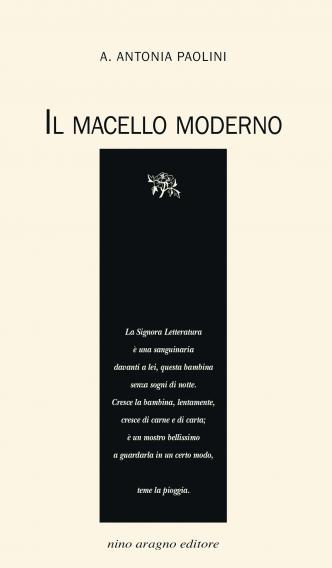
Until - as Laura Pugno, editor of Aragno's 'i domani' series with Maria Grazia Calandrone and Andrea Cortellessa, writes on the back cover - this 'violent invasion, this metamorphosis that so closely resembles death becomes true belonging, a unique land in which to recognise oneself, the only origin'. The voice that rises from the rubble becomes lyrical, the writing is now in verse. Clean, sharp verses that cut through the empty space, with no echo, with nothing to bring back a familiar sound. The syllables keep each other company only in the assonances of phrases punctuated with rhythm and fury, like the ancestral cries of the herdsmen to call the herds, which Béla Bartók already transformed into music.
"A sunny white landscape// For years for months// Is a hospital sunny?/ Is there sunshine in pain?/// It was salt/ All white/ It looked like snow/ But it didn't melt// Stored here under salt/ The burned skin in that white, red./ Bumped it without wanting to/ Couldn't escape/ White white with salt for months/ Didn't see the courtyard didn't hear the wind/ Needles and medicine, highways of codeine and morphine/ Dried up everything/ Don't feel anything anymore/ Falling into the salt/ White/ A quarry under the skin under the sky/ A quarry all white/ That burns and doesn't warm up".
Antonia Paolini's is the song of the lonely sparrow after the day has died. It continues stubbornly into the night, painful, proud. Ironic even. An irony-earthquake, seething rebellion, angry and eloquent, revenge of the powerless but sentient and intelligent mind that claims itself, dignity of being nothing - opposites that cancel each other out - beauty that is, only because it is ephemeral. Poignant. An irony that fights like David against Goliath. "Resurrection sound/letter by letter". Resurrection 'of the living dead', of the 'living death'.


