
Il Piccolo celebrates its marvellous 80th anniversary
The launch of the 2026/2027 theatre season marks the start of a new, highly anticipated chapter for the theatre

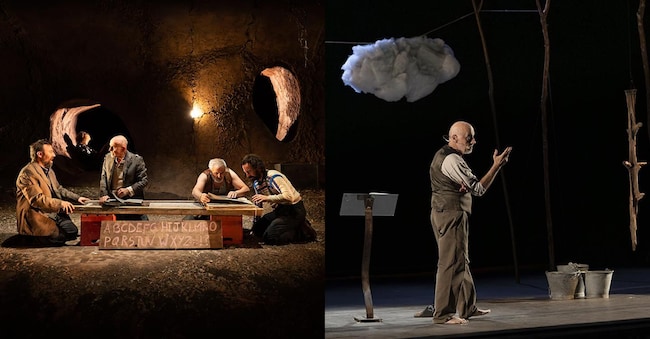
The Piccolo Teatro in Milan was founded in 1947, at a very difficult time for Italia. The Second World War had only just ended and Milan still bore the scars of the bombings, the rubble and the silence imposed by censorship. For Paolo Grassi and Giorgio Strehler, culture had to once again become a space accessible to all, capable of uniting people and restoring faith in the future. Their aim was to open the doors of the arts to the entire community, transforming the theatre into a place of encounter and growth, where a new society could be imagined in the wake of the conflict’s wounds. If time is a game, the Piccolo Teatro has been playing for eighty years. And every season adds a new move. *The Game of Time* is the title chosen for the new 2026/27 season and to mark the approach of an anniversary that signifies an important milestone in the theatre’s history. From 1947 to the present day, generations of artists and audience members have passed through a place where change has been a constant. Time offers a lens through which to revisit the journey taken and imagine the next act. And now, let’s raise the curtain!
The shows
The 2026/27 season programme opens with some of the most eagerly awaited productions of the new year. These include Coro degli amanti, Tiago Rodrigues’s directorial debut in Italy, and Che dolore terribile è l’amore by Daria Deflorian, adapted from Han Kang’s Non dico addio. Next up is Thomas Verstraeten’s The City of Arrival, presented in November, which explores the themes of migration and identity in collaboration with Milan’s universities. As part of a production programme comprising a total of 30 new co-productions, including three international ones, the season finds one of its cornerstones in a return to the great works of the repertoire and in continuity with the history of the Piccolo.
Bertolt Brecht
Among the key highlights is the production of Bertolt Brecht’s Mr Puntila and his Man Matti, a new staging by Claudio Longhi that revisits one of the founding figures of twentieth-century theatre, featuring Franco Branciaroli and Lino Guanciale. This production forms part of a line of exploration that draws on tradition whilst bringing it up to date for the contemporary stage. Lino Guanciale also takes the lead in January in *Faust* , directed by Antonio Latella, a fresh interpretation of Goethe’s text that engages with one of the deepest core themes of European drama. Two different productions, two distinct styles, one actor at the heart of a journey that spans the season.
In keeping with the tradition of Milan’s historic theatre, great classics and fresh interpretations of the repertoire are returning to the stage: Carmelo Rifici directs a new Oresteia by Aeschylus, whilst Giacomo Bisordi is working on La vita agra by Luciano Bianciardi, starring Paolo Pierobon. Emma Dante presents a reinterpretation of Six Characters in Search of an Author, also taking on the role of the lead actress. Work on training continues with Riccardo Frati, who completes his trilogy with Castelli di rabbia by Alessandro Baricco, following The Little Prince and The Baron in the Trees. Massimiliano Civica directs Quinto: Non uccidere, whilst Pascal Rambert stages the monologue Viaggio a Hong Kong starring Sandro Lombardi. Alongside the new productions, there is also room for actors and directors already associated with the Piccolo Teatro, including Marco Paolini with Bestiario idrico and Dov’è il Po?, Sonia Bergamasco, directed by Antonio Latella in OSCAR, Stefano Massini with The Tsar, and Valerio Binasco with One of the Last Nights of Carnival. The season also unfolds through collaborations with associate artists and the international dimension that characterises the Piccolo: these include Sotterraneo with Il fuoco era la cura, lacasadargilla with Città sola, Marco D’Agostin and Marta Ciappina with Catalogue, and Daria Deflorian’s project in dialogue with the international scene and the Avignon Festival. A network of relationships that confirms the Piccolo as a European hub for theatre production and research.
In this 80th-anniversary season, the renewed link with La Scala is of crucial importance, as it has its roots in the very history of Milan’s post-war cultural renaissance. Between 1946 and 1947, in fact, the city’s opera and theatre scenes were rebuilt from the rubble of the war, ushering in a dialogue that today is once again taking the form of a shared vision. Against this backdrop comes, on the one hand, the first-ever appearance of the Teatro alla Scala Corps de Ballet on the stage of the Teatro Strehler with *i* *Mont Ventoux* */i*. The choreographic work, entrusted to the KOR’SIA company and inspired by Petrarch’s *Ascesa al monte Ventoso*, stems from an idea by Mattia Russo and Antonio de Rosa and is developed under the direction of Frédéric Olivieri. It is a project that brings the language of contemporary dance into a space historically dedicated to drama. On the other hand, the narrative is symbolically reversed with the return of Arlecchino, Servant of Two Masters to the stage of the Teatro alla Scala, from which it had been absent for twenty years. The Piccolo Teatro’s flagship production, in the very month in which the theatre itself celebrates its eightieth anniversary, has been reimagined in a new production entrusted to the students of the “Luca Ronconi” course at the Scuola del Piccolo, led by Stefano de Luca and Enrico Bonavera, the production’s long-standing leading actor. The programme is rounded off with a series of events dedicated to family audiences and theatrical tradition. The Carlo Colla & Figli Puppet Company presents Aladdin’s Lamp and The Puppet Harlequin, a puppet-based reinterpretation of Goldoni’s iconic character.

