Space economy

China's long march to space conquest

The Dragon country continually fields missions and agreements with countries not aligned with the West. Moon landing planned for 2030

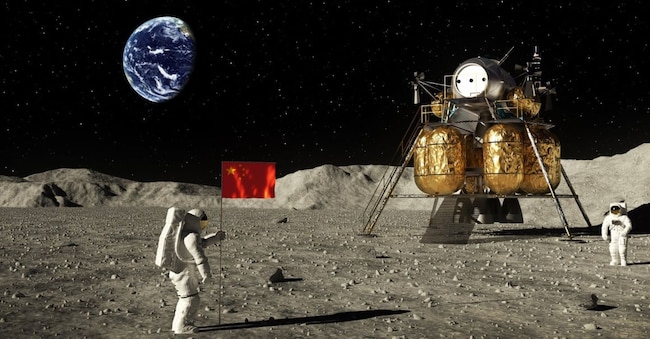
by Leopoldo Benacchio

Missione lunare. L’anno prossimo la missione Chang’e-7 dovrà cercare il ghiaccio di acqua al Polo sud del nostro satellite, per il 2030 è previsto l’allunaggio umano

4' min read

4' min read

China is pressing the accelerator pedal in its space policy, which it sees as increasingly important, both to expand and consolidate its global zone of influence and for its military policy, which sees, like the US and Russia, space as another zone to be controlled.

African alliances

.

Continued space missions and agreements with countries not yet aligned with the West, such as many Africans, are there to witness Beijing's effort to increase its role as a global space power, which so worries the US.

Loading...

The Cmsa (China Manned Space Agency), the Epl (People's Liberation Army), and an increasingly committed private sector, as much as this term may mean to us in China, are the main players in this rather impressive development, which is perhaps little followed in Europe.

Last year, we saw the Chang'e 6 robotic probe bring back lunar soil samples from the dark side of our satellite, the Tiangong space station, the 'Celestial Palace', the Shenzhou shuttle, the 'celestial ship', which has been continuously used and improved since 1999 to transport astronauts, and the Beidou constellation, the 'Big Dipper', similar to the American GPS or the European Galileo. And these are only the best-known realisations; there are now hundreds of Chinese satellites.

In the space plan presented at the end of last year, it is stated very frankly that the road map, presented with 17 points, aims to make China the leading country in space, both by increasing the science part, which obviously lies below space engineering, and by consolidating some strategic choices already made.

The moon landing in 2030, while America trudges on

.

First, there is the Tiangong orbiting space station, orbiting the Earth from 2022, which is destined to expand and be able to host more Chinese astronauts, taikonauts, and allied countries, who will follow a large programme, both technical and scientific experimentation, with some 180 research projects on microgravity physics, space biology and new technologies.

The year 2030 is indicated as the year in which the Dragon Country will succeed in lunar landing, and this is the point that gives the Americans a headache as they struggle between delays and budget cuts for their Artemis programme.

The difference between the two is obvious: the Chinese one is a practical programme, taking mainly robots to the Moon, while the American one is increasingly an ideological chase to be first back on our satellite.

Beijing is putting together the pieces of the puzzle to put the first Chinese on the Moon: the Long March 10 rocket, which is to be upgraded; the crew capsule, Mengzhou, the 'ship of dreams'; the Lanyue lander, named after a poem by Mao Tse Tung; the Wangyu spacesuit, 'looking at the cosmos'; and the Tansuo lunar rover, 'exploring the cosmos', which is particularly important in Chinese plans to delegate many tasks on the lunar surface to robots. Chinese figurative culture emerges powerfully in the names used.

The overall development is proceeding smoothly, according to Lin Xiqiang, deputy director of Cmsa.

In 2026, the next piece of the planned plan for lunar exploration, the Chang'e-7 mission, in collaboration with Egypt and others, will have to search for water ice at the south pole of our satellite. With this, we enter the friction zone with the US, which envisages the same area for their moon landing, and also see the first important step in a policy of collaboration with the African states, which are associated in the Space Agency of that immense continent, which has its fulcrum and headquarters in Cairo, in the future Space City. China has collaborations with 23 African countries, to which it has provided tracking stations and advanced technology with the obvious aim from a geopolitical point of view: to have new bases on the African continent.

On Mars in 2038

.

The solar system also features prominently in China's updated space plan: the Moon in 2030, as mentioned, but also Mars, in 2038, where a permanent robotic station is planned to test the extraction of water, oxygen and fuel directly from the red planet. Also planned is a 'sample return' mission with soil samples from Mars by 2028, which Trump has instead made NASA abandon. One difference from the past: they will be analysed in the space station, also together with foreign partners.

It will take a lot of money and political leadership will have to remain firm, fundamental conditions, but even more than that, an overall strategic vision and the ability to dare, reasonably but decisively, to innovate seems to be needed. What Europe has lacked so far we find here.

This was demonstrated by the launch on 14 May of the first 12 satellites for a cutting-edge project for the first in-orbit computing system led by private start-ups Ada Space and Zhejiang Lab.

They form a small, for the time being, constellation that will process data directly in space, instead of on the ground, reducing dependence on terrestrial computing infrastructure. The constellation will be able to process 5 peta operations per second with 30 terabytes of on-board storage. The satellites are equipped with advanced artificial intelligence capabilities, laser links between them at up to one hundred Gigabits per second and also carry various remote sensing instruments, polarimeters, X-ray and gamma-ray analysis.

Copyright reserved ©

Brand connect

Loading...

Newsletter

Notizie e approfondimenti sugli avvenimenti politici, economici e finanziari.

Iscriviti