
The long night of the American ballot box
In the face of the country's vertical split, the polls don't help either

2' min read
2' min read
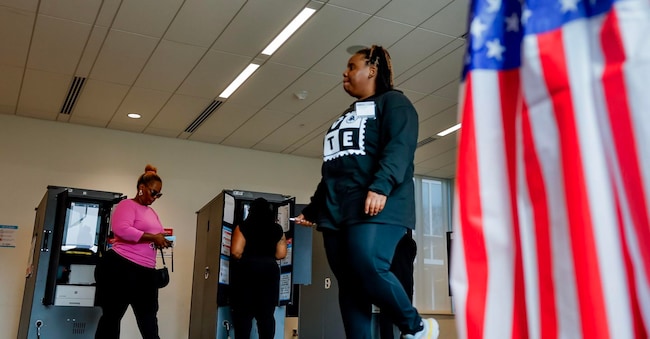
The New York real estate developer with a home in Umbria predicts a big Republican victory. The Italian-American professor who teaches in Michigan looks hopefully at the queues to get into Harris's last rally. The cousin of a Roman Jewish friend who says she will vote Trump to save the historic relationship with Israel. The museum curator from Ohio who tells how no one dares to talk politics any more lest they have to argue with their neighbour. Which of these pieces best represents the mosaic that will be put together in the Italian night? While voting is already taking place in the USA, it is impossible to know.
In the face of the country's vertical split, the polls do not help either. With the main ones firmly nailed down at 50-50, or rather 48-48, Ann Selzer's Iowa poll has shaken things up: the independent pollster, whose predictions in 2016 and 2020 proved to be right, sees Harris ahead of Trump in Iowa, the 'red' state that would thus become 'blue'. And if this is happening in Iowa, what is happening in the rest of the Midwest, the heart of that deep-rooted America embodied by the two vice presidential candidates Walz and Vance, one a spokesman of silent solidarity and the other of shouted anger? And is it true that only Selzer has perceived the voter movement while the other institutes have underweighted the female variable (to name but one), or is it she who has made a resounding blunder?
In the final analysis, is this really an epochal choice, which will also weigh on the rest of the world, or are we witnessing the mediatisation of a physiological clash in a democracy in which left and right take turns with regularity? Should we be more afraid of Trump, whose autocratic outbursts could turn out to be a boutade, or of Harris, whose progressivism could be implemented to the hilt?
With the time of history - those 20-30 years needed to understand choices and consequences, based on documents and autobiographies - everything will be clearer. On election night, the winner will become clear in the minutes of the exit polls and the hours of the counting, at most in the days of the appeals that everyone considers inevitable. That is if, as many fear, we do not have to witness street clashes, fomented by opposing factions or fuelled by Russian hybrid warfare via permeable social platforms.
The vote for the White House concentrates all this, although in reality the results of the House and the third of the Senate that will be renewed almost count more. A blue president with a red Congress (and vice versa) could not pass a budget, ratify a treaty, even appoint an ambassador. From New York to Seattle, from Atlanta to Phoenix, from Chicago to Fort Worth, but also from London to Rome, from Paris to Kiev, from Jerusalem to Berlin, the countdown is on. Like New Year's Eve, people are waiting for midnight. But with much more anxiety than excitement.

