Mind the Economy

The Lost Soul of the Left

The promises that part of the progressive tradition seems to have lost along the way

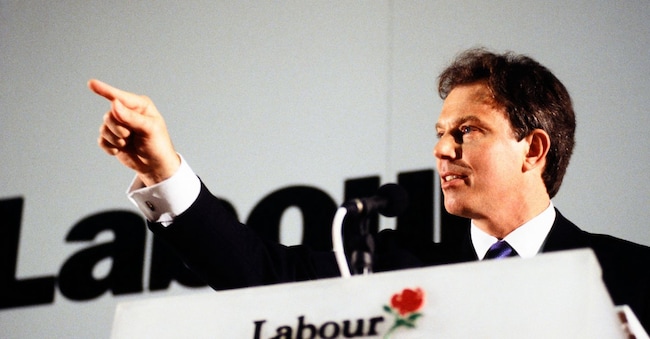
Tony Blair, durante la campagna elettorale prima delle elezioni del 1997. Alamy Stock Photo

13' min read

Translated by AI
Versione italiana

13' min read

Translated by AI
Versione italiana

Tony Blair was forty-three years old on the morning of 2 May 1997, when he first entered Downing Street. He brought with him a majority of 179 MPs. These were figures the Labour Party had never seen before. He had promised the British people a young, modern country where prosperity and social justice could go hand in hand. Thirty years on, the assessment of that experience is, at best, ambiguous. New Labour did indeed win, but to do so it had to shed a substantial part of its historical legacy. It was Anthony Giddens, a sociologist at the London School of Economics, who gave that process a name and a theoretical framework when, in 1998, he published *i* *The Third Way* . The welfare state remained in place, as did redistribution, but the purpose changed. It was no longer a question of measures designed to protect people from the social costs of the market, but of policies aimed at enabling them to function within it independently and not to fall by the wayside too easily. To call it a capitulation to neoliberalism, as has often been done, would be simplistic and, ultimately, incorrect. When Blair spoke of education, of social exclusion, of growth that was meant to translate into opportunities, he was addressing real problems. The point is another: what happens to the idea of emancipation when politics becomes convinced that its role is, ultimately, to help people adapt to an economic system that is regarded as a given?

Ten years earlier, in September 1987, Margaret Thatcher had told Woman’s Own: “There is no such thing as society”. That remark encapsulated a clear vision of the relationship between the individual, the market and institutions, one that was destined to gain traction far beyond the Conservative Party. If what happens to us depends above all on our own behaviour, then politics must concern itself with the choices of individuals rather than with the structures that determine who has access to what and who is in charge. Blair, let’s be clear, did not take that logic all the way. His government resumed investment in the health service and state schools, introduced the national minimum wage, and set itself the target of eradicating child poverty within twenty years. But opportunities were expanded above all by enhancing everyone’s capabilities; public support became increasingly linked to a willingness to look for work; and education became an investment in human capital. The market needed to be regulated and corrected, of course, but its claim to determine the value of a job and how much those doing it should earn was now contested far less than the socialist tradition had done for a century. Blair dismantled a number of Conservative policies, but in doing so he reinforced their cultural premises. He looked after the poor and the marginalised – no one can deny that – but, for him, emancipation ultimately came to mean the chance to succeed within an economic system whose foundations were not to be questioned.

Loading...

The Left, however, returned to government in a world that had truly changed. Capital flowed from one country to another in a matter of hours, factories were closing or relocating elsewhere, and trade union membership was falling year on year. In the early 1980s, Mitterrand had tried to take a different path, with nationalisations, increased public spending and a boost to demand, but within two years, caught between capital flight and rising inflation, he had been forced to backtrack, in what became known as the ‘turn towards austerity’. That lesson weighed heavily on an entire generation of progressive leaders, from Clinton – who in 1996 signed the reform to ‘put an end to welfare as we know it’ – to Schröder, with Agenda 2010 and the Hartz reforms.

In Italia, this trajectory has taken different forms and unfolded at different times, but the underlying direction has not been all that different. The Italian Communist Party (PCI), which decided to change its name at the Bolognina conference in 1989, arrived at the Third Way almost without passing through social democracy, which had never really taken root here. From 1993 onwards, apart from the brief interlude of the first Berlusconi government, the country was led by technocratic and centre-left governments: these were the years of fiscal consolidation, privatisations and the Treu package on flexible working. These were choices that had their justifications, starting with Italy’s entry into the euro, but which also helped to establish the framework for a new common sense here too.

The Conquest of Common Sense

In the late 1920s, Antonio Gramsci reflected on a question that political scientists would only take seriously much later. Why, he wondered, do certain ideas prevail without the need for force? The answer lay in the concept of common sense. In the Quaderni, common sense is defined as the ‘philosophy of non-philosophers (…) that is, the conception of the world absorbed uncritically by the various social milieus in which moral individuality develops’. A store of beliefs that each person carries with them without ever having truly examined them in depth. Hegemony is, for Gramsci, therefore, the capacity to exercise ‘intellectual and moral leadership’ over that store, to secure consent even before obedience.

It is no coincidence that the first person to interpret Thatcherism through the lens of Gramsci was a left-wing intellectual, Stuart Hall, who in January 1979 – a few months before Thatcher moved into Downing Street – pointed out that the right was winning a battle of ideas even before the election. She knew how to speak of freedom, the family and the need to rein in the overreaching state. Thatcher, it seems, shared that analysis. When asked what her greatest success had been, she is said to have replied, ‘Tony Blair and New Labour’.

The Third Way thus appears to be an attempt by the European left to return to government by accepting, for the most part, the boundaries of what is possible as defined by the neoliberal revolution. Rather than a capitulation, it was a gradual rewriting of terms and concepts. Competitiveness, flexibility and investment in human capital became the key objectives, and at a certain point, questioning their legitimacy began to seem unnecessary. I believe that the crisis of the progressive narrative stems more from this semantic shift than from an outright conversion to liberalism.

Luc Boltanski and Ève Chiapello, in The New Spirit of Capitalism (1999), demonstrated how capitalism in the 1980s and 1990s was able to absorb some of the criticism levelled at it around 1968. Not so much what they call ‘social’ criticism – which denounced exploitation and inequality – but what they define as ‘artistic’ criticism. The rejection of hierarchy, the demand for autonomy and creativity, and the intolerance of lives that have already been scripted.

For much of the twentieth century, the promise of progressive politics had been a different one. Poverty, ignorance, having to depend on a master, and being excluded from all decision-making were the result of social relations that needed to be changed, not accepted as fate. Emancipation certainly meant aspiring to a better life, but above all it meant tackling the conditions that produced subordination. Take the case of state schools. They were the driving force behind social mobility, the path through which the son of a farm labourer could become a teacher or a doctor. But it was also the place where citizens were shaped to understand the society in which they lived, to judge it, and perhaps to realise that certain hierarchies – accepted for centuries as natural – were in fact not natural at all. With the rise of the human capital paradigm, this second perspective lost ground and ceased to generate political action. School becomes an investment, serving to make future workers more productive and employable. The trouble begins when this aim takes precedence over all others, and the sole yardstick for evaluating schools becomes job placement.

Loading...

The situation regarding work has gone more or less the same way, if not worse. For the labour movement, a worker’s freedom depended on their position within the organisation, on their ability to negotiate collectively with others on an agenda they had helped to define. The vocabulary of flexibility has shifted the entire focus onto the individual. It is up to you to remain competitive, to keep up to date, to reinvent yourself and to learn to manage transitions. Your career is your own business. And the conditions under which that career unfolds become a given that cannot even be discussed.

Now, there is nothing unusual about saying that a changing economy requires new skills. But it is quite another matter to think that the main task of politics is to prepare people for changes they have not chosen and on the direction of which nobody has consulted them. And so equality is reduced to the possibility of climbing a few rungs on a ladder whose very nature nobody questions any more.

Achievement and recognition

This is precisely the point Michael Sandel emphasises in his critique of the rhetoric of meritocracy. If success is nothing more than a reward for talent and hard work, then the money one earns also says something about one’s worth as a person. Those who have made it to the top tend to think they have earned it all on their own, whilst those who have been left behind risk convincing themselves that it is entirely their own fault. The difference in income thus becomes a difference in dignity. A nurse, a primary school teacher, and those who care for our elderly every day do work we could not do without, yet which is recognised neither socially nor economically. The hedge fund manager or the top executive of a multinational gambling company, on the other hand, are the ones we admire, regardless of their contribution to the well-being of our communities. The market has turned into a moral tribunal to which we have outsourced the task of assigning value to people based on their price.

Perhaps no one has grasped the root of this problem better than Axel Honneth. The image we have of ourselves is also shaped by the way others see us, by the experience of being recognised as part of something of value. When a group of workers, a region or a section of society begins to feel that what it does no longer matters, it risks losing not only its income but also its place in the world. It is a wound that a left-wing movement entirely focused on individual opportunities struggles to recognise. Those who feel invisible or unrecognised, as Honneth would say, certainly want to earn more and secure a less uncertain future for their children. But they also want their work and their story to be seen and appreciated. When we think of a just society, we think of a society where no one is invisible.

Nancy Fraser, who in the early 2000s was involved in a lengthy debate with Honneth on these issues, sees the matter somewhat differently. In her view, recognition without redistribution risks being reduced to a symbolic consolation, and the left in recent decades has done precisely that: it has fought, quite rightly, for the rights of women, minorities and LGBT people, but has turned a blind eye to the distribution of income and power. Fraser has coined a term for the alliance that has emerged between emancipatory movements and the more dynamic sectors of capitalism, led by finance and technology: ‘progressive neoliberalism’. The election results partly bear her out. Amory Gethin, Clara Martínez-Toledano and Thomas Piketty, analysing elections in twenty-one Western democracies from 1948 to 2020, have shown that left-wing parties – once the parties of less-educated workers – have gradually become the parties of the university-educated. They call it the ‘Brahmin left’, as opposed to the ‘merchant right’. The working-class vote, meanwhile, has sought other homes.

This is yet another part of our heritage that the European left seems to have abandoned. The struggle for liberation from traditional affiliations and the sacrosanct recognition of plural identities have often caused us to lose sight of the value of those bonds through which people give meaning to their lives. Sandel criticises John Rawls and his liberalism precisely because it is founded on a “unencumbered self”, a self devoid of ties, heritage and traditions. “Community” has become a suspect term, a sign of insularity and conservatism. The result is that we no longer have a progressive idea of belonging, and that space has been filled by nationalist and populist right-wing forces, which have rebuilt their vocabulary and political success on those very words – community, protection, sovereignty, identity. We shall examine later how this could have happened, in terms of symbols and narratives.

But the need to belong is a fundamental need and cannot be left entirely to the right. Autonomy does not develop in a vacuum, but within relationships, institutions and shared practices. The problem, if anything, is understanding which forms of belonging are compatible with an open society. A democratic community does not require its members to share the same origins, the same faith or the same idea of what constitutes a successful life. It requires them to feel jointly responsible for the conditions in which they live and to be willing to discuss their differences in public; and it guarantees everyone the opportunity to have a say in shaping the rules.

The political significance of solidarity

The quality of a democracy is recognised precisely by the pluralism of the bonds that hold it together. Feeling part of a political community means realising that it also includes people who are different from us, with interests and ideas that may challenge our most deeply held convictions. To show solidarity, we need only realise that everyone’s freedom depends on the quality of the institutions and the relationships we share.

After all, the welfare state was created partly for this very reason. Education, healthcare and social security shaped a sense of citizenship in which both manual workers and professionals could feel they were part of the same project. These were policies designed not only to correct the market’s distortions, but to affirm that certain aspects of life – such as learning, falling ill or growing old – are not things one faces alone. That message, however, loses its revolutionary power when welfare becomes, first and foremost, a cost, and education nothing more than a family investment. The system continues to function, but people no longer find in it the sense of a shared experience. And politics begins to appear as a separate profession, the preserve of experts who manage budgetary constraints and agendas over which citizens have no say. It is no surprise, then, that the language of competence and necessity has replaced that of choice and conflict. And that voting is reduced to choosing who will best lead us down a path that has already been mapped out, ‘because there are no alternatives’. The history of democratic achievements, however, tells us exactly the opposite. Universal suffrage, social rights, the eight-hour working day, compulsory and free education, and anti-discrimination laws all arose from dogged struggles against conditions that for centuries had seemed immutable. Someone always had to imagine a different world when it still seemed impossible.

The Promise of Emancipation

Rediscovering this history does not mean resurrecting the mass parties and political identities of the twentieth century. It is impossible to go back, and in many cases it would not even be desirable. Rather, we must patiently engage in a process of collective discernment, separating what must be let go from what needs to be rethought. There is certainly something to rethink, and it concerns the very meaning of democratic freedom, which cannot be reduced to having alternatives to choose from. I can change jobs, but not the conditions under which I carry out the one I have. I am free to say whatever I think, but ultimately what I say counts for absolutely nothing. We need institutions that distribute power, that make decisions open to challenge, and that encourage cooperation. It is at this point that emancipation once again becomes a pluralistic issue, because it concerns social relationships that no one, on their own, is capable of changing.

Jacob Hacker, for example, proposes thinking in terms of ‘predistribution’: intervening in how market incomes are formed (wages, collective bargaining, access to capital, corporate governance) before having to correct the outcomes through taxation and transfers. And we have an article in the Constitution, Article 46, which since 1948 has recognised workers’ right to participate in the management of companies and has remained without implementing legislation for almost eighty years. The law that came into force in May 2025 – Law No. 76, arising from a citizens’ initiative proposed by the CISL – is a first step, though still a tentative one according to several legal experts, as it leaves almost everything to the discretion of businesses and collective bargaining. Then there is a wholly Italian tradition – that of the ‘civil economy’, dating back to Antonio Genovesi and 18th-century Naples – which has never accepted the idea that the market is the realm of individual interest and society that of solidarity. For Genovesi, the market itself was the arena of mutual aid. A left wing in search of a different conception of the individual could draw heavily on that tradition.

We must try to start afresh by exercising a ‘creative fidelity’ to tradition – a tradition that cannot be renounced but which must be updated to enable us to read the signs of the times. The Left cannot be content merely to distribute opportunities and rights a little more equitably within an economic order deemed unchangeable. We must return to asking the fundamental questions about the conditions for a free and dignified life, about the social value of work – and not merely its price – and about who really controls economic power. To answer these questions fully, we will also need a different understanding of human nature. If we think of people merely as rational calculators of their own self-interest, politics is left with nothing more than setting the rules of the game and mitigating its most unjust outcomes. But human beings are capable of cooperating, of returning a favour, of placing trust in others, and of feeling outraged by a wrong suffered by a stranger. These are inclinations that do not eliminate conflicts of interest and are not, on their own, sufficient to sustain institutions; yet without them, no democracy could survive.

Ultimately, it is a matter of returning to the idea of democracy as a community of practice in which people contribute to deciding, together, the conditions of their lives. This is the promise that part of the progressive tradition seems to have lost along the way. There is one final point to emphasise. An idea of emancipation cannot stand on arguments alone. It needs stories, symbols and memories in which people can recognise themselves. And it is precisely here that the left’s failure has been most serious, and almost no one has noticed. By ceasing to speak the language of change, it has also stopped recounting its own achievements. It has left it to other traditions and other cultures to tell Italians who they are and where they come from.

Copyright reserved ©
Loading...

Brand connect

Loading...

Newsletter

Notizie e approfondimenti sugli avvenimenti politici, economici e finanziari.

Iscriviti