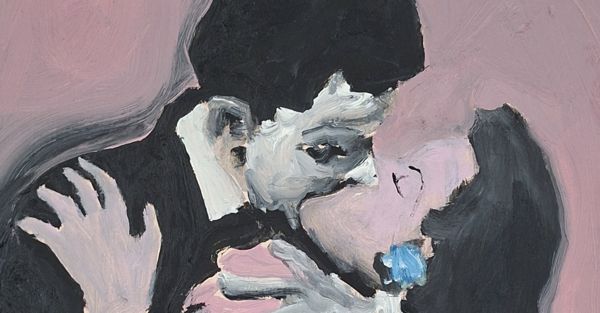
Luca Giovagnoli’s exhibition at the Palazzi dell’Arte in Rimini: nature, the sea and beauty

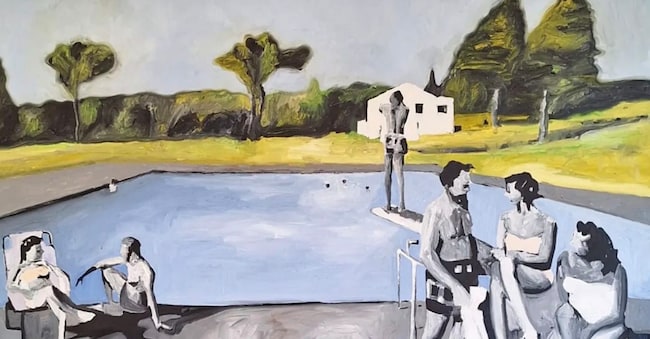
Every city cherishes an image of itself that does not correspond to its history, but to its aspirations; and Rimini, from this perspective, is not merely a seaside resort or the capital of an Italian season now consigned to family photo albums, but a vehicle for the imagination, a promise of happiness that continues to produce images even when that happiness itself has already faded. It is within this sentimental landscape that ‘Summer Dream’ unfolds, the exhibition dedicated to Luca Giovagnoli at the Palazzi dell’Arte, in the heart of the city’s historic centre. The artist – represented by Matteo Sormani, founder of Art-Preview and director of Augeo Art Space – paints time as if it were a photograph left in the sun for too long. On his canvases, the colours do not fade, but change in nature; and so pink invades the sand, the skin and the sky, whilst the blue ceases to depict the sea, becoming a mental space instead. ‘Each canvas seems to recall something that probably never happened, and this is precisely the strength of his painting: transforming memory into fiction without it losing its emotional truth,’ explains curator Valentina Ciarallo.
The artist from Rimini belongs to that rare category of painters who do not seek to evoke a sense of nostalgia through allusion. The 1950s and 1960s, the beach huts, the striped parasols, the diving boards and the retro swimwear are not reconstructed with historical accuracy, but serve as narrative elements – the vocabulary of a story about anticipation, desire, eros and, above all, time standing still. The temptation would be to immediately evoke Federico Fellini. After all, Rimini makes this conditioned reflex almost inevitable.
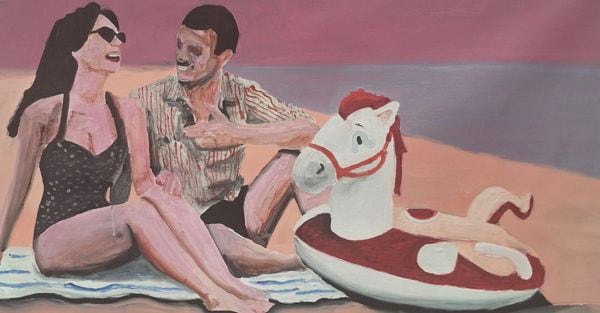
Yet the relationship between Giovagnoli and the director is not one of iconographic homage, but rather concerns a certain way of looking. As in Fellini’s private drawings, here too desire gives rise to figures that seem like apparitions amongst enigmatic women, pensive men and couples frozen in the moment just before something we shall never see. The painting functions as a still frame, and the viewer always arrives a second too late or a second too early. The narrative, in fact, is entirely entrusted to ellipsis. No painting truly tells a story, and every scene possesses the grammar of cinema. A kiss, a figure on a trampoline, a girl doing the washing, a group of friends sitting at a café table. These are all fragments that seem to ask the viewer to complete the story with their own memories. In this sense, Giovagnoli focuses more on psychology than on anecdote, and his characters – as the curator points out – ‘exist in a state of slight estrangement: they are at once very close and yet unattainable’. Melancholy does not stem from loss, but from the distance that separates each individual from their own ideal image. Summer thus becomes a state of mind, not a season on the calendar.
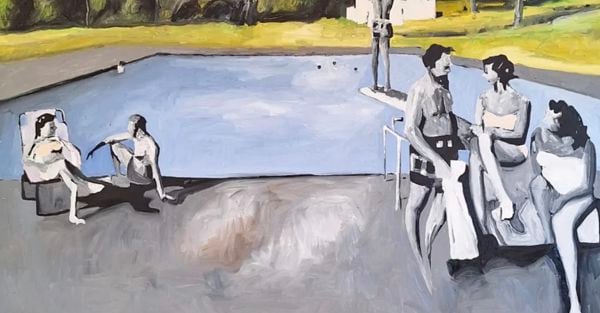
His painting is textural, built up with broad swathes of colour, minimalist in its composition, almost obstinate in its omission of detail. Faces are simplified to the point of becoming masks of memory. The surfaces forgo perspectival depth and everything seems to take place in a flat, silent dimension, where colour takes on the role that elsewhere would fall to the narrative. Eros runs through many of the works without ever becoming provocative. It is a cinematic eroticism, built on distance rather than on display. High heels, white socks, hotel rooms, Venetian blinds filtering the light, bodies hidden rather than revealed. The tension arises from what remains off-screen, and once again it is cinema – rather than a chronicle of desire – that dictates the rhythm of the images. The exhibition – part of the ‘Estate Contemporanea’ programme, running until 13 September at the Palazzi dell’Arte in Rimini, alongside ‘Sailing to Byzantium. 6 Artists from New York, curated by Richard Milazzo – also presents a different vision of Rimini, far removed from both the seaside postcard image and stylised nostalgia.
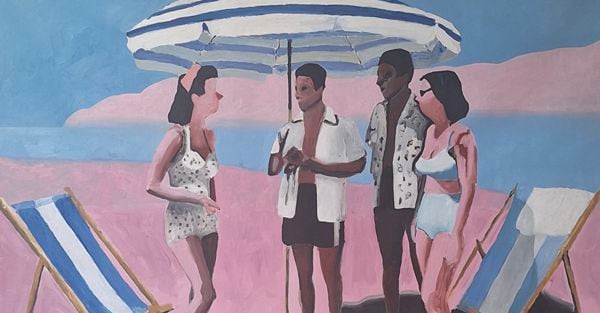
It is an inner city, filtered through the artist’s personal memory and yet one that anyone who has experienced that sense of imperfect happiness – which accompanies summers remembered more fondly than those actually lived – can relate to. Giovagnoli places his faith in the enduring power of images and makes no claim to explain the present; instead, he prefers to construct a sentimental archive in which we can recognise something of ourselves, so much so that, at the end of the visit, an unusual sensation lingers: that of having journeyed through a summer that belongs to everyone and to no one. An imagined summer, perhaps invented, and precisely for this reason capable of appearing truer than many accounts of reality.