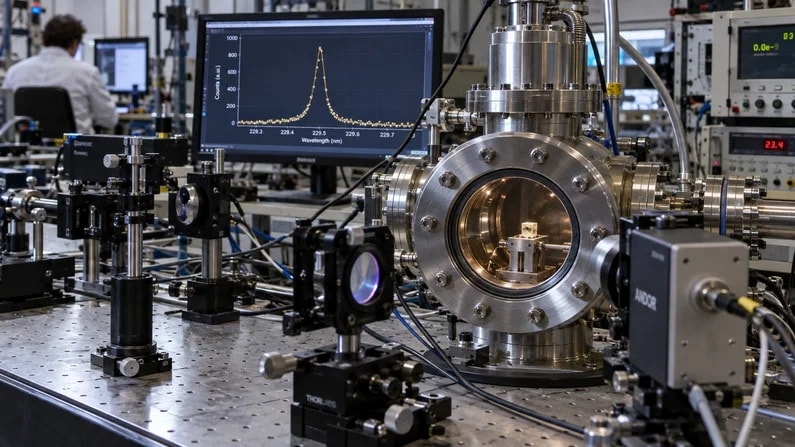
The Lutetium-176 atomic clock is a record-breaker. But the Thorium-229 one is hot on its heels
New technologies that use rare isotopes to measure time with unprecedented precision are opening up new frontiers in science

Key points
‘Wait a second’, ‘I’ll be there in a second’. We all say it, even when we know full well that it will take a little longer. In everyday language, a ‘second’ has come to mean a very brief interval. In science, however, it is a unit of measurement that must be defined and reproduced with the utmost rigour. It is the final stage in a story that began with the observation of the alternation of day and night and the movement of the stars: the search for a regular rhythm by which to organise our lives.
Today, this research also involves a little-known chemical element, Lutetium. Some of its isotopes – different forms in which the element’s atom occurs – are used in nuclear medicine; whilst another, lutetium-176, is at the heart of the new optical clock developed at the Centre for Quantum Technologies at the National University of Singapore. This new record-breaking atomic clock has achieved a relative uncertainty of approximately 1.2 parts per ten billion billion: to put this into perspective – assuming we can even imagine it – this is equivalent to a deviation of just one second in around 260 billion years. It is clear that this is not a verified operating lifespan, but rather a way of expressing an uncertainty estimate in a more visualised form. It is currently the best of the best; indeed, the authors – perhaps exaggerating slightly – claim that it cannot be improved upon. We shall see.
From the pendulum to the laser
To understand how it works, we can start with the pendulum. A watch requires a phenomenon that repeats with great regularity and a system to count those repetitions. As precision increases, in a pendulum the mechanical oscillations – which are, as far as possible, always identical – are counted; in mechanical watches, even very expensive ones, the harmonic motion of a balance wheel is used, whilst in quartz watches, even those costing just a few tens of euros, the frequencies of the quartz crystal itself are utilised. The new instrument from Singapore uses laser light, the rhythm of which is continuously controlled thanks to the properties of a single atom.
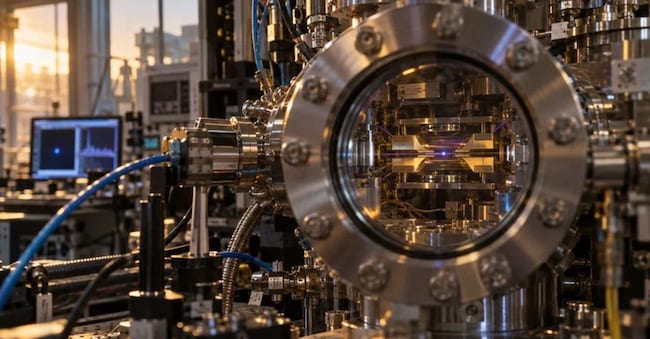
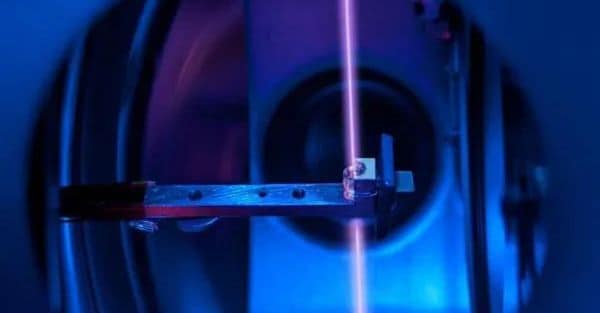
More precisely, it is an ion: in other words, it consists of a lutetium atom from which an outer electron has been removed, causing it to acquire a positive charge. It is suspended in an electromagnetic trap using electric fields, without coming into contact with any surface. Lasers and control systems operate around this microscopic component: as we have already realised, this is a laboratory instrument, not a device to be worn on the wrist.
The solution: the atom as a sort of tuning fork
The electrons in an atom can only occupy certain energy levels, like the steps on a long staircase. To move from one to another, they must absorb just the right amount of energy, which corresponds to a specific frequency of light. The researchers tune the laser to the chosen transition and use the ion’s response to fine-tune it; this is the solution: the atom acts as a sort of tuning fork with which to tune the instrument. It is the oscillations of light, not the movements of the atom, that mark the time! In the case of lutetium, the light used is in the near-infrared region, at a wavelength of approximately 848 nanometres. It sounds complex, but conceptually it isn’t: we isolate an electron from its atom; the atom becomes positively charged and is no longer neutral. We then trap it in a special cage, shine a laser beam on it and determine what frequency is needed to make the electron vibrate as it moves from one energy level to another.