Airlines

Luxury in the air: the battle between airlines is being fought in the Economy and Premium Economy classes

The new frontier in air travel is comfort: today’s passengers are willing to pay for a better experience. Airlines are investing in innovative and high-tech products

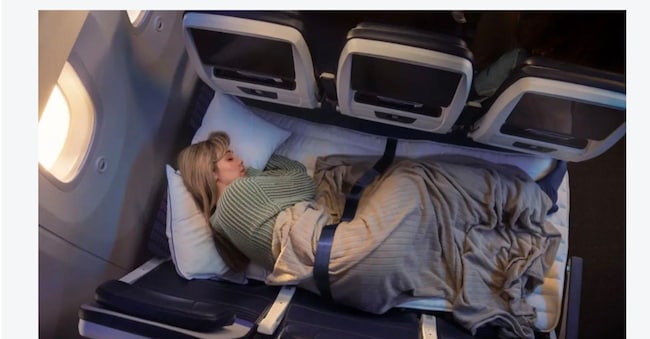
L’economy Class di United, la Relax Row, che diventa letto

6' min read

Translated by AI
Versione italiana

6' min read

Translated by AI
Versione italiana

Demand for air travel shows no sign of slowing down, despite rising fuel prices and the inevitable knock-on effects on ticket prices. What is making the difference at this stage is, above all, passengers’ willingness to spend a little extra to travel in greater comfort. This trend is rapidly changing what airlines have to offer, particularly on long-haul routes.

The class benefiting most from this transformation is the one between Economy and Business: Premium Economy. But this trend is no longer limited to business travellers. More and more leisure passengers – that is, those travelling on holiday – are choosing to pay a surcharge for more space, greater privacy and a more comfortable seat, especially when the flight lasts eight, ten or more hours.

Loading...

The quarterly results from Delta Air Lines and United Airlines confirm the strength of demand on the transatlantic market: in the second quarter, revenue on this route rose by around 7 per cent and 10 per cent respectively. This robust demand thus continues, at least for now, to offset the impact of higher fuel costs. All US airlines are adding routes to Europe: the latest to do so is United, which from next May will operate flights to Cagliari and Olbia from Newark/New York, and to Milan Malpensa from Washington DC.

The new frontier is comfort

Airlines are tapping into a willingness to spend that, until a few years ago, was concentrated mainly on Business Class. Today, however, passengers seem to want one specific thing: a few extra hours’ sleep, more legroom, a wider seat and the chance to arrive at their destination feeling less tired.The latest generation of aircraft – which are more efficient and designed to handle ever-longer intercontinental flights – have helped drive this trend.

And the segmentation of the product range has become increasingly sophisticated: it is no longer simply a case of Economy versus Business, but rather a whole range of intermediate products. Even Economy class is changing. Some airlines offer seats with extra legroom, whilst others allow passengers to purchase the adjacent seat, a solution designed not only for those seeking comfort but also for those who want to avoid spending many hours in close proximity to their neighbour.

United is focusing on Economy seats that convert into beds

One of the most interesting examples comes from United Airlines, which has announced the ‘Relax Row’, a new solution for Economy class due to be introduced from 2027. The idea is as simple as it is effective: a row of three seats can be transformed into an almost flat surface using a dedicated mattress and pillow. The solution is designed primarily for long-haul and overnight flights, for families but also for solo travellers, offering an alternative between traditional Economy and Premium Plus.

The Relax Row will be situated between Economy and Premium Plus and will comprise 12 dedicated rows on each aircraft in the scheme. Its introduction on the Boeing 787 and 777 is scheduled to take place as part of the development programme by 2030.

The message is clear: comfort is no longer necessarily synonymous with Business Class. There is a segment of passengers willing to pay a significant premium – though not necessarily the price of a premium cabin – just to be able to sleep on an intercontinental flight. At present, no details have been released regarding the price of this configuration, but it is hoped that it will be lower than that of Premium Economy.

United is not, however, the first airline to try this approach. Air New Zealand had paved the way with its Skycouch project, which allows a row of Economy seats to be converted into a larger space where passengers can relax or sleep.

In Europe, Lufthansa introduced ‘Sleeper’s Row’ in 2021, and on the new Allegris aircraft in Economy Class on certain long-haul routes such as São Paulo, Los Angeles and Singapore: here too, three seats convert into a bed complete with a mattress and pillow. However, this option cannot be booked in advance, as the airline has chosen to retain the last-minute booking system. This means that passengers can purchase a ticket even whilst at the gate, whilst waiting to board. By doing so, Lufthansa is able to sell seats that would otherwise remain unused. For those lucky enough to secure the row of seats, the supplement ranges from 159 to 229 euros per leg.

Loading...

Delta and American are pushing ahead with Premium Economy

Delta Air Lines’ strategy is somewhat different. The American airline is investing primarily in the premium segment, with a genuine Premium Economy class designed to offer a significant step up from standard cabin.Delta Premium Select offers, on eligible aircraft and in eligible configurations, more personal space, wider seats, greater recline and a legrest or footrest. On some international routes, legroom extends to around 38 inches. It is not a fully flat bed, but the difference compared to traditional Economy can be substantial. And it is precisely this mid-range category that is becoming increasingly important for those facing a long-haul flight but who are unwilling or unable to afford the cost of Business Class.

American: from Premium to the new Business

American Airlines, on the other hand, is taking action on several fronts. In terms of Business Class, the new Flagship Suite focuses on privacy and an experience more akin to that of a small private cabin. The product features a door, a fully reclining bed, a built-in chaise longue, wireless charging and a large entertainment screen. The chaise longue is one of the most interesting features: it allows passengers to adopt a more relaxed position without necessarily having to convert the seat into a bed straight away.

At the same time, American is introducing a new Premium Economy class on its Boeing 787-9s and refurbished Boeing 777-300ERs. The aim is to create an ever clearer distinction between traditional Economy class and passengers willing to pay a surcharge for a better in-flight experience.

Delta One and the return of the suite

In the American business class market, Delta remains one of the leading players with its Delta One service. The latest configurations offer seats that recline fully to 180 degrees and, in some cases, fully-fledged suites with a door to ensure greater privacy. The airline is also introducing a new generation of Delta One Suites on the Airbus A350-1000 and is upgrading the A330-200 and A330-300.

For those travelling on transatlantic routes such as London–New York, the difference compared with Economy Class is clear: you are not just buying a better seat, but a completely different product, designed to allow you to work, eat and, above all, sleep during the flight.

Alaska and Hawaiian: betting on long-haul routes

The integration of Alaska Airlines and Hawaiian Airlines is also creating new opportunities for intercontinental flights, such as the route from Seattle to Rome.

The Boeing 787s operated by Hawaiian on long-haul routes feature a Business Class with suites complete with a door and fully reclining seats. This product is of particular interest, especially given the expansion of transatlantic routes and passengers’ growing focus on comfort on long-haul flights.

The economy is becoming increasingly tech-driven

The competition isn’t just about seat comfort. Another area of comparison is entertainment and connectivity. High-definition personal screens, Bluetooth, USB-C ports and power sockets are becoming increasingly important features even for Economy Class passengers. These may seem like minor details, but they can make all the difference on a ten- or twelve-hour flight.

American Airlines, for example, is once again focusing on individual screens following a period in which the industry had been considering reducing their use. The airline plans to install personal entertainment systems on over 800 narrow-body aircraft, featuring 4K QLED screens, USB-C ports and AC power sockets.

United and Delta are also investing in this area. Delta, in particular, is developing integration between the in-flight screen, Bluetooth and the Delta Sync platform, making the in-flight entertainment system an increasingly central part of the travel experience.

New passengers pay for a better experience

The transformation currently taking place in air travel therefore reflects a more profound change. Passengers are not necessarily choosing between Economy and Business class: increasingly, they are tailoring their own journey by purchasing individual comfort options.

More legroom, an empty seat next to you, a Premium Economy seat, a seat that almost turns into a bed, or a Business Class seat with a door. Airlines are segmenting their offerings to cater for different spending levels, without neglecting the demand from those seeking a superior experience. This is a particularly important trend in a context where fuel continues to represent a significant cost.

As long as demand remains strong, particularly on international routes, airlines will have a strong incentive to sell not just seats, but different levels of comfort.The real change, therefore, could well be this: the future of air travel depends not only on how many passengers fly, but on how much each passenger is willing to pay for a better flying experience.

Copyright reserved ©
Loading...

Brand connect

Loading...

Newsletter

Notizie e approfondimenti sugli avvenimenti politici, economici e finanziari.

Iscriviti