Dining with

The crisis in manufacturing, the European dilemma and Italian excellence

Lorenzo Mariani. Leonardo’s chief executive talks about his roots in Rome’s scientific and industrial middle class and outlines the future of the security industry against a backdrop of geopolitical uncertainty

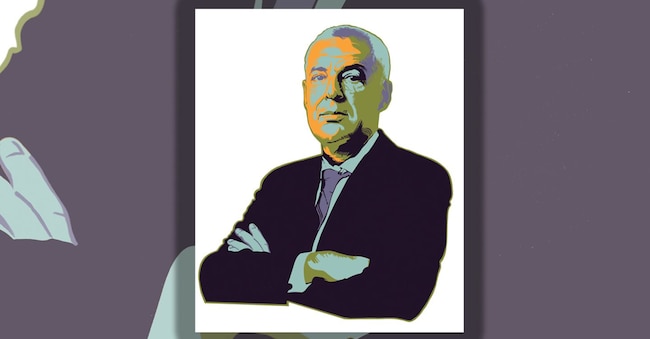
Il percorso. Lorenzo Mariani è Amministratore Delegato e Direttore Generale di Leonardo dal 7 Maggio 2026. Figura manageriale di riferimento nel settore aerospazio, difesa e sicurezza, ha conseguito la laurea in Ingegneria Elettronica con lode nel 1990 ed ha prestato servizio come ufficiale di Marina nel 1991 (Illustrazione di: Ivan Canu)

7' min read

Translated by AI
Versione italiana

7' min read

Translated by AI
Versione italiana

‘Today, we are being shaped in a traumatic and violent way by the speed of change. In the 1990s, when I started at Finmeccanica, the phenomena that caused total upheavals in industrial systems occurred every ten years. Then, through the combined influence of technology, manufacturing and geopolitics, this interval fell to six years. This initial dramatic shortening of the major cycles held true until 2019. Now it has halved. In these difficult times, everything changes every three years.”

Lorenzo Mariani is the chief executive of Leonardo. We are in the guest quarters on Piazza Monte Grappa, on the top floor. Through the windows, you can see St Peter’s Basilica and the Altar of the Fatherland, the flags of the Quirinale and the Pincio. Before we start eating, Mariani outlines the particular psychological and emotional state of a company director and the specific strategic and operational profile of every modern business: ‘It is not a situation that terrifies or overwhelms. But there is certainly an awareness that this represents a new and radical challenge for those leading large technology and manufacturing conglomerates. It has never happened before. In every industrial sector, artificial intelligence is leading to shorter design and production lead times and a reduction in capex – the fixed capital expenditure that once represented a very high barrier in every sector. Today’s landscape is characterised by shorter lead times, lower capital expenditure and the removal of barriers to entry.”

Loading...

Mariani, an engineer, represents the low point – and the new beginning – of an Italian industrial history which, over the long term, is directly part of the flow of the future. He is a senior executive at Leonardo-Finmeccanica who has been entirely ‘shaped’ by the history of this manufacturing company, which plays a central role in Italy’s techno-industrial balance and dynamics. He joined as a young man, shortly after completing his studies. He has risen through the ranks entirely within the company, working across research and production, sales and markets, technology and geopolitics. Mariani says: ‘The general context for the Old Continent is one of a decline in manufacturing. For over half a century, the automotive sector has formed the backbone of the industrial system. The crisis in the Western car industry is having a significant impact across the whole of Europe. At Leonardo, we are at the forefront of many international technological frontiers. And, thanks to our manufacturing facilities and our national supply networks, we are a solid backbone and an active source of resilience for Italia as a nation of factories.”

For starters, both are served a seafood salad. Mariani’s background is Roman, though not in the sense of the politics and bureaucracy that characterise the capital, but in the sense of the business culture – often overlooked and overshadowed by the first two – which has existed in Rome ever since the 1930s, when it became the linchpin of the public industry created by Alberto Beneduce’s IRI and which coalesced around Finmeccanica in the post-World War II period.

Mariani – born and brought up in the Trieste neighbourhood, with a degree in engineering from the University of Rome 1 – belongs, by family background, to a particular – and rare – type of Roman middle class: the scientific professional middle class, another hidden and influential minority within Roman society which, in physics for example, has produced figures ranging from the young men of Via Panisperna to Giorgio Parisi. In Lorenzo’s family, his mother Concetta, a graduate in pharmacy, and his father Aurelio, a chemist, both worked at the National Institute of Health. ‘My father,’ recalls Mariani, ‘had very close research ties with French, Swedish and German scientists.’ This was something of a rarity in Rome, where the middle class usually has a legal and administrative background and vocation. “My family,” he explains, “has always had a multifaceted outlook. Alongside the scientific and technological aspects, there is also a humanistic and artistic dimension. My paternal grandfather, Lucio, was a painter and an archaeologist, and director of the Museum of the Baths. He took part in the excavations at Leptis Magna in the Libyan desert, where the Arch of Septimius Severus, Hadrian’s Baths and the Severan Basilica were unearthed. My great-grandfather, Cesare Mariani, was a religious painter who created frescoes in churches and basilicas across Rome.”

First up is a plate of spaghetti with clams. The wine is a Greco di Tufo, served cold, almost ice-cold. Mariani, like many managers and executives at the then Finmeccanica, completed his military service as an officer, spending just under a year and a half in the Navy in Livorno. Shortly afterwards, in 1992, he joined Alenia Defence, whilst the head of the entire group was the chief executive, Fabiano Fabiani. He recalls this as he alternates between a sip of white wine and a sip of mineral water to beat the heat: ‘The first six years were another form of elite military service. I was involved in research and pure, hard-core engineering. I was based between Rome and La Spezia. My work centred on product design in the naval sector, in radar factories, and in the development of equipment.’ In 1998, when Finmeccanica’s chief executive was Alberto Lina and, at the intersection of politics and economics, the privatisation of the group – which would lead to its listing in 2000 – was beginning to take shape through the financial engineering of Mario Draghi, Director-General of the Treasury, Mariani made the classic leap that transforms factory and laboratory engineers into businesspeople: he moved into sales, which, in Finmeccanica’s specific case, involves – more so than in many other companies – a significant geopolitical dimension. Indeed, those who manufacture helicopters, civil and military electronics, radar and security equipment operate in markets where demand comes not only from companies but also from governments. Mariani notes: ‘In some ways, my career path formed a small piece in the mosaic of a company which, throughout the second half of the twentieth century, possessed an immense industrial and technological heritage, though this was not always translated into concrete business opportunities. This drive towards the market, combined with the modernisation of governance brought about by the company’s listing, made the company’s operations more agile, precise and effective. This was true even at the middle and operational levels, of which I was a part at the time. In 2002, I joined MBDA for the first time, Europe’s leading consortium specialising in missiles and defence technologies for land, air and sea. I learnt a lesson back then that still holds true today: European collaboration – in that case ensured in the shareholding structure by the joint presence of Finmeccanica, BAE Systems and Airbus – is a necessary and effective option.”

Breaking with the rule that a business lunch should consist of just one dish, we both opt for sea bass baked in salt with spinach on the side. His promotion to a senior management role came at Selex, the group’s electronics company, where, from 2015, Mariani became a top-level executive reporting directly to the then CEO, Mauro Moretti. Amid the complexity of the Italian government’s decision – as the largest shareholder, via the Ministry of Economy and Finance, holding 30.2 per cent of the share capital – to appoint a CEO of a unique nature such as that of Leonardo, Mariani earned his stripes with his return as a seasoned manager to MBDA in 2020: ‘The worst thing I ever did was when, as managing director of Selex, I was timid and indecisive, failing to change what I should have changed. The best thing was the development of MBDA, with turnover increasing from 3 to 7 billion euros over five years and orders rising from 4 to 13 billion. This growth has benefited the Italian industrial sector, which has grown two and a half times over the same five-year period. MBDA’s model works for the military market, with its dual structure of shareholder companies and governments, the need to verticalise processes, consolidate supply chains and speed up decision-making, and the creation of a European champion. For the civilian market, however, this model comes up against too many veto powers held by individual countries.”

A fruit salad arrives, followed by coffee. The world is indeed changing at the speed of light. The manufacturing sector is undergoing a complex and drastic restructuring. At the intersection of geopolitics and geoeconomics, the United States retains its lead in public (and private) capital in highly sensitive and high-security sectors, whilst China, with its reticence and its effective interpretation of state capitalism, remains an unknown quantity. ‘Europe has significant problems. But it also has important resources. The specific industrial cultures of individual countries complement one another well. Let us try to take this into account. The German approach, the French system, British innovation, Swedish organisation and the increasingly structured flexibility of us Italians are not mere rhetorical concepts. They are real elements which, when compared with the United States and China, we as Europeans can bring to bear. In these difficult times, Leonardo has many factors in its favour, and therefore in favour of Italia and Europe: for example, our strength in electronics, which, together with cyber-security and artificial intelligence, is the new glue binding together the aeronautical and naval sectors, radar technology and helicopter manufacturing, in times of war and peace’, concludes Lorenzo Mariani, the last heir to a lineage of business leaders forged in engineering faculties and on the battlefield shaped by the highs and lows of the public and post-public economy, and, at the same time, by the rigours of the market.

Copyright reserved ©
Loading...

Brand connect

Loading...

Newsletter

Notizie e approfondimenti sugli avvenimenti politici, economici e finanziari.

Iscriviti