
The Marco Polo of Renaissance artists confronted with Generative Artificial Intelligence

The text of the so-called 'Description of the World' about the travels of the famous Venetian traveller, Marco Polo, was written together with Rustichello da Pisa during their imprisonment in Genoa in the late 13th century. This work significantly broadened Europe's understanding of Asia, going beyond classical Greek and Latin sources and biblical teachings. Among the numerous manuscript copies in various European languages, some are illuminated by renowned Renaissance artists working for high-ranking patrons. The images illustrated salient events in the Polyane narratives and did not merely illustrate, but complemented, altered and sometimes even contradicted the textual content, depending on the artists' interpretations and the patrons' requests.
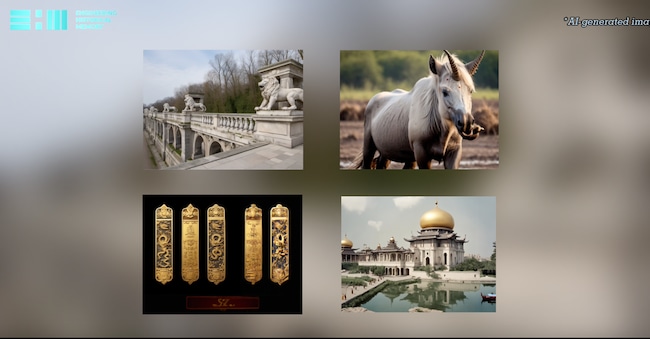
Leaping forward to the present day, generative artificial intelligence (IAG) has revolutionised the world of visualisation in the transition from text to image. IAG models produce highly realistic images in different styles from textual cues, offering new ways to visualise historical and cultural narratives. In an innovative project led by Dr. Andrea Nanetti, Professor at the Canton Academy of Fine Arts in China, and Dr. Li Boyang, Professor at Nanyang Technological University in Singapore, students combined traditional research methods with IAG tools to study certain polyane descriptions, such as the so-called Marco Polo Bridge, still visible today in Beijing, the Sumatran rhinoceros, Mongolian passports, and Yuan dynasty palaces.
The Lugou Bridge in Beijing, revered by Marco Polo as the most beautiful in the world, epitomises the way historical descriptions intersect with visual representation. Renaissance artists imagined the bridge in line with what they knew from experience. The IAG images revealed discrepancies and reinterpretations, omitting some features or adding others, demonstrating that both medieval artists and contemporary AI are influenced by their respective archives of visual knowledge.
Similarly, Marco Polo's reference to animals comparable to the unicorn - when the narrative realistically describes the Sumatran rhinoceros - was visualised in the illuminated manuscripts as a white horse with a long horn in the middle of its forehead. The description of Mongolian paiza, metal passes issued to officials, further exemplifies the relationship between text and visual representation. The students used the IGA to create 3D models by combining Marco Polo's descriptions with original paiza preserved in various museums around the world. Similarly, Marco Polo's detailed descriptions of Yuan dynasty palaces, with their opulent gold decorations, complex architecture and vast halls, were also translated into 3D digital reconstructions. The unassisted IAG slips into drifts similar to those of Renaissance artists, but can be well directed with the integration of contemporary visual materials from archaeological sites, museums and libraries.
These experiments conducted between Singapore and China at the intersection of art history, artificial intelligence and extended reality product design are freely accessible on the award-winning digital platform Engineering Historical Memory (EHM), along with geolocalised toponyms and specialised information on Marco Polo. EHM now collaborates with the International Committee for Historical Sciences (CISH, Bern, Switzerland) through an internal committee for computational sciences and history chaired by Professor Andrea Nanetti, while the vice-chair is Professor Wang Jun, founder and director of the Digital Humanities Research Centre at Peking University. Together, EHM and the CISH aim to promote dialogue between computer science scholars and professionals from around the world by encouraging and supporting collaborative interdisciplinary projects, knowledge exchange and the dissemination of innovations.

