
The marriage of fashion and design grows thanks to luxury projects
Collaboration between the two sectors evolves towards a more contemporary style and an increasing research content

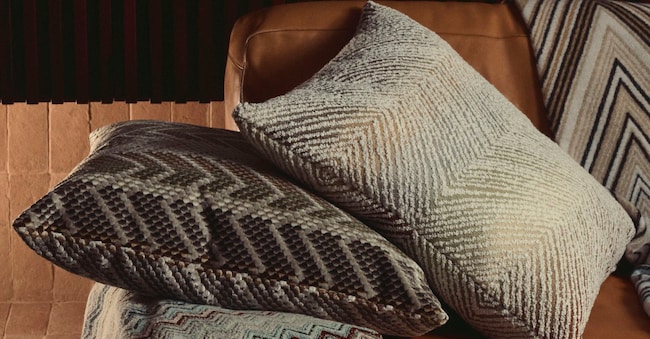
Despite the slowdown of the global luxury market in 2025, there is no end to the interest of the big fashion brands in the home sector, which is considered strategic to guarantee their customers a complete, all-round experience of their brand values and aesthetics.
A market in turmoil
"We are constantly receiving requests for new collaborations from fashion and luxury companies," confirms Andrea Gentilini, ceo of Luxury Living Group (Haworth Lifestyle Group), which produces the home collections of Fendi, Versace, Dolce&Gabbana, Trussardi, Bentley and Bugatti under licence. "At the moment, however, we are busy consolidating our brand portfolio, which is already very busy, especially after the return of Fendi Casa to our group last summer." During Design Week (scheduled from 20 to 26 April), we will in fact see the brand's new collections on display, produced in the Forlì factories of Luxury Living Group (LLG), which together with Fendi, way back in 1987, was one of the first to initiate the combination of fashion and design that would later become so successful and followed, thanks to an intuition of the then owner of the Emilian group, Alberto Vignatelli, and the Fendi sisters. In 2021, Fendi Casa then passed under the control of Design Holding (now Flos B&B Italia Group), managed by a new company, Fashion Furniture Design, which was 100% taken over by LLG last July.
Retail in contraction, large projects good
According to Gentilini, we are witnessing a 'rebalancing between markets. Retail has contracted in some geographies, particularly Russia, China, the United States and unfortunately, after the start of the war in Iran, also in the Middle East. But projects for branded residences or private villas on the other hand continue to grow, even in the Gulf area, and this has allowed us to achieve our growth targets and we are confident that the development path will continue". According to Gentilini, there is also a stylistic evolution of the market towards a taste that is more oriented towards contemporary and design, to research and innovation content, but also to 'mix&match' proposals, going beyond the idea of 'total look' that has characterised this sector for years.
The importance of the large projects market is also confirmed by Moreno Brambilla, president and managing director of Oniro Group, which produces the home collections of Roberto Cavalli, Gianfranco Ferré, Etro and Jacob&Co. under licence. "Contract projects and branded residences are increasingly central to our strategy," he explains. "2025 was a year of progressive relaunch, supported by a pipeline of international projects and a strengthening of collaborations with fashion and lifestyle brands. The year 2026 will mark a more structured growth, thanks also to our ability to intercept the evolutions of the contemporary luxury market, which is increasingly oriented towards integrated experiences and customised projects'. Looking ahead, Brambilla says he is certain that the "fashion-furniture" phenomenon is a movement "destined to accelerate, also because it is part of a broader dynamic: the convergence between fashion, design, architecture and hospitality".
Growth forecasts for 2026
The CEO of Missoni, Livio Proli, also confirms the growth trend expected for 2026, for the entire group, as well as for the Home division, founded in 1983, which today accounts for about 20% of total sales: "For 2026, the group is aiming for stable single-digit growth. The Home line will meet this forecast, thanks to international expansion and an increase in customised projects and greater integration with the real estate and hospitality worlds".

