We learn from our mistakes

The marshmallow challenge and the secret of effective collaboration

Children and adults face the marshmallow challenge: the real strength lies in the way they interact and collaborate authentically.

by Giulio Xhaet*

Adobestock

3' min read

Translated by AI
Versione italiana

3' min read

Translated by AI
Versione italiana

Do you know the marshmallow challenge? Somebody certainly does, but you are probably missing some surprising details.

It is 2006, and designer and engineer Peter Skillman organises a competition unlike any other, to prove an insight of his, namely that in groups that have to work together and have little time to bring a goal home, individual skills are less important than people think.

Loading...

He thus put together teams of four and issued them with a challenge.

As Daniel Coyle recalls in The Collaboration Code, the groups were of 2 types. On the one hand, business students and prestigious business schools, managers, engineers, lawyers. On the other... children who went to kindergarten.

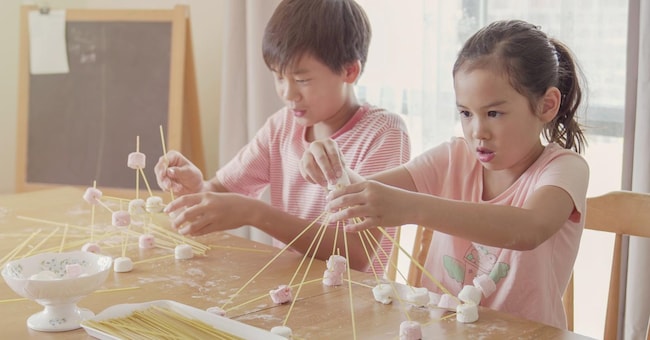
The groups had to build the tallest possible structure, using these materials: 20 uncooked spaghetti, 1 metre of tape, 1 metre of string, 1 marshmallow. One rule: the marshmallow must be placed at the top of the structure.

What happened? The business students and other professionals devised strategies, examined materials, formulated thoughtful questions. They thought about different options, reasoned rationally and intelligently. The process led to action: they divided up the tasks and began to build.

And the children? They did not elaborate any strategies. They did not analyse, they did not share structured ideas, they did not ask questions. They stood very close together. They fumbled relentlessly, often taking materials from each other's hands.

They were communicating in monosyllables: "Here!" "No, here!" "Noooo, wait, here!" Their technique? Assembling a lot of things together.

Dozens of challenges were issued to test Skillman's hypothesis in a proven manner.

And here are the results: on average, the groups of students and professionals built structures 25 centimetres high. The average for the groups of kindergarten children was 66 centimetres. More than twice as high. In short, the children systematically asphalted the adults.

How is this possible?

To understand this, we start by confirming Skillman's hypothesis: in group challenges, individual skills are tremendously overrated.

What really matters, and is almost always underestimated, is the mode of interaction.

The business school students seemed to be collaborating, but were actually involved in what psychologists called role management, characterised by 'nervous' questions people asked themselves before and during the competition: "What are the rules with others?" "Who is in charge, who makes the decisions?" "Can I criticise someone's idea?"

Which led to a hesitant and subtly competitive style of interaction. Self-limiting, theoretical, impractical. Rule-following, difficulty-ridden.

Instead of focusing on the goal, they were so concerned about not damaging their social role that they missed the essence of the problem: the marshmallow weighs more than it looks and the noodles alone collapse!

The actions of the children in comparison to the adults seemed like a ramshackle racket, but in reality they distilled a forge in ferment: they took risks side by side, experimented, made mistakes and quickly understood how to solve problems.

And of course, he didn't care about social roles.

Perhaps the most important lesson? Daniel Coyle recalls: 'The kindergarten children succeeded not because they were smarter, but because they really worked together. Therefore, a group of people who are less competent on paper can achieve results that are more than the sum of their parts'.

In short, groups do not always work better than individuals, on the contrary. In order to be able to express the Aristotelian maxim of the group going beyond the sum of individual skills, we should observe very carefully how children behave.

* Partner & Head of Communication Newton Group

Copyright reserved ©
Loading...

Brand connect

Loading...

Newsletter

Notizie e approfondimenti sugli avvenimenti politici, economici e finanziari.

Iscriviti