Climate change

Climate and shipping: how the Mediterranean is invaded by alien species

From scorpion fish to jellyfish in the Pacific, through burnt forests in Spain and the erosion of marine biodiversity: the Mediterranean is transforming. Blame climate, shipping traffic and lack of prevention. Scientists sound the alarm: 'The sea we knew is disappearing'

by Davide Madeddu (Il Sole 24 Ore) and Ana Somavilla (El Confidencial, Spain)

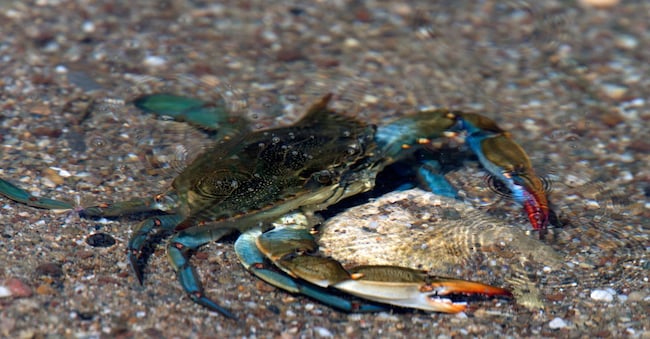
Un granchio blu, specie introdotta o aliena nel Mediterraneo dall'America, a Manavgat, in Turchia (Alamy Stock Photo)

4' min read

4' min read

They arrive quietly, hidden in the ballast water of merchant ships or attached to the keels. They are fish, jellyfish, algae and invertebrates from distant seas, which find an increasingly tropical habitat in the Mediterranean. And they stay there. The result? A sea that changes face, driven by global warming and the globalisation of maritime transport, while native species retreat or disappear.

"Among the main factors in the introduction of alien species is maritime traffic," explains Manuela Falautano, a researcher at Ispra. "Through ballast water and organisms encrusted on keels, but also through the Suez Canal, aquaculture and the trails left by boats. The result is an increasing presence in our seas of fish that have nothing to do with the Mediterranean fauna.

Loading...

Increased sightings and catches

.

In the last year, sightings and catches of scorpion fish (it is edible but the spines can cause very painful bites even 48 hours after the animal's death), spotted puffer fish (the species has a powerful neurotoxin that makes it highly toxic when eaten, even after cooking. In addition, it has powerful teeth with which it can inflict painful bites), dark spotted pufferfish and striped pufferfish (herbivorous species that are edible but have spines that can cause painful bites even after the animal's death). It is no coincidence that Ispra and the CNR have also launched the 'watch out for those4!' awareness campaign.

The Mediterranean is changing

.

Presences that, as the researcher points out, are a sign of the sea that is changing. "The Mediterranean is suffering," the researcher argues, "with the presence of aline species and a depletion of resources. Moreover, biological cycles have been altered. Alien species are of sub-tropical and tropical affinity, while typical ones are suffering'. Playing an important role in this scenario are the researchers who carry out constant monitoring of marine environments. "Monitoring is being carried out and must be increased, as must applied research," the researcher adds. "Furthermore, it is necessary to make the community aware of its responsibility to behave in an environmentally friendly manner.

And the change also brings with it other alien species: these are the Pacific Jellyfish and the vegetation that arrives from other seas and manages to resist despite the different environment.

More monitoring required

.

Stressing the importance of research and monitoring is Ernesto Azzurro, a researcher at the CNR, also in the light of the sightings recorded especially in the Ionian Sea. "The observation of a new tropical species may arouse curiosity, but it is actually only the tip of the iceberg of a profound upheaval in marine biodiversity," he says. "The Mediterranean, as we have known it, is disappearing. Species no longer adapted to the new climatic conditions are rapidly regressing, and among them many that for millennia have represented our nourishment, our culture and our traditions. This process is leading to the formation of new ecosystems, with profoundly different and as yet largely unknown ecological arrangements.

A mix of factors

.

So the causes 'depend on multiple factors'. "In particular, as far as biological invasions are concerned, it is crucial to remember that alien species must first be introduced into a new environment, a process that by definition takes place thanks to human activities,' he adds. 'Think, for example, of the opening of the Suez Canal in 1869, which created a direct corridor between the Red Sea and the Mediterranean, or the numerous vectors, such as ships' ballast water. It is very important to be able to recognise these new species, also to prevent potential risks such as poisonous spines or toxic meat'. In this scenario there is the role of citizens who 'can make a fundamental contribution to monitoring biological invasions, simply by reporting their observations to the scientific community'.

The role of citizens

.

Quite complicated then, as is the case on land, to proceed with eradication since 'the vastness of the sea makes this impossible'. 'It would be desirable for all of us, as citizens, to become more aware of the extent of these changes,' he concludes. 'Only in this way will we be able to make our voice heard by the political class. It will not be possible to reverse the course, or even slow down the phenomenon, if we are not able to question a development model that continues not to care about planetary limits and to act as if we lived on an infinite planet'.

Spain, among fires, jellyfish and sea turtles

The changing Mediterranean does not only affect the waters. In Spain's Mediterranean regions, climate change is also manifesting itself on land: increasingly intense heat waves and water stress are putting Mediterranean forests - made up of holm oaks, cork oaks and pine trees - in crisis and causing increasingly frequent fires.

According to the Pyrenean Climate Change Observatory, alterations in the life cycles of animals and plants are leading to phenomena such as migration to higher latitudes and altitudes, desynchronisation between species (e.g. between pollinators and plants), and the expansion of pests such as the pine processionary moth.

Spain's seas are also warming: the rising temperature is jeopardising delicate ecosystems such as posidonia meadows, which are essential for biodiversity and coastal protection. Native fish populations are decreasing and tropical ones are increasing, including exotic fish and invasive jellyfish.

In recent years, there have also been mass deaths of corals and gorgonians, and a colonisation of the Balearic Sea by exotic species. Between 2019 and 2023, 11 Caretta caretta turtle nests were identified on Balearic beaches: an unprecedented event that experts attribute directly to global warming.

In response, Spain has extended its network of marine protected areas and participates in programmes to monitor biodiversity and control invasive species. But the urgency for structural interventions remains high.

*This article is part of the European collaborative journalism project "Pulse"

Copyright reserved ©
Loading...

Brand connect

Loading...

Newsletter

Notizie e approfondimenti sugli avvenimenti politici, economici e finanziari.

Iscriviti