
The Mediterranean Sea has become the sentinel of the climate crisis
An interactive exhibition in Palermo recounts the changing eco-systemic of the mare nostrum

Key points
Saffron, turmeric, red and yellow at the market in Gabès, the Tunisian city by the sea whose inhabitants are becoming climate migrants to Europe. Rising water levels (as far as the Kerkennah islands) are forcing them to leave everything behind. The Mediterranean Sea, the ancient cradle of civilisation, is now a 'climate sentinel': alien fish, the Mar Menor in Spain (Europe's largest salt lagoon was granted legal personality after an eco-systemic collapse, and thanks to the efforts of a popular movement).
Liberti: 'Any global imbalance becomes immediately visible here'
"Hotspot Mediterraneo" is the first major interactive exhibition - photos, video and audio - on the eco-systemic change that is happening to the mare nostrum. The exhibition, conceived by documentary photographer Francesco Bellina and environmental journalist-writer Stefano Liberti, is free of charge and can be visited at the Eco-museum of the sea in Palermo, until 1 February 2026.
"The Mediterranean Sea is a sentinel of climate," says Liberti, "because it records everything first, and does so in an amplified way. It is a shallow sea compared to the oceans, with limited exchanges: this makes it extremely sensitive to variations in temperature, salinity, winds, river inputs. Any global imbalance here becomes immediately local, visible, and therefore narratable'.
This is what the exhibition's creators have attempted to do: 'To narrate a crisis as it unfolds, as the prism of a global crisis. The Mediterranean is a semi-enclosed sea,' the journalist continues, 'inhabited, crossed, exploited. It is a sea between lands. Around the basin live 500 million people. We have tried to give voice to this sea through our view of fishermen, scientists, activists'.
Bellina: "Common history and culture"
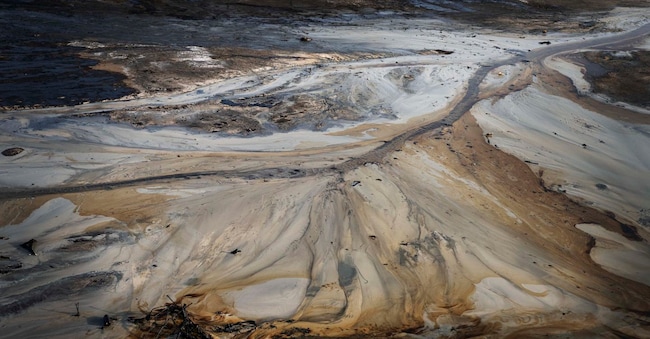
Along the interactive route, faces, places, horizons parade: "We have to think of the Mediterranean as an ecosystem linked by a common history and culture," says Bellina. "Within this ensemble, we can see areas where we already seem to be in a post-apocalyptic phase, for example the beach of Gabès where the Groupe Chimique Tunisien - Gct - is located: a beach where you can't breathe because of the bad smell, full of turtle carcasses and dead fish. On the other hand, we see areas that are still in time to recover: I'm thinking of Mazara and Trapani, fishing in crisis and the presence of blue crabs and Caretta Caretta turtles'.

