Cars

The Megane E-Tech Electric gets an update: greater range, more technology and a new battery

Renault has updated its compact electric saloon with a 67 kWh lithium-iron-phosphate battery, offering a range of up to 500 km and fast charging at 165 kW. Two trim levels are available, along with an expanded range of technological features.

by Federico Cociancich

5' min read

Translated by AI
Versione italiana

5' min read

Translated by AI
Versione italiana

Four years after the debut of the first generation, Renault is once again updating the Megane E-Tech Electric, one of the models that marked the French brand’s relaunch in the zero-emission compact saloon segment in 2022. The facelift is not a radical overhaul: the RG medium platform remains essentially unchanged in its basic layout, as does the general layout of the cabin. The changes mainly concern the battery, the exterior design, the technological features and the range structure.


Loading...

An updated front end

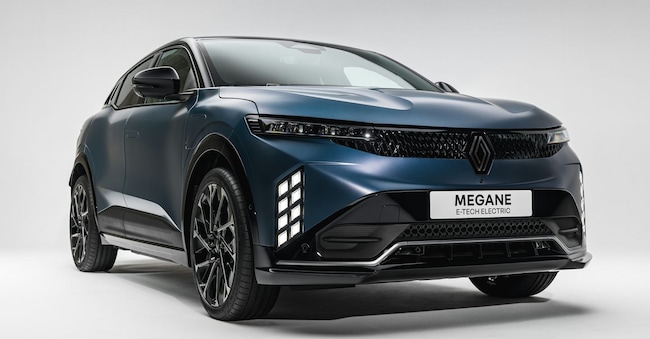
In terms of styling, the most noticeable change is to the front end, which has been redesigned but not radically altered: the main headlights remain unchanged, whilst the rest – from the bumper to the secondary light clusters – is new. The side air intakes have been replaced by a new lighting signature comprising eight diamond-shaped elements arranged in a chequerboard pattern, positioned at the corners of the bumper. The closed grille with a gloss black finish retains the brand’s diamond-shaped motif, whilst the Renault logo has been moved downwards, altering the perceived position of the front end and accentuating its forward-leaning stance.

The rear light clusters have also been updated: they retain their horizontal design across the full width of the vehicle, but now feature a three-dimensional design without a cover lens.

The Megane is 4.2 metres long, has a wheelbase of 2.7 metres and weighs 1,772 kg. It is also 2 cm taller than the previous version, but this is due to the installation of the new battery pack. The boot capacity ranges from 440 to 1,332 litres when the rear seats are folded down.

The interior has not undergone any significant aesthetic changes. The main new feature inside is the infotainment platform’s software, which has been significantly updated.

Megane E-Tech Electric, tutte le foto del restyling 2026

Photogallery39 foto


The new LFP battery and cell-to-pack architecture

The most significant technical change concerns the battery. The new Megane E-Tech Electric features a 67 kWh lithium-iron- phosphate (LFP) chemistry, replacing the previous nickel, manganese, cobalt (NMC) unit, which, whilst boasting a higher energy density, tends to degrade more quickly and is more complex to manage thermally during charging. Renault highlights the adoption of a cell-to-pack (C2P) architecture featuring 232 Pouch 2-type cells, described as a world first.

The choice of LFP chemistry offers a number of advantages: greater thermal stability, the absence of cobalt and nickel in the composition, and a generally longer lifespan. In terms of claimed range, Renault states that it can exceed the psychological threshold of 500 km (in the WLTP cycle), an improvement on the previous generation (468 km), particularly given that the typical user of Renault electric cars travels an average of just 44 km per day.

The rare-earth-free wound-rotor synchronous motor, manufactured at the Cléon plant in Normandy, delivers 160 kW (220 cv) and 300 Nm of torque. The top speed is 160 km/h (electronically limited), with a claimed 0–100 km/h acceleration time of 7.6 seconds.

In terms of charging, the new LFP battery chemistry enables a DC charging power of 165 kW, an increase of 35 kW compared with the previous version. Renault states a charging time from 15% to 80% of approximately 24 minutes. Compatibility with the 11 kW bidirectional AC charger is confirmed, with the option to choose the 22 kW version. The vehicle-to-load (V2L) and vehicle-to-grid (V2G) functions remain: the former allows external devices to be powered up to 3.7 kW via an adapter; the latter, available only in certain markets, allows energy to be fed back into the domestic electricity grid.


Infotainment and connectivity: the new My Rnlt platform

In terms of connectivity, the main new feature is the update to the digital platform, developed in collaboration with Google, known as My Rnlt (pronounced ‘my Renault’). It features two 12-inch displays: the first in front of the driver and the second, positioned vertically and angled to the left, for infotainment. The content and connectivity options have changed significantly; there are now over 100 apps available to download directly onto the car, and they can be installed directly, without having to go via your smartphone as was previously the case.

Google Maps remains the navigation app, but it is now deeply integrated into the platform. Route planning now allows you to manage charging stops and see an estimate of the charge level upon arrival. An interesting feature displays a reliability rating for individual charging points, with a statistical estimate (based on historical data) of the likelihood that they will be free and operational. The agreement between the French car manufacturer and Google involves data sharing: vehicle location and status data are provided to the American tech giant to power its services, such as traffic forecasts, map updates and features specific to electric vehicles – including, indeed, information on charging points.

Another feature linked to the integration with Google Maps relates to battery pre-conditioning: as the system knows the charging destination in advance, it automatically starts heating or cooling the battery to optimise charging performance.

Renault includes three years’ data connectivity, with 2 GB per month, in the price of the car. This allows you to access the full range of apps without having to share your smartphone’s data connection. The package includes up to three hours of video streaming or 40 hours of audio streaming per month. However, it is fair to ask whether 2 GB per month is sufficient for everyday use: given current average app usage, this is a rather modest amount, suitable for occasional use but not for those who make intensive use of in-car connectivity.


Gemini AI: available, but not yet in Europe

Among the new features unveiled is the integration of Google Gemini AI as a next-generation voice assistant. Gemini is said to enable more natural interaction than the current Google Assistant, with the ability to maintain context across successive requests and handle instructions in colloquial language. It should be noted, however, that this feature is currently only available in the United States. It will become available in European markets at a later date via an over-the-air (OTA) update. Renault has also announced that the integration of Gemini will not be limited to the new Mégane, but will be gradually extended to other models in the range, again via software updates, including non-electric cars that are a few years old, within the limits permitted by the processing power of the individual systems.

Among the other technological innovations is the driver recognition function via facial scanning (which uses the camera that monitors the driver’s attention), allowing the user’s personalised profile – including seat position, multimedia preferences and infotainment account – to be loaded automatically. The data is stored exclusively on board the vehicle, without being transmitted to external servers. Smart Mode has also been introduced, which automatically switches between the Eco, Comfort and Sport driving profiles based on the driver’s behaviour and the type of road, without the need for manual intervention.

In terms of driver assistance systems, the car is equipped with over 30 features. New additions include intelligent adaptive cruise control with side-vehicle detection to restrict overtaking on the right, the Emergency Stop Assist function in the event that the driver is not at the wheel (typically in private car parks), and an update to the surround-view display function, which now shows heavy goods vehicles, road markings and distance indicators.


A simplified range

Renault has cleverly streamlined its range to just two trim levels: Techno and Esprit Alpine. This simplification is in line with a stated aim: to make the choice easier for the buyer.

The Techno trim level is the entry-level specification and includes a dual-screen display, heat pump air conditioning, battery pre-conditioning and 19-inch alloy wheels. The Esprit Alpine trim is the top-of-the-range version, featuring 20-inch alloy wheels, electric massage seats, a Harman Kardon sound system and a comprehensive suite of driver assistance systems. Both trims are fitted with the 67 kWh battery and the 220 cv motor.

Copyright reserved ©
Loading...

Brand connect

Loading...

Newsletter

Notizie e approfondimenti sugli avvenimenti politici, economici e finanziari.

Iscriviti