Cannes Film Festival

The Palme d'Or to the memorable 'A Simple Accident' by Jafar Panahi

The palmarès awarded Best Actor Wagner Moura, Best Actress Nadia Melliti

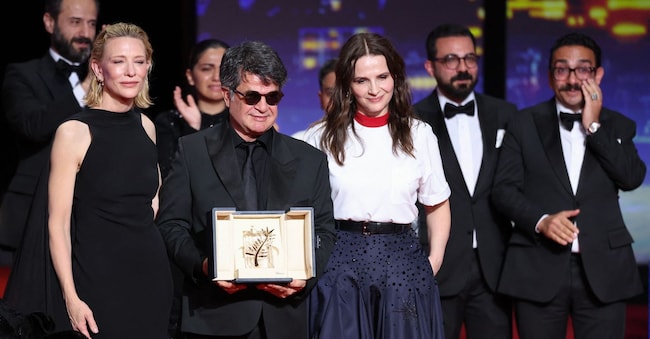
Il regista, sceneggiatore e produttore iraniano Jafar Panahi (2S) posa sul palco con l’attrice australiana Cate Blanchett (S) e l’attrice francese e presidente della giuria del 78° Festival di Cannes Juliette Binoche dopo aver vinto la Palma d’Oro per il film “Un simple accident” (Un semplice incidente) durante la cerimonia di chiusura della 78° edizione del Festival di Cannes a Cannes, nel sud della Francia, il 24 maggio 2025. (Foto di Sameer AL-DOUMY / AFP)

3' min read

3' min read

A historic Palme d'Or: Jafar Panahi's 'A Simple Accident' won the most important prize at this year's Cannes Film Festival. On a day marked by the blackout that hit the French city along with neighbouring municipalities, the award ceremony took place with a result that both thrilled and convinced.

Panahi finally made it out of Iran and paraded on the famous Croisette steps to accompany his latest work: it was one of the most emotional moments in years, but the film manages to do perhaps even more.

Loading...

"I think this is the time to say to all Iranians around the world: let's put aside problems and differences, the most important thing is the freedom of our country," the director said on receiving the award.

In this film, shot without permission, a small group of characters are the protagonists who believe they recognise in a man the torturer who tortured them in the past. They will have to figure out how and when to take revenge on him.

An extremely successful socio-political allegory, 'A Simple Accident' is able to alternate the tones of farce with those of tragedy, combining them to achieve a result of great dramatic and stylistic strength.

However, in such a dark and brutal operation, there is room for a great deal of humanity, demonstrated above all by a touching sequence in which the wife of the alleged torturer is ready to give birth to her second child.

House arrest, time in prison, and a ban on making films have never stopped Jafar Panahi, an artist capable of showing how cinema is a weapon to fight against injustice and is something that cannot be stopped in any way: this film, enriched by a masterful sequence plan and a memorable finale, is yet another demonstration of the greatness of its author and the importance of cinema like his in today's world.


From Grand Prize to Best Actress

The Grand Jury Prize went to Joachim Trier's Norwegian 'Sentimental Value', confirming an incredible year for the Scandinavian nation after Dag Johan Haugerud's 'Dreams' won the Berlin Festival.

At the centre of the plot of 'Sentimental Value' is Nora, a television and theatre actress, the daughter of a famous film director with whom she has an extremely complex relationship.

The two speak very little to each other, but the chance to get together could be a script the father has written hoping his daughter will accept the lead role.

Mixing Ibsen and Woody Allen, Joachim Trier signs an intimate drama about memories, trauma and the possible reconciling power of art.

Best Director deservedly went to Brazilian auteur Kleber Mendonça Filho who, in 'The Secret Agent', recounted the dictatorship in his country in a truly powerful and original key. Set in the late 1970s, his film is one of the most shocking visions of this year's Cannes Film Festival and also won its outstanding lead actor Wagner Moura the Best Actor award.

Somewhat surprisingly, however, the title of best actress was lifted by Nadia Melliti, the talented protagonist of Hafsia Herzi's 'Le petite dernière', but without the strength of other great performances, such as that of Léa Drucker in the beautiful and jury-overlooked 'Dossier 137' by Dominik Moll or Valeria Golino in 'Fuori' by Mario Martone, the only Italian title in competition.

Other prizes

.

An ex aequo at the Jury Prize, divided between Mascha Schilinski's German 'Sound of Falling' and Oliver Laxe's 'Sirat', a co-production between France and Spain: both were among the most talked-about titles among those in competition on the Croisette, capable of splitting the judgments but also of captivating audiences and critics.

The best screenplay was that of 'Jeunes mères' by the Dardenne brothers, great Belgian directors, who have been awarded two Palme d'Or prizes in the past, enriching their trophy cabinet with a somewhat generous award.

The Special Award went to the powerful Chinese feature film 'Resurrection' by Bi Gan, an immersive experience, with a stylistic slant somewhere between experimental and video art, which tells of a future in which mankind has lost the ability to dream and in which cinema will play a truly decisive role.

Finally, it is worth mentioning that the Caméra d'or, the title of best first work, was won by Iraqi Hasan Hadi for 'The President's Cake', a film included in the Cinéraux Fortnight.

Copyright reserved ©
Loading...

Brand connect

Loading...

Newsletter

Notizie e approfondimenti sugli avvenimenti politici, economici e finanziari.

Iscriviti