
The story of the migrant in a hot-air balloon
'The Raven Who Fell in Love with Me', by Abdelaziz Baraka Sakin, is the story of two boys who leave Sudan together. One of them wants to study linguistics at Oxford, but nothing will go as planned

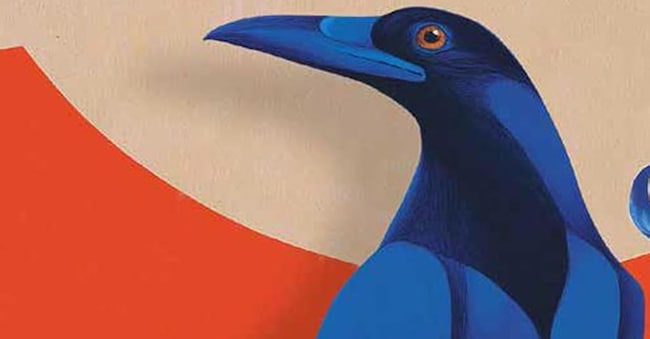
As Sudan enters itsfourth year of civil war amidst the indifference of the world and no one counts the deaths in the hundreds of thousands that followed the democratic and peaceful revolution that had deposed dictator Omar al-Bashir, Italian readers finally get the spellbinding voice of one of its most talented writers. The Raven Who Fell in Love with Me, by Abdelaziz Baraka Sakin, originally from Darfur, does not tell the story of the war, which he has not seen (he has been in exile in Europe since 2012). He tells the story of Nour, a young Sudanese man who fled with his childhood friend. Separated from him, having obtained political asylum in France, she found him one day by chance at Graz station. "In his right hand he held an almost completely consumed cigarette, from which hung a very light cylinder of ash which he had not yet dropped and which emanated a small cloud of smoke. With his open left hand, however, he asked passers-by for change'.
Nour, in Austria on business, had lost track of his friend for two years, ever since they had parted in the"jungle" of Calais: the makeshift camp where migrants from northern France have been massing for a few decades now, trying to get to England. "He was so thin he looked like a bamboo cane, taller, with shaggy hair and a beard that hadn't seen a barber in at least a year and a half and in which some grey hairs had also appeared. He smelled of beer even from a distance and appeared devastated by crack, two things he had never consumed before. Even the colour of his skin was no longer the same: from black and shiny it had turned pale and yellowish. The only thing that remained of my lifelong friend, Adam Saad Saadan, later nicknamed Adam England, werehis big good eyes".
"Adam England!" he shouts, but his friend does not recognise him. When he puts 100 euros into his hand, there is only suspicion in his vacant stare. Baraka Sakin has the enveloping, sly voice of a storyteller. It sounds likean endlessly perfected tale, polished by constant replication and improvement, by observing the effect of phrases on the faces of onlookers, the poignant one of Nour who finds his closest friend absent to himself, unable to recognise his companion, while waving his restless eyes like a large black bird searching for scraps to eat. The helpless acknowledgement of lost intelligence, lost humanity, wrecked ambitions because what is possible for some, born under a lucky star, is unattainable for others, even if they are brimming with talent, determination and passion.
As soon as he is found, if found can be said of someone who does not recognise you, Adam disappears, frightened perhaps by the stranger's unexpected generosity. Dismayed, Nour leaves everything behind and goes in search of his closest friend, who had carried him on his shoulders when he had sprained his ankle while they were travelling - hunted - along the extremely dangerous Ant Trail to Europe. He meets the people who had frequented him over the past two years, building up a warm portrait of the diverse humanity that populates Austria and France. Even when she learns that she will never see him again, Nour is determined to find out what had made the stubborn young man who spoke perfect English, wanted to study linguistics at Oxford, and become an English professor, so immemorial and perhaps insane. It was for this reason that he had earned that strange nickname: 'His dream was to find himself on the other side of the Channel and speak English as if he had been born in central London,' writes Baraka Sakin with affectionate irony.
Except that Adam was too afraid of the sea to cross the Channel, and he had no more money, because what he needed to pay the passeurs he had given to a young mother who wanted to join her husband who was stuck between the wheels of a lorry leaving for England. A husband 'who in six months [had] arrived nowhere', and yet she was still waiting for him, in vain. Adam, left by Nour, who decides to stay in France, left by the woman he loves, who writes to him from England where she has managed to arrive thanks to him, with his imagination exacerbated by despair, had set up a project that would be called heroic and visionary if it had come from a white explorer of some time ago, but which in his case, that of a migrant with holes in his shoes sleeping on the ground among the rubbish and the dunes, is only considered farnish: crossing the Channel in the manner of crows - which he loved since he obsessively read poetry as a child The Raven by Edgar Allan Poe. Fly through it in a hot-air balloon! And so takes flight this bright and sad modern fable, about friendship, love and failure, about dreams too big for some, about the cruelty of reality and our indifferent society.


