Current Affairs

The Milan–Bologna high-speed line reopens after eight days of works

Six 200-tonne switches have been replaced. Speed restrictions will remain in place until 28 August, whilst there are still 1,300 construction sites operating daily across the network and major service disruptions to Genoa and Rome

 Imagoeconomica

3' min read

Translated by AI
Versione italiana

3' min read

Translated by AI
Versione italiana

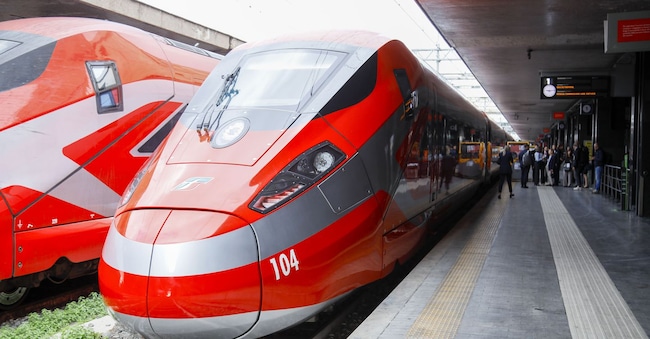
At 4.55 am on Tuesday 18 August, the Frecciarossa 9505 from Milan to Naples was the first train to resume services on the high-speed line between Milan and Bologna. Rete Ferroviaria Italiana (RFI) has reopened the entire route following the suspension from 10 to 17 August, during which trains ran between Piacenza and Milan on the standard line. Full speed will not be restored immediately but will be gradually reintroduced, increasing until full service is resumed on 28 August.

Six trades of 200 tonnes

RFI carried out work simultaneously at three sites: two at the Livraga marshalling yard, in the Lodi area, and one at the Piacenza Ovest junction. More than a hundred engineers replaced six sets of points (the mechanisms that allow trains to change tracks), each 140 metres long and weighing 200 tonnes.

Loading...

Whilst the works were underway, high-speed trains bypassed the closed section by using the conventional line. Around 200 high-speed trains, capable of reaching speeds of 300 kilometres per hour, travel on the Milan–Bologna route every day, but RFI concentrated the works during the week of Ferragosto due to the ‘significant drop in passenger numbers on the route’.

The Ferragosto works and the network upgrade

This is nothing new for the Milan–Bologna line. This is the third consecutive Ferragosto with similar works taking place on the line: in 2024, three construction sites between Castelfranco Emilia and Fidenza had replaced other points; in 2025, services on the line were suspended again for a week at Parma, Campegine and Rubiera.

In 2026, the entire Italian rail network will have an average of 1,300 active construction sites every day, comprising new works, maintenance and technological upgrades. In 2025, RFI invested €11.6 billion, 49 per cent more than in 2023. Thirty-seven per cent went towards network maintenance and resilience, with the remainder allocated to major infrastructure projects.

There are around 272,000 planned disruptions in a year, and those managed by RFI have increased by 115 per cent compared with 2023. In May, Aldo Isi, CEO and Director-General of RFI, spoke of “a completely new scenario, involving 1,300 construction sites”. Ferrovie describes this phase as “the biggest railway transformation of recent decades”.

The Verona–Vicenza line is also reopening

The Milan–Bologna line marks the second major resumption of services in two days: at 5 am on Monday 17 August, services resumed between Verona Porta Nuova and Vicenza and on the Vicenza–Schio line, following a fifteen-day suspension. During the suspension, RFI carried out work on the new Verona–Vicenza high-speed line, at Vicenza station and on the existing line. The works cost around 72 million euros on the Verona–Vicenza line and a further 1.5 million on the Vicenza–Schio line.

However, changes to timetables and journey times will remain in place until 21 August to allow for the completion of certain tasks and the carrying out of technical checks.

Work still to be completed

However, the construction works are not yet complete: on the Milan–Genoa line, the section between Bressana Bottarone and San Martino Cava Manara, in the province of Pavia, remains completely closed. RFI is carrying out work on the 764-metre-long railway bridge over the River Po, with an investment of around 50 million euros. The line will reopen on 29 August, but work will continue on a single track until 30 September.

Construction work is also continuing on the Florence–Rome line. Following the works on the Florence railway junction in July – which had halted services for 84 hours between Florence Campo di Marte and Florence Santa Maria Novella – RFI is carrying out works on the ‘Direttissima’ high-speed line and the conventional line between Chiusi and Orvieto. The main works concern the Fabro tunnel and the Paglia viaduct and will result in train timetables being rescheduled with longer journey times and a reduced service. The works will continue until 28 August, whilst a gradual return to full service will take place between 29 and 31 August.

Copyright reserved ©
Loading...
Loading...

Brand connect

Loading...

Newsletter

Notizie e approfondimenti sugli avvenimenti politici, economici e finanziari.

Iscriviti